






Wildlife on the Move as Species Expand Into New Regions
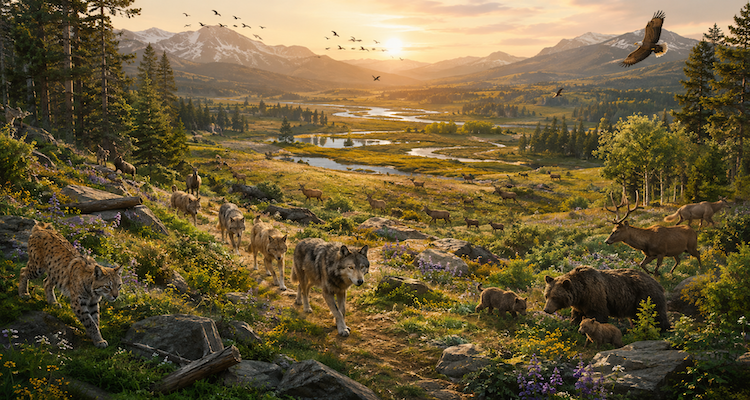
A moose appearing farther south than expected. Tropical fish turning up in temperate waters. Birds nesting hundreds of miles beyond their traditional breeding grounds. Across the world, wildlife is quietly redrawing its own maps.
While habitat loss and endangered species often dominate conservation headlines, a less visible story is unfolding alongside them. Many animals and plants are expanding into regions where they were once rare or entirely absent. Some are following changing environmental conditions. Others are taking advantage of restored habitats, altered landscapes, or reduced competition. Together, these movements are reshaping ecosystems in ways that scientists, land managers, and communities are only beginning to understand.
The shift matters because it challenges one of the most basic assumptions people hold about nature: that species belong to fixed places. Increasingly, they do not.
Nature’s Boundaries Are Becoming More Flexible
Wildlife distributions have never been completely static. Species have always responded to environmental changes, moving as climates shifted and habitats evolved. What makes the current moment different is the speed and scale at which some movements are occurring.
Warmer temperatures are allowing certain species to survive in areas that were previously too cold. In marine environments, fish, crustaceans, and other sea life are appearing farther toward the poles. On land, insects, birds, mammals, and plants are establishing populations in new territories.
Yet climate is only part of the story.
Conservation efforts have restored habitats in some regions, creating new opportunities for wildlife expansion. Reforestation projects, wetland recovery, and wildlife corridors have helped species move across landscapes that were once fragmented or inaccessible.
In some cases, animals are reclaiming portions of their historical range after decades or even centuries of absence.
The Return of Large Mammals
One of the most visible examples involves large mammals.
Wolves, bears, elk, and other species have gradually reappeared in regions where they were once eliminated. Improved legal protections, changing public attitudes, and habitat recovery have all contributed to these returns.
These expansions often generate mixed reactions. Conservationists may celebrate the return of native wildlife, while farmers, ranchers, and local residents may face new challenges associated with living alongside large predators or herbivores.
The result is a complex balancing act. Wildlife recovery can strengthen ecosystems, but successful coexistence requires planning, education, and adaptive management.
The broader lesson is that conservation is no longer focused solely on preventing extinction. It increasingly involves managing the consequences of recovery itself.
Birds Are Leading the Way
Among wildlife groups, birds are often the first to reveal changing ecological patterns.
Birdwatchers and researchers have documented numerous species appearing outside their historical ranges. Some are extending breeding territories northward. Others are altering migration routes or remaining year-round in locations where they once spent only brief periods.
Because birds respond quickly to environmental conditions, they act as early indicators of broader ecological change.
When a bird species establishes itself in a new region, it can influence local food webs, competition patterns, and even plant communities through seed dispersal and pollination.
These shifts may seem subtle at first. Over time, however, they can transform entire ecosystems.
Oceans Are Experiencing Their Own Migration Story
The movement of wildlife is not limited to forests, grasslands, and wetlands.
Oceans are witnessing some of the most dramatic range expansions. Marine species can often move more freely than land animals, allowing them to track favorable water temperatures over large distances.
Fish populations are increasingly being observed in regions where they were previously uncommon. Some commercial fisheries have had to adapt as target species shift into new waters while others become less abundant.
This creates economic consequences as well as ecological ones. Coastal communities that depend on fishing may find traditional species becoming harder to catch, while entirely new opportunities emerge elsewhere.
The changing distribution of marine life demonstrates how wildlife movement can affect livelihoods just as much as biodiversity.
Not Every Expansion Is Positive
The idea of wildlife returning or expanding may sound inherently beneficial, but the reality is more nuanced.
Some species moving into new regions integrate relatively smoothly into existing ecosystems. Others create unexpected disruptions.
Predators entering unfamiliar habitats can alter prey populations. Herbivores may affect vegetation patterns. New competitors can place pressure on resident species already facing environmental stress.
The distinction between natural range expansion and biological invasion can also become blurred. Species responding to environmental changes are not necessarily invasive, but their arrival can still produce significant ecological consequences.
Understanding these differences is becoming one of the key challenges for modern conservation science.
A Hidden Insight: Wildlife Is Becoming More Dynamic
Perhaps the most important insight is that conservation strategies built around static maps may become less effective in a rapidly changing world.
Historically, protected areas were often designed around the assumption that species distributions would remain relatively stable. Today, wildlife movement suggests a more dynamic reality.
A national park established to protect a particular species may eventually host different species altogether. Critical habitats may shift over time. Migration routes may evolve.
This does not diminish the value of protected areas. Instead, it highlights the growing importance of connectivity. Wildlife corridors, landscape-scale conservation, and flexible management approaches may become just as important as preserving individual sites.
The future of conservation may depend less on protecting fixed locations and more on enabling movement.
What These Shifts Mean for People
Wildlife range expansion is not simply an environmental story. It is increasingly a human one.
Farmers may encounter new pollinators that benefit crops. Communities may experience changing interactions with wildlife. Outdoor recreation industries may adapt to new species becoming locally abundant. Public health officials may monitor shifts in disease-carrying insects.
Even cultural identities connected to local landscapes can change as familiar species disappear and new ones arrive.
For many people, the wildlife they see today may differ significantly from what previous generations considered typical. The natural world is becoming more fluid, and human societies are adapting alongside it.
The Next Chapter of Wildlife Movement
Predicting exactly which species will expand next remains difficult. Local environmental conditions, habitat availability, conservation policies, and ecological interactions all influence outcomes.
What seems increasingly clear, however, is that wildlife movement will remain one of the defining ecological stories of the coming decades.
Some species will struggle to adapt and decline. Others will find opportunities in changing environments and establish themselves in unexpected places. Many will do both, depending on the region.
The emerging picture is neither entirely positive nor entirely negative. It is a reminder that nature is not standing still.
As wildlife continues to move across landscapes and oceans, the question is no longer whether ecosystems are changing. It is how societies choose to understand, manage, and live alongside those changes. The species quietly expanding into new regions today may offer the earliest glimpse of the ecological world that future generations will inherit.
This content is published for informational or entertainment purposes. Facts, opinions, or references may evolve over time, and readers are encouraged to verify details from reliable sources.