










Tourism, Culture, and the Joy of Exploration: Why Travel Means More When We Understand the Places We Visit
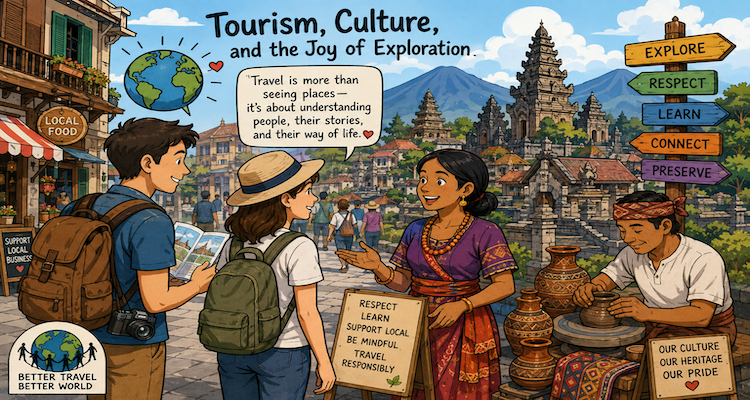
Travel is often measured in destinations, photographs, landmarks, and miles covered. Yet some of the most memorable journeys are defined by something less visible: the moment a visitor begins to understand the place beyond its postcard image.
A historic street becomes more meaningful when its architecture reveals a community’s past. A local meal becomes more than a culinary experience when it carries generations of tradition. A festival, craft, language, or ritual can offer visitors a glimpse into how people understand identity, belonging, and everyday life.
This is where tourism and culture meet. Tourism can create opportunities for exploration and exchange, but it can also place pressure on the communities and heritage that make destinations distinctive. The real challenge is not simply encouraging more people to travel. It is ensuring that exploration deepens understanding without reducing culture to a product designed only for visitors.
Key Takeaways
- Travel becomes more meaningful when visitors engage with the stories, traditions, and communities behind a destination.
- Cultural tourism can support local economies, heritage conservation, and creative industries when benefits reach host communities.
- Popularity alone does not make tourism sustainable; destinations must balance visitor demand with local quality of life.
- UNESCO emphasizes stakeholder participation and community involvement in sustainable tourism and heritage management.
- Responsible travelers can contribute by respecting local customs, supporting local businesses, and treating communities as hosts rather than attractions.
Travel Is an Encounter With Culture
Every destination has a physical landscape, but it also has a cultural one.
Visitors may arrive to see monuments, coastlines, museums, or famous neighborhoods. What gives these places meaning, however, is often the human history around them. Buildings reflect earlier periods. Food carries agricultural traditions and migration stories. Music and art preserve and reinterpret identity. Religious and social customs reveal values that may be unfamiliar to outsiders.
That makes exploration more than movement from one location to another. At its best, travel is a process of learning.
This does not require turning every holiday into a history lesson. Leisure, rest, and spontaneity are part of the pleasure of travel. But curiosity can change the experience. Asking why a city developed in a particular way, learning the meaning of a local celebration, or choosing a locally owned guide can create a stronger connection between visitor and destination.
The value of cultural exploration lies partly in this shift from consumption to understanding.
Why Culture Matters to Tourism
Culture is not an optional decoration added to tourism. For many destinations, it is central to what makes the place distinctive.
UNESCO describes cultural tourism as an important and growing part of the global tourism landscape and has developed programmes that connect heritage protection with tourism management. Its approach emphasizes that tourism and heritage should be planned together, with cultural and natural assets protected while appropriate tourism is developed.
This relationship can create meaningful opportunities. Cultural and heritage attractions can support guides, artists, craftspeople, restaurants, accommodation providers, and other local businesses. UNESCO has also highlighted the role of culture-based strategies in urban and rural development, including heritage regeneration, local creative industries, and community participation.
But the benefits are not automatic.
A destination can attract millions of visitors while local residents receive limited economic benefit. Traditional practices can be simplified for tourist consumption. Rising demand can place pressure on housing, infrastructure, ecosystems, and public spaces. The same popularity that brings attention to a place can also threaten the qualities that originally made it attractive.
That tension is one of the central questions facing modern tourism.
The Difference Between Seeing a Place and Understanding It
A visitor can spend several days in a destination and still encounter only a carefully packaged version of it.
This is not always intentional. Tourism naturally creates shortcuts. Guidebooks identify highlights. Social media concentrates attention on famous locations. Tight itineraries encourage travelers to move quickly from one attraction to another.
The result can be a form of travel focused on collecting experiences rather than understanding context.
A more meaningful approach does not require rejecting popular attractions. Famous sites often deserve their reputation. The difference lies in what happens around them.
For example, a visit to a historic monument can lead to questions about:
- Who built it and why?
- How has the surrounding community changed?
- What role does the site play in local life today?
- Who benefits economically from tourism?
- What pressures does visitor traffic create?
These questions do not reduce the joy of exploration. They can make it richer.
The strongest travel experiences often combine discovery with context. A traveler still enjoys the view, the food, and the atmosphere, but also gains a clearer understanding of the people and history behind them.
Sustainable Tourism Starts With the Host Community
One of the most important ideas in responsible tourism is also one of the easiest to overlook: a destination is someone’s home.
Visitors may experience a place temporarily, but residents live with the consequences of tourism every day. Transport systems, public spaces, housing costs, environmental pressures, and changes to local businesses can all affect community life.
UNESCO’s sustainable tourism guidance stresses the importance of engaging local communities and businesses rather than focusing only on the visitor experience. It argues that sustainable tourism requires dialogue, local participation, and deliberate efforts to create meaningful economic opportunities for host communities.
This matters because tourism revenue does not automatically remain within a community. Decisions about development, transport, accommodation, and visitor services influence who benefits and who bears the costs.
A sustainable destination therefore requires more than attractive marketing. It requires questions about local participation, conservation, infrastructure, and the long-term quality of life of residents.
Recent UNESCO work on culture-driven sustainable urban tourism also encourages visitors to support local professionals and businesses as part of a broader approach to strengthening local cultural economies.
The Joy of Exploration Comes With Responsibility
Responsible travel is sometimes presented as a restrictive idea, as though enjoying a destination and protecting it are opposing goals. In practice, many responsible choices can make travel more rewarding.
Travelers can:
- Learn basic information about local customs and social expectations.
- Support locally rooted businesses where practical.
- Respect rules at cultural, religious, and natural sites.
- Avoid treating residents as props for photographs or entertainment.
- Look beyond the most crowded attractions when appropriate.
- Consider how their behavior affects the environment and community around them.
These choices are not a guarantee that tourism will be sustainable. Structural problems often require action from governments, destination managers, businesses, and communities. Individual behavior alone cannot solve challenges such as inadequate infrastructure or poorly managed development.
Still, visitors are participants in the tourism system. Their choices can influence what kinds of experiences and businesses receive demand.
When Tourism Helps Preserve What It Celebrates
Tourism can create incentives to preserve heritage, but only when preservation remains a genuine priority.
UNESCO’s World Heritage and Sustainable Tourism Programme promotes an approach in which tourism development and heritage management are integrated, with participation from relevant stakeholders and an emphasis on protecting cultural and natural assets.
The underlying principle is important: heritage should not simply become a backdrop for tourism.
A historic neighborhood, traditional craft, or cultural practice has value beyond the money visitors may spend on it. Communities should not have to reshape their identity entirely around outside expectations.
This distinction becomes particularly important when tourism grows rapidly. UNESCO has pointed to concerns in destinations such as Bali about environmental degradation, cultural dilution, and weak connections between visitors and local communities, while supporting initiatives aimed at improving heritage knowledge and encouraging respectful visitor behavior.
The lesson is broader than any one destination. Tourism works best when visitors are invited into a real place rather than a simplified performance of one.
A Different Way to Think About Travel
Perhaps the most useful measure of a journey is not how much a traveler managed to see.
It may be what they came to understand.
Exploration has always involved curiosity. That curiosity can be directed beyond landmarks toward the people, histories, traditions, and environments that give destinations their character.
This perspective also challenges the idea that meaningful travel must always involve distant or famous places. A nearby town, regional festival, historic neighborhood, or unfamiliar community can offer the same essential experience: the opportunity to encounter a different story and see the world from another point of view.
Travel does not automatically create understanding. Crossing a border does not guarantee cultural awareness, and visiting a heritage site does not necessarily produce respect for its significance.
Understanding requires attention.
That is why tourism, culture, and exploration belong together. Tourism provides the movement. Culture provides context. Exploration provides the curiosity that connects the two.
Conclusion
The joy of travel is not found only in reaching somewhere new. It also lies in discovering why a place matters to the people who live there.
Tourism can create economic opportunities, support cultural and creative activity, and encourage people to engage with histories and traditions beyond their own. But those benefits depend on how tourism is planned, managed, and experienced. When communities have a meaningful role and heritage is treated as something to protect rather than merely consume, travel can become a form of exchange rather than extraction.
The most rewarding traveler may not be the one who sees the most places, but the one who leaves with a deeper understanding of at least one.
This content is published for informational or entertainment purposes. Facts, opinions, or references may evolve over time, and readers are encouraged to verify details from reliable sources.