






Why Humans Still Fear the Dark Wild: The Animals That Emerge Only at Night
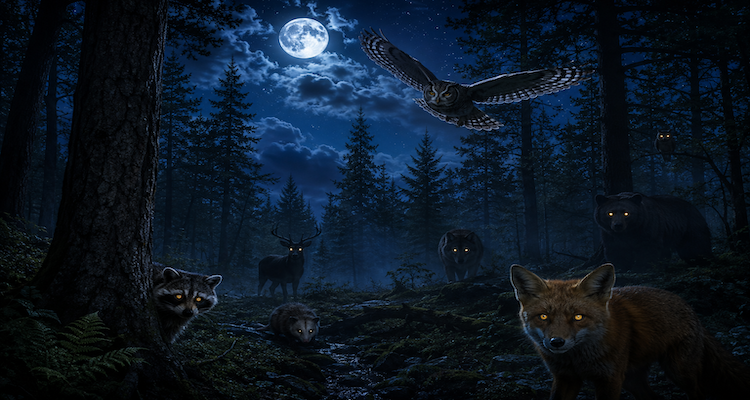
A rustle in the undergrowth after sunset can trigger an instinctive reaction that feels older than memory itself. Even in cities illuminated by streetlights and smartphone screens, many people remain uneasy when confronted with darkness in the natural world. The fear is rarely irrational. Across forests, deserts, wetlands, and mountains, an entirely different ecosystem awakens after dusk—one inhabited by animals that humans seldom see, yet have feared for centuries.
Our relationship with nocturnal wildlife reveals something deeper than a simple fear of predators. It exposes how modern humans, despite unprecedented technological control over their surroundings, remain psychologically connected to an ancient world where darkness often meant vulnerability.
The Hidden Majority of Wildlife
Daylight gives the impression that humans dominate nature. But after sunset, the balance shifts.
Scientists estimate that a significant proportion of mammal species are primarily nocturnal, meaning they are most active at night. From owls and bats to foxes, leopards, civets, and countless insects, darkness serves as a refuge, hunting ground, and communication network.
Many animals evolved nocturnal habits to avoid predators, escape daytime heat, or reduce competition for resources. In deserts, for example, species such as fennec foxes and kangaroo rats emerge only after temperatures become tolerable. In tropical forests, creatures ranging from slow lorises to clouded leopards navigate complex environments using highly specialized senses.
Humans, however, are overwhelmingly diurnal. Our vision is optimized for daylight, leaving us at a disadvantage after dark. When we enter wilderness at night, we become visitors in an environment designed for others.
That reversal of control helps explain why the dark wild continues to unsettle us.
Evolution Never Completely Left Us
Long before artificial lighting transformed human societies, nighttime posed genuine risks.
Early humans faced threats from large nocturnal predators, including big cats, hyenas, wolves, and other carnivores. Anthropologists suggest that natural selection favored heightened alertness after sunset. Individuals who responded cautiously to unfamiliar sounds or movements may have been more likely to survive.
Modern life has reduced many of those dangers, but the underlying cognitive mechanisms remain.
Psychologists often refer to this tendency as “prepared fear”, the idea that humans are biologically predisposed to react strongly to ancestral threats. Darkness limits visibility, increases uncertainty, and deprives the brain of information. In response, the mind becomes more vigilant, sometimes filling gaps with imagined dangers.
A snapping branch in daylight may appear harmless. The same sound at midnight in a forest can immediately trigger anxiety.
The dark, in other words, does not merely conceal animals. It amplifies uncertainty.
The Night Specialists Humans Rarely See
Some nocturnal animals inspire fascination, while others evoke unease.
Owls, for instance, have occupied a complex place in human culture for millennia. Revered in some societies as symbols of wisdom, they have also been associated with omens and mystery because of their silent flight and haunting calls.
Bats present another example. Despite their essential ecological role as pollinators and insect controllers, bats have long been linked with folklore, superstition, and fear. Their erratic flight patterns and nocturnal habits have made them enduring symbols of the unknown.
Large predators intensify these reactions. Leopards, jaguars, wolves, and bears often move most actively during twilight or nighttime hours. While encounters remain relatively rare in many regions, their invisibility can make them seem more threatening than they statistically are.
Even small creatures contribute to nighttime anxiety. The glowing eyes of raccoons, the sudden appearance of a fox, or the chorus of unseen insects can transform familiar landscapes into unfamiliar territory.
Humans are often less afraid of the animals themselves than of not knowing where those animals are.
Artificial Light Is Changing the Dark Wild
The modern world is steadily erasing natural darkness.
Expanding urbanization has produced widespread light pollution, altering ecosystems across continents. Artificial illumination affects migration patterns, feeding behavior, reproduction, and predator-prey relationships among numerous species.
Sea turtle hatchlings, for example, can become disoriented by coastal lighting. Nocturnal pollinators may struggle to navigate illuminated landscapes. Some predators exploit artificial light to hunt more efficiently, while others avoid lit areas altogether.
Ironically, as cities become brighter, people may be growing less familiar with genuine nighttime environments. Many children and adults rarely experience complete darkness outdoors.
This cultural shift creates an unexpected paradox: humans fear wilderness at night partly because they increasingly lack direct experience with it.
The less time people spend in natural darkness, the more mysterious—and intimidating, it becomes.
Fear, Storytelling, and the Cultural Power of Night
Human cultures have always populated darkness with stories.
Folklore from around the world features night-dwelling spirits, shape-shifters, forest beings, and supernatural predators. These narratives often emerged in societies where nighttime travel carried real risks.
Yet such stories served practical purposes. They reinforced caution, discouraged dangerous behavior, and helped communities make sense of unexplained sounds or disappearances.
Today, film, literature, and digital media continue this tradition. Horror cinema frequently relies on forests, remote landscapes, and unseen nocturnal creatures because these settings tap into deeply rooted psychological responses.
The popularity of wildlife documentaries focused on nighttime behavior reveals another side of this fascination. Audiences are not merely afraid of nocturnal animals; they are captivated by them.
Fear and curiosity often coexist.
A New Understanding of the Night
Advances in thermal imaging, infrared cameras, and motion-sensitive wildlife monitoring are revealing just how active ecosystems become after sunset.
Researchers are discovering previously undocumented behaviors, communication patterns, and predator-prey interactions among nocturnal species. Conservationists increasingly recognize that protecting nighttime habitats is as important as preserving landscapes themselves.
This growing knowledge is changing public attitudes. Rather than viewing the dark wild solely as a source of danger, many people now see it as a vital and largely hidden dimension of biodiversity.
The most meaningful insight may be this: our fear of nighttime wilderness is not simply a relic of the past. It reflects an enduring awareness that humans are only one species among many.
When darkness falls, the natural world does not go silent. It simply changes shifts, handing the landscape over to creatures uniquely adapted to a realm we can never fully control.
Perhaps that is why the dark wild still unsettles us—and why it continues to inspire wonder.
This content is published for informational or entertainment purposes. Facts, opinions, or references may evolve over time, and readers are encouraged to verify details from reliable sources.