










Are We Outsourcing Too Much Thinking to AI? The Cognitive Trade-Off We Rarely Discuss
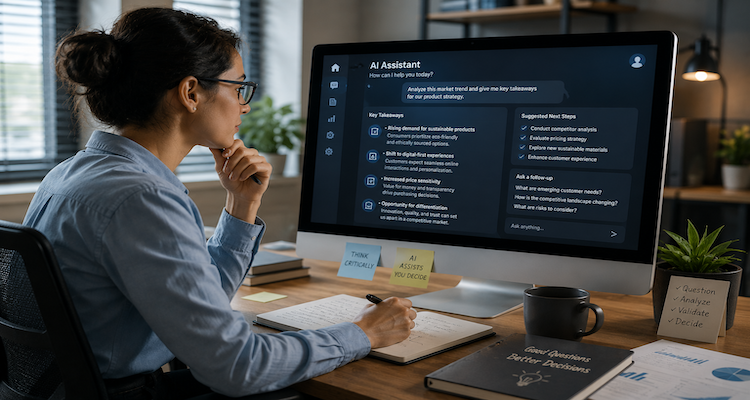
A subtle shift is unfolding in offices, classrooms, and homes: people are no longer just using artificial intelligence to find information—they are increasingly using it to think on their behalf.
The change often feels harmless. A student asks an AI assistant to summarize a chapter. A manager requests a strategic outline before a meeting. A writer relies on AI to brainstorm ideas. A traveler lets algorithms plan an entire itinerary. Each interaction saves time. Each reduces friction. Yet together, these small conveniences raise a larger question: what happens when the effort of thinking itself becomes optional?
Artificial intelligence has rapidly evolved from a productivity tool into a cognitive partner. While the benefits are undeniable, society may be entering a phase where the cost of convenience is receiving far less attention than the convenience itself.
AI Is Becoming an Extension of Human Cognition
Throughout history, humans have outsourced mental tasks. Writing reduced the need to memorize. Calculators diminished the necessity for complex arithmetic. Search engines transformed how knowledge is stored and retrieved.
AI represents a different category of outsourcing.
Traditional tools helped humans access information more efficiently. Generative AI systems increasingly help humans interpret, analyze, synthesize, and even make decisions. The technology is moving beyond answering questions to shaping the questions people ask in the first place.
This distinction matters.
When a person uses a calculator, they still understand the problem they are solving. With AI, users may increasingly accept conclusions without fully understanding the reasoning behind them. The convenience of receiving polished answers can discourage deeper engagement with complexity.
The issue is not whether AI can think. It is whether humans may gradually think less because AI appears capable enough.
The Rise of Cognitive Offloading
Psychologists use the term “cognitive offloading” to describe the practice of shifting mental tasks to external tools. Smartphones already serve as external memory systems, storing phone numbers, appointments, and directions.
AI dramatically expands this phenomenon.
Instead of remembering facts, people can instantly retrieve them. Instead of organizing thoughts, they can generate outlines. Instead of evaluating multiple perspectives, they can ask AI to compare options and recommend a course of action.
In moderation, cognitive offloading is beneficial. Human brains are limited, and delegating routine tasks frees mental capacity for creativity, strategic thinking, and problem-solving.
The concern arises when outsourcing becomes habitual rather than intentional.
A growing number of knowledge workers report using AI to draft emails, summarize meetings, prepare presentations, and generate first drafts. Educational institutions are simultaneously debating how much AI assistance should be permitted in learning environments. These developments suggest that AI is increasingly embedded not merely in work processes, but in the process of thinking itself.
Convenience Can Quiet Curiosity
One of the most overlooked consequences of AI adoption may be its effect on curiosity.
Deep understanding rarely emerges instantly. It develops through struggle, through confusion, experimentation, mistakes, and revision. The process can be slow and uncomfortable, but it is often where original insights emerge.
AI compresses that process.
When answers arrive in seconds, people may become less inclined to wrestle with difficult questions. Why spend an hour exploring competing viewpoints if an AI system can provide a coherent summary immediately?
The risk is not ignorance. In fact, AI can expose users to more information than ever before.
The risk is intellectual passivity.
If people consistently accept machine-generated interpretations without scrutiny, they may lose opportunities to develop judgment, skepticism, and independent reasoning, skills that remain essential in an uncertain world.
Ironically, the more sophisticated AI becomes, the more valuable human curiosity may become.
Workplaces Are Redefining What Expertise Means
Businesses are among the fastest adopters of generative AI, integrating it into customer service, software development, marketing, research, and administration.
This shift is already changing workplace expectations.
Employees who once differentiated themselves through information recall may find those advantages diminishing. Instead, employers increasingly value individuals who can ask better questions, evaluate AI outputs, identify inaccuracies, and make nuanced decisions.
The emerging premium is not on producing content quickly; it is on exercising sound judgment.
Consider fields such as law, journalism, healthcare, and finance. AI can accelerate research and generate preliminary analyses, but professionals remain responsible for interpreting context, recognizing ethical implications, and assessing risks. A convincing answer is not necessarily a correct one.
As AI systems become commonplace, critical thinking may evolve from a desirable skill into a competitive necessity.
Education Faces a Defining Challenge
Schools and universities are confronting perhaps the most significant implications.
If students rely extensively on AI to write essays, solve problems, or explain concepts, educators face a difficult question: how can learning be measured when assistance is ubiquitous?
Some institutions have responded with restrictions. Others are redesigning assignments to emphasize discussion, project-based learning, and oral examination.
Yet the broader challenge extends beyond assessment.
Education has traditionally focused not only on acquiring knowledge but also on cultivating habits of mind: analysis, persistence, reasoning, and reflection. If AI handles increasing portions of intellectual labor, educational systems may need to place greater emphasis on these distinctly human capacities.
Students who learn how to collaborate with AI while maintaining independent thought may ultimately possess a significant advantage over those who either reject the technology entirely or depend on it uncritically.
The Hidden Shift: From Information Scarcity to Judgment Scarcity
For decades, society operated under conditions of information scarcity. Finding reliable information required effort.
Today, the opposite is true.
Information, and increasingly, interpretation—is abundant. What has become scarce is judgment.
This may be the most important insight in the AI era.
When everyone has access to sophisticated tools capable of generating reports, strategies, and explanations, the differentiating factor is no longer access to knowledge. It is the ability to evaluate quality, detect flaws, recognize bias, and determine when AI should not be trusted.
In other words, AI may not reduce the need for human thinking. It may raise the standard for it.
Finding the Right Balance
The debate should not center on whether people should use AI. The technology is already reshaping daily life and will continue to do so.
The more useful question is how people can use AI without surrendering their intellectual autonomy.
A practical approach may involve treating AI as a collaborator rather than an authority. Use it to generate possibilities, challenge assumptions, organize information, and accelerate routine tasks. But reserve final judgment for human reasoning.
History suggests that new technologies rarely diminish human capability by default. The outcome depends on how societies choose to use them.
Artificial intelligence can amplify human intelligence, expand creativity, and increase productivity. Yet those benefits are most likely to emerge when people remain active participants in the thinking process rather than passive recipients of machine-generated conclusions.
The future may belong not to those who rely most heavily on AI, but to those who know when to rely on it—and when to think for themselves.
This content is published for informational or entertainment purposes. Facts, opinions, or references may evolve over time, and readers are encouraged to verify details from reliable sources.