


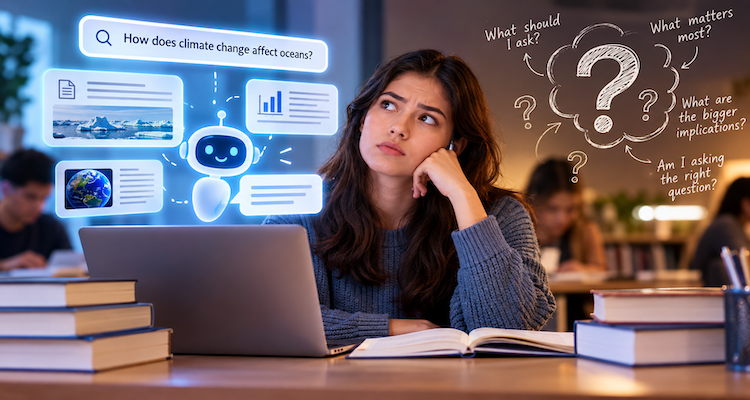







The Future of Human Knowledge in an AI-Assisted World
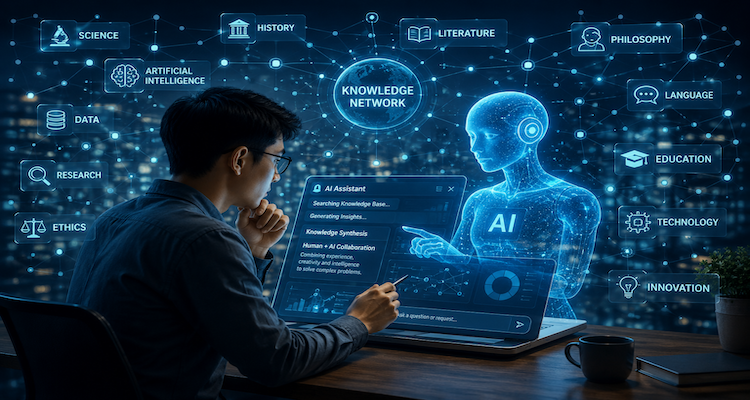
Knowledge is no longer scarce. For most of human history, the challenge was gaining access to information. Today, the challenge is deciding what deserves attention, trust, and understanding.
A student can ask an AI assistant to explain quantum mechanics in plain language. A manager can summarize hundreds of pages of reports within minutes. A doctor can rapidly review medical literature. The barriers to accessing information are falling at extraordinary speed. Yet a new question is emerging beneath this convenience: if machines increasingly retrieve, organize, and even interpret knowledge for us, what becomes of human understanding itself?
The answer may define not only the future of education and work, but also how societies think, innovate, and preserve wisdom in the decades ahead.
From Information Scarcity to Information Abundance
Human civilization has repeatedly transformed through shifts in knowledge systems. The invention of writing allowed ideas to outlive their creators. The printing press democratized learning. The internet placed vast libraries into billions of hands.
Artificial intelligence represents another turning point, but with a critical difference: AI does not merely store information. It actively participates in the process of knowledge creation and retrieval.
Large language models can summarize research, generate code, draft essays, translate languages, and identify patterns across enormous datasets. Rather than searching through information manually, people increasingly ask AI systems direct questions and receive synthesized answers.
This changes the relationship between humans and knowledge itself. Instead of navigating information, many users are beginning to delegate that navigation to machines.
The shift is subtle but profound.
Knowing Less, Understanding More?
Critics often worry that AI will make people intellectually lazy. The concern is not unfounded. Calculators reduced the need for mental arithmetic, while GPS diminished people’s reliance on spatial memory. AI may similarly reduce the need to memorize facts.
Yet history suggests that technological tools rarely eliminate intelligence. Instead, they redefine where human effort is directed.
When calculators became common, mathematics education gradually emphasized problem-solving over lengthy calculations. Search engines reduced memorization while increasing the importance of evaluating sources.
AI could produce a similar transition. Memorizing facts may become less valuable than understanding concepts, asking effective questions, and critically assessing machine-generated responses.
The future may reward individuals who know how to think rather than simply what to remember.
This distinction matters. Knowledge has never been merely the accumulation of facts. Genuine understanding involves context, judgment, interpretation, and experience, qualities that remain deeply human.
The Rise of the Curator Mindset
One of the least discussed consequences of AI is the emergence of a new cognitive role: the human curator.
In an AI-assisted environment, people may spend less time collecting information and more time selecting, validating, connecting, and applying it.
Consider modern workplaces. Employees increasingly use AI tools to draft reports, analyze trends, or generate ideas. The competitive advantage is shifting away from producing raw information toward deciding which insights matter and which should be ignored.
This represents a major behavioral change.
Historically, expertise often meant possessing specialized knowledge unavailable to others. In the future, expertise may depend more heavily on discernment, the ability to distinguish reliable information from plausible but inaccurate outputs.
The most valuable professionals may not be those with perfect recall, but those capable of combining human experience, ethical reasoning, domain expertise, and AI-generated analysis.
In many fields, judgment could become more valuable than memory.
Why Trust May Become the New Knowledge Currency
As AI-generated content proliferates, trust is becoming increasingly important.
Anyone can now produce polished articles, videos, images, and presentations within minutes. Quantity is no longer the challenge. Credibility is.
Educational institutions, publishers, businesses, and governments are already confronting questions about authenticity, verification, and misinformation. AI systems can occasionally produce inaccurate or fabricated responses, even when presented confidently.
This reality highlights a crucial insight: future knowledge systems may depend less on information access and more on trusted networks of verification.
Human experts, peer-reviewed research, reputable institutions, and transparent editorial standards may become even more important in an age flooded with synthetic content.
Paradoxically, the easier it becomes to generate information, the more society may value trusted human expertise.
Education Is Entering a New Era
Schools and universities are among the first institutions being forced to adapt.
Traditional education models have long emphasized memorization, standardized testing, and individual knowledge recall. AI challenges each of these assumptions.
If students can instantly obtain explanations, summaries, and draft essays, educators must reconsider what meaningful learning looks like.
Many institutions are beginning to place greater emphasis on critical thinking, creativity, collaboration, media literacy, and original analysis. The ability to ask insightful questions may become as important as providing correct answers.
There is also a growing recognition that students must learn how AI works, including its limitations and biases.
Digital literacy is evolving into AI literacy.
Future graduates may be expected not only to use AI tools effectively but also to recognize when not to rely on them.
Human Creativity May Become More Collaborative
Knowledge creation itself is changing.
Researchers increasingly use AI to accelerate literature reviews, identify patterns in data, and generate hypotheses. Writers employ AI for brainstorming and drafting. Software developers rely on coding assistants to improve productivity.
Rather than replacing human creativity outright, AI often acts as a collaborator.
This partnership could expand human capacity dramatically. Scientists may devote more time to experimentation and interpretation instead of administrative tasks. Creators may explore more ideas in less time. Entrepreneurs may test concepts rapidly with limited resources.
However, genuine originality still appears closely tied to human experience, emotion, intuition, and lived reality.
AI can recombine existing patterns. Humans remain uniquely capable of assigning meaning to those patterns.
The future of knowledge creation is therefore unlikely to be exclusively human or exclusively machine. It will increasingly be co-created.
What Could Be Lost Along the Way?
The benefits of AI-assisted knowledge are significant, but potential risks deserve attention.
Overreliance on AI could weaken independent reasoning if users accept machine outputs uncritically. Societies may also face new inequalities if access to advanced AI systems remains uneven.
There are cultural concerns as well. Human knowledge includes traditions, oral histories, ethical frameworks, and collective experiences that cannot always be reduced to data points.
If efficiency becomes the sole priority, slower forms of reflection and deep learning may diminish.
Preserving curiosity, skepticism, and intellectual humility may therefore become essential cultural priorities.
A Future Defined by Human Judgment
The future of human knowledge is not a competition between people and machines. It is a negotiation over roles.
AI will almost certainly become an indispensable intellectual partner across education, business, science, and everyday life. Yet the qualities that make knowledge meaningful, wisdom, ethics, context, empathy, and judgment, remain fundamentally human responsibilities.
The defining skill of the coming decades may not be remembering more than machines. It may be understanding what deserves to be remembered, trusted, questioned, and acted upon.
In an AI-assisted world, knowledge will remain power. But human judgment may become its most valuable form.
This content is published for informational or entertainment purposes. Facts, opinions, or references may evolve over time, and readers are encouraged to verify details from reliable sources.