










When Power Becomes Strategy: Why Businesses Are Competing for Electricity Access
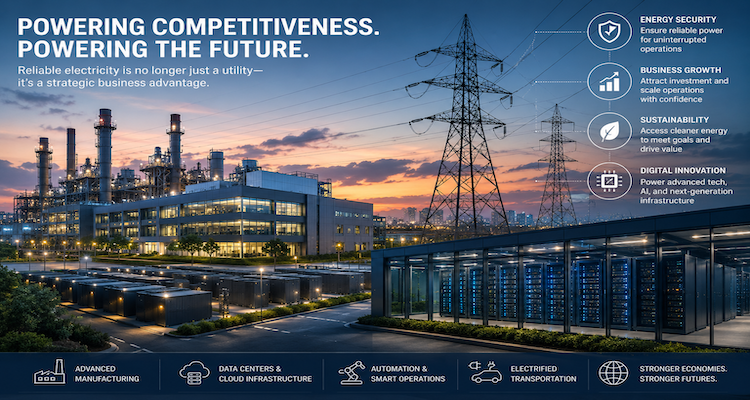
A decade ago, access to electricity was largely considered a utility issue something businesses expected to be available when they needed it. Today, for a growing number of companies, reliable power has become something far more strategic. In certain industries, access to electricity is increasingly influencing where facilities are built, how investments are planned, and which regions attract long-term growth.
The shift is subtle but significant. While businesses have traditionally competed through talent, technology, logistics, and capital, many are now evaluating electricity availability as a factor that can directly affect competitiveness. What was once a background infrastructure concern is moving into boardroom discussions and long-range planning.
The reason is simple: modern economies run on electricity more than ever before.
The Rising Energy Appetite of Modern Business
The digital transformation of nearly every industry has dramatically increased dependence on power. Data centers, cloud computing infrastructure, artificial intelligence systems, advanced manufacturing facilities, electric vehicle production, and automated warehouses all require substantial and reliable electricity supplies.
A manufacturing plant that experiences unexpected power interruptions can face production delays and financial losses. A data center supporting millions of users cannot afford prolonged outages. AI training systems require enormous computing resources, which translate directly into energy consumption.
As businesses become more technology-driven, electricity is no longer merely an operational requirement. It is becoming a foundational business asset.
This trend is especially visible in sectors that rely on continuous operations. Semiconductor manufacturing, cloud services, logistics automation, and digital infrastructure all depend on power availability at a scale that would have seemed extraordinary just a few years ago.
Why Location Decisions Are Changing
Historically, companies selected locations based on factors such as labor availability, transportation networks, tax incentives, and proximity to customers.
Those considerations remain important, but energy infrastructure is gaining new influence.
Regions with reliable electrical grids, expanding transmission capacity, and access to diverse energy sources are becoming more attractive to investors. Conversely, areas facing grid constraints may struggle to attract major industrial or technology projects.
The growing demand for data centers offers a clear example. Major technology companies often evaluate power availability before committing to new facilities. In some regions, electricity demand from planned data centers has become so large that utilities and local governments must consider grid expansion years in advance.
This creates a new form of competition not just among businesses, but among cities, states, and countries seeking investment.
Reliability Matters as Much as Cost
For decades, conversations about business energy strategy focused heavily on reducing electricity costs.
Cost still matters, but reliability is becoming equally important.
An inexpensive electricity supply loses its appeal if it cannot consistently support operations. Businesses increasingly recognize that downtime can be more expensive than higher energy bills.
A brief disruption might affect customer service systems, interrupt manufacturing schedules, delay deliveries, or compromise digital operations. For organizations that operate around the clock, reliability often becomes a risk-management issue rather than a budgeting issue.
This explains why some companies are investing in backup generation, battery storage systems, and diversified energy sources. The objective is not simply reducing expenses, it is protecting business continuity.
The New Competitive Edge: Energy Security
One of the most underreported business shifts is the growing importance of energy security.
Traditionally associated with national governments, energy security is becoming a corporate concern.
Businesses increasingly want confidence that future growth plans will not be limited by electricity shortages, grid congestion, or infrastructure bottlenecks. This is particularly important for industries planning large-scale investments that may operate for decades.
An organization that secures reliable energy access can expand more confidently, adopt advanced technologies faster, and reduce operational uncertainty.
In contrast, companies facing uncertain power availability may encounter growth constraints that competitors avoid.
The result is a new strategic calculation: electricity access is becoming part of long-term competitive positioning.
How Renewable Energy Is Reshaping Business Decisions
The rise of renewable energy has added another layer to the conversation.
Many companies have established sustainability goals and are seeking cleaner sources of electricity. Access to renewable power is increasingly influencing location choices, supplier relationships, and investment strategies.
Businesses are signing long-term power purchase agreements, supporting renewable energy projects, and partnering with utilities to secure cleaner electricity supplies.
For some organizations, renewable energy offers more than environmental benefits. It can help manage long-term energy costs, improve resilience, and strengthen relationships with customers and investors who prioritize sustainability.
The growing alignment between environmental objectives and business strategy is transforming how companies think about energy procurement.
What This Reveals About the Economy
The increasing focus on electricity reveals a broader economic transformation.
Economic growth is becoming more closely linked to energy infrastructure than many people realize.
Artificial intelligence, cloud computing, advanced manufacturing, electrified transportation, and digital services all depend on abundant electricity. As these sectors expand, access to power becomes a critical enabler of innovation and productivity.
This creates a feedback loop. New technologies increase electricity demand, which increases pressure on infrastructure, which then influences business decisions and investment patterns.
The companies that understand this relationship early may gain advantages that extend beyond energy itself.
The Human Side of the Power Competition
Although discussions about electricity often focus on corporations and infrastructure, the effects extend to workers, communities, and consumers.
Regions that attract energy-intensive industries may see job creation, infrastructure development, and increased economic activity. Communities with strong energy systems can become hubs for technological investment and innovation.
At the same time, growing electricity demand raises important questions about grid modernization, affordability, environmental impact, and equitable access.
The challenge for policymakers and businesses alike is balancing economic opportunity with long-term sustainability and reliability.
The outcome will influence not only corporate competitiveness but also the future shape of local economies.
A Shift That Will Shape the Next Decade
The most important insight may be that electricity is transitioning from a utility expense to a strategic resource.
Businesses once competed primarily for customers, talent, and market share. Increasingly, they are also competing for the infrastructure that enables growth.
This does not mean electricity will become scarce everywhere. Rather, it highlights how critical dependable energy has become in an economy powered by data, automation, connectivity, and emerging technologies.
The companies that view energy access as a long-term strategic advantage may be better positioned to adapt to future demands. Those that treat electricity as merely an operational necessity could find themselves constrained by factors they once took for granted.
As industries become more electrified and digital, one reality is becoming difficult to ignore: access to reliable power is no longer just about keeping the lights on. It is becoming a defining factor in business competitiveness itself.
The information presented in this article is based on publicly available sources, reports, and factual material available at the time of publication. While efforts are made to ensure accuracy, details may change as new information emerges. The content is provided for general informational purposes only, and readers are advised to verify facts independently where necessary.
Related News
- The Energy Paradox of Efficiency: Why Using Less Electricity Does Not Always Mean Using Less Energy
- Why Extreme Weather Is Turning Electricity Resilience Into an Everyday Consumer Issue
- Why Energy Independence Is Becoming a Household Decision, Not Just a National Strategy
- The Hidden Energy Cost of Keeping Everything Available Instantly