









When Every Spare Moment Is Filled: The Hidden Cost of Constant Occupation
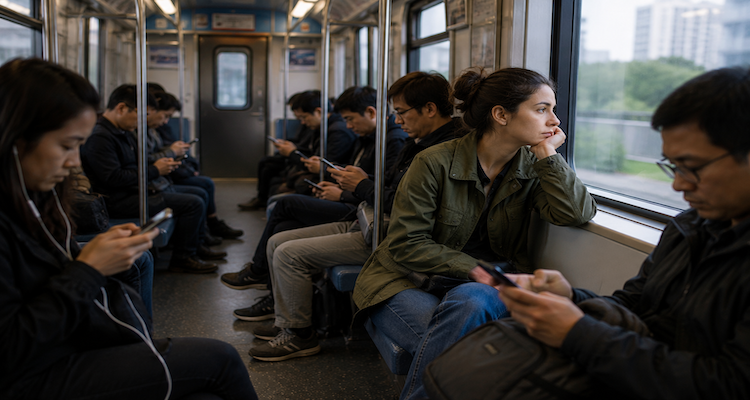
A few minutes waiting for an elevator. A short ride on public transport. Standing in line at a coffee shop. Moments that once passed in quiet observation are now routinely occupied by scrolling, streaming, messaging, listening, reading, or responding. What used to be empty space in daily life has become increasingly crowded.
The shift happened so gradually that many people barely noticed it. Smartphones, wearable devices, on-demand entertainment, and endless digital content have transformed idle moments into opportunities for consumption or productivity. The result is a culture where being unoccupied can feel unusual, uncomfortable, or even wasteful.
Yet as every spare moment becomes filled, an important question emerges: what are we losing when there is no room left for boredom, reflection, or simply doing nothing?
The Disappearance of Mental Downtime
For most of human history, periods of mental idleness were unavoidable. People walked without headphones, waited without screens, and spent time alone with their thoughts. These moments were not necessarily enjoyable, but they created opportunities for reflection, imagination, and mental processing.
Today, downtime often lasts only seconds before a device fills the gap. A notification arrives. A social media feed refreshes. A video begins playing automatically.
The convenience is undeniable. Digital tools make information accessible, help people stay connected, and turn waiting time into productive time. But the constant occupation of attention may also reduce opportunities for the mind to wander naturally.
Many creative breakthroughs, personal insights, and problem-solving moments occur when attention is not directed toward a specific task. During a walk, a shower, or a quiet commute, the brain often connects ideas in unexpected ways. When every pause is immediately occupied, those mental connections may have less room to develop.
Why Boredom Is Becoming Rare
Boredom has long carried a negative reputation. It is commonly viewed as something to avoid rather than something useful.
Yet psychologists and educators have increasingly recognized that boredom can serve a purpose. It encourages curiosity, exploration, and creative thinking. It pushes people to seek new ideas rather than passively consume existing ones.
Children provide a clear example. When every free moment is scheduled or entertained, opportunities for imaginative play may decrease. Unstructured time often becomes the space where creativity emerges.
Adults experience a similar effect. Constant stimulation can create a habit of seeking immediate engagement. Over time, the ability to sit with uncertainty, think deeply, or tolerate temporary inactivity may weaken.
This does not mean boredom should be celebrated as a goal. Rather, its disappearance may reveal a broader shift in how attention is managed and valued.
The Economy Competing for Every Second
A significant reason spare moments are increasingly filled is that attention has become one of the world’s most valuable resources.
Streaming services compete for viewing time. Social platforms compete for engagement. News outlets compete for clicks. Podcasts, newsletters, games, and apps all compete for moments that once existed outside commercial activity.
The competition is not necessarily malicious. Businesses naturally seek audience attention. However, the cumulative effect is powerful. Entire industries are designed to reduce friction between a person and the next piece of content.
As a result, many people move seamlessly from one form of engagement to another throughout the day. The transition between activities becomes so smooth that genuine pauses become increasingly rare.
The hidden consequence is that attention can begin to feel fragmented. Rather than experiencing clear boundaries between work, leisure, reflection, and rest, people may find themselves continuously connected to a stream of information.
The Productivity Trap
Filling spare moments is not always about entertainment. Increasingly, it is about productivity.
Many people listen to educational content while exercising, answer emails during breaks, or use commuting time for professional development. The desire to maximize time often comes from positive motivations: career growth, learning, and self-improvement.
However, the pressure to optimize every minute can create an unexpected burden.
If every idle moment must be useful, relaxation itself can start to feel unproductive. Rest becomes another item on a performance checklist rather than a natural human need.
This reflects a broader cultural shift where value is often measured through output. The challenge is that human well-being does not always operate according to efficiency metrics. Reflection, recovery, and unstructured thinking frequently produce benefits that are difficult to quantify but essential to long-term performance.
What This Trend Reveals About Modern Life
The filling of spare moments is not simply a technology story. It reflects changing attitudes toward attention, time, and identity.
Many people now experience information abundance rather than information scarcity. The challenge is no longer finding something to read, watch, or learn. The challenge is deciding when to stop.
This shift has altered expectations. Being reachable is often assumed. Responding quickly is frequently rewarded. Silence can be interpreted as absence rather than presence.
At the same time, younger generations are growing up in environments where continuous stimulation is normal. Their relationship with boredom, focus, and downtime may differ significantly from previous generations.
The broader trend suggests that society is moving toward a state where attention itself becomes a form of personal infrastructure—something that requires active management rather than passive protection.
The Surprising Value of Empty Space
One of the most overlooked insights in this conversation is that mental space functions much like physical space.
A room filled with furniture becomes difficult to navigate. A schedule filled with obligations becomes difficult to adapt. Likewise, a mind filled with constant input may have less capacity for reflection and original thought.
Empty space is not necessarily wasted space.
Writers often discover ideas during walks. Entrepreneurs frequently identify solutions away from meetings and screens. Artists, researchers, and innovators regularly describe periods of wandering thought as essential to their work.
The common factor is not inactivity but openness. When attention is not immediately directed, the mind gains an opportunity to process experiences, organize information, and generate new perspectives.
This may explain why some people intentionally create moments of digital silence through meditation, device-free walks, journaling, or simply leaving their phones behind for short periods.
What Happens Next?
The trend toward filling spare moments is unlikely to reverse. Technology will continue offering more personalized content, smarter recommendations, and greater convenience.
The more interesting question is how individuals choose to respond.
Some may embrace constant engagement and view it as a natural evolution of modern life. Others may increasingly seek intentional spaces for disconnection, reflection, and uninterrupted focus.
The future may not be defined by whether people use technology, but by how consciously they use it.
As attention becomes increasingly valuable, the ability to protect moments of mental openness could become a significant personal advantage. In a world designed to occupy every spare second, choosing not to fill every moment may become one of the most meaningful choices a person can make.
The quiet spaces between activities once seemed ordinary. Today, they may be among the most important resources people have left.
This content is published for informational or entertainment purposes. Facts, opinions, or references may evolve over time, and readers are encouraged to verify details from reliable sources.