










How Predictive Technology Is Anticipating Your Decisions Before You Act
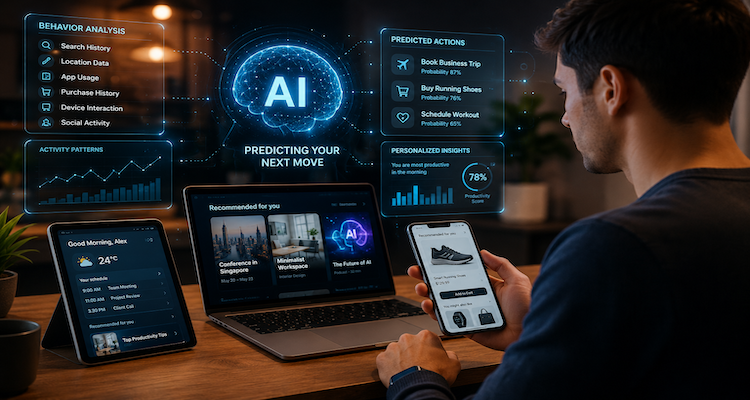
A subtle shift is unfolding across the digital landscape. Increasingly, the technologies people use every day are no longer waiting for instructions. Instead, they are learning to anticipate needs, suggest actions, and sometimes even initiate processes before a conscious decision is made.
The phenomenon is easy to overlook because it often appears helpful rather than intrusive. A streaming platform recommends a show before you start searching. A navigation app suggests a route before you enter a destination. An online retailer displays products that seem oddly relevant. What feels like convenience is actually the result of increasingly sophisticated prediction systems operating behind the scenes.
The real story is not that technology can predict behavior. It is that prediction has become one of the defining competitive advantages of the digital economy, shaping how people work, shop, travel, communicate, and make decisions.
The Rise of Predictive Intelligence
For decades, computers primarily responded to commands. Users clicked, typed, searched, and selected. Modern digital systems are moving beyond that reactive model.
Today’s platforms collect countless signals from interactions, preferences, timing patterns, locations, device usage, and browsing habits. These signals help build models that identify patterns and estimate what a person is likely to do next.
Predictive intelligence combines advances in artificial intelligence, machine learning, behavioral analytics, and large-scale data processing. Rather than focusing solely on what a user has done, these systems attempt to estimate future actions based on similarities between past and present behaviors.
The goal is not perfect prediction. Human behavior remains complex and often unpredictable. Instead, companies seek probabilities. If a system can correctly anticipate user needs even part of the time, it can significantly improve engagement, efficiency, and customer satisfaction.
Why Prediction Is Becoming More Valuable Than Information
The internet’s early years were defined by access to information. Search engines helped people find answers. Social platforms connected users with content.
Today, information is abundant. The challenge is filtering it effectively.
Prediction solves a different problem. Rather than helping users search through overwhelming amounts of information, predictive systems attempt to reduce decision-making effort altogether.
This shift reflects a growing reality of modern life: attention has become a scarce resource.
When a platform predicts what a user wants, it reduces friction. Fewer clicks, fewer searches, and fewer decisions often translate into better user experiences. Businesses benefit because convenience frequently leads to stronger engagement and customer loyalty.
As a result, prediction is becoming a central feature across industries rather than a specialized capability reserved for technology companies.
The Hidden Behavioral Feedback Loop
One of the most fascinating developments is that predictive technology does not simply observe behavior, it can influence it.
Consider music streaming services. Recommendations often introduce listeners to artists they may never have discovered independently. Over time, those recommendations can shape listening habits.
The same dynamic appears in video platforms, online shopping, social media feeds, and news distribution systems.
This creates a feedback loop. Technology predicts behavior, users respond to predictions, and those responses generate new data that improves future predictions.
The result is a system that continuously learns and adapts.
An important insight often missed in discussions about artificial intelligence is that prediction systems are not merely forecasting the future. In many cases, they are subtly participating in the creation of that future by influencing choices and attention.
That influence is not necessarily negative. It can help users discover useful products, relevant information, or efficient solutions. However, it also raises important questions about autonomy, diversity of choices, and digital influence.
Predictive Technology Is Expanding Beyond Screens
While recommendation engines receive much of the attention, predictive systems are increasingly moving into physical environments.
Smart homes learn occupancy patterns and adjust lighting or temperature automatically. Vehicles monitor driving behavior and assist with navigation, safety, and maintenance decisions. Wearable devices identify activity patterns and generate personalized health insights.
In workplaces, predictive systems help forecast inventory needs, optimize schedules, identify equipment failures, and streamline operations.
The broader trend suggests that prediction is becoming an infrastructure layer embedded throughout daily life rather than a feature confined to apps and websites.
As sensors, connected devices, and artificial intelligence systems become more integrated, predictive capabilities will likely become more invisible and more pervasive simultaneously.
The Business Race to Understand Human Intent
Many companies are no longer focused solely on understanding customer actions. They are attempting to understand customer intent.
Intent represents the motivations behind behavior. A search query, purchase, or click reveals an action. Predictive systems attempt to identify the purpose behind that action.
This distinction matters because intent is often more valuable than behavior itself.
For example, recognizing that a user is researching a future purchase can be more useful than knowing what they bought last month. Similarly, understanding that a traveler is planning a trip can create opportunities for personalized services before bookings are finalized.
Businesses across retail, finance, healthcare, education, and entertainment increasingly view predictive intelligence as a strategic asset because it enables earlier and more personalized engagement.
What Makes This Moment Different
Predictive technology has existed for years, but several developments are accelerating its impact.
Artificial intelligence models have become more capable of recognizing complex patterns. Computing power continues to increase. Connected devices generate more behavioral data than ever before. At the same time, consumers have grown accustomed to personalized digital experiences.
These factors are converging to create systems that can make increasingly accurate predictions across a wider range of situations.
Yet the most significant change may be cultural rather than technical.
People are becoming comfortable with technology taking a more proactive role. Instead of asking whether a recommendation is helpful, many users now expect personalized suggestions as a standard feature.
That shift in expectations is enabling predictive technologies to expand into new areas of everyday life.
The Limits of Knowing What Comes Next
Despite impressive advances, predictive systems remain far from perfect.
Human decisions are influenced by emotions, changing circumstances, social interactions, and unexpected events that algorithms cannot fully anticipate.
Prediction models can also inherit biases from historical data, leading to inaccurate assumptions or reinforcing existing patterns. This is why responsible development, transparency, and user control remain important considerations.
The future of predictive technology will likely depend not only on improving accuracy but also on maintaining trust.
People may welcome systems that save time and reduce complexity, but they are less likely to embrace technologies that feel manipulative or opaque.
A Future Built Around Anticipation
The next chapter of digital innovation may not be defined by faster devices or larger data centers. It may be defined by how effectively technology learns to anticipate needs before they are expressed.
From personalized services and intelligent workplaces to connected homes and adaptive entertainment, prediction is steadily becoming a foundational capability of modern technology.
The deeper significance extends beyond convenience. Predictive systems reveal a broader transformation in the relationship between humans and machines. Technology is evolving from a tool that responds to commands into a partner that increasingly attempts to understand intent, context, and future behavior.
Whether that future feels empowering or unsettling may depend on how these systems are designed, regulated, and used. What is certain is that the ability to anticipate human decisions is no longer a futuristic concept. It is already becoming one of the defining forces shaping the digital experience.
The information presented in this article is based on publicly available sources, reports, and factual material available at the time of publication. While efforts are made to ensure accuracy, details may change as new information emerges. The content is provided for general informational purposes only, and readers are advised to verify facts independently where necessary.