










Why Wildlife Monitoring Is Entering an Invisible Era
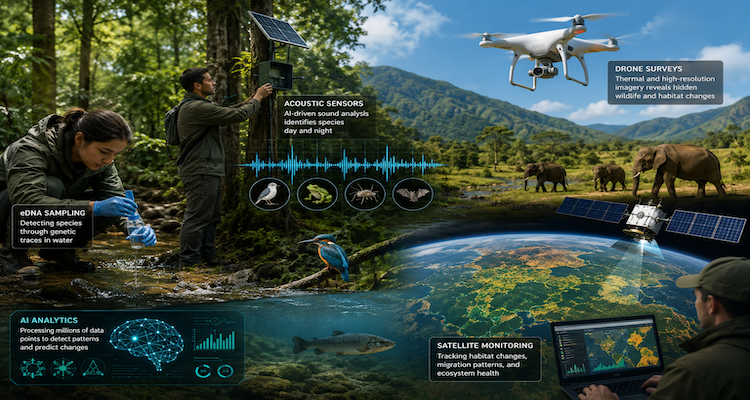
The image of a wildlife researcher patiently waiting with binoculars or checking footprints in the mud still captures the public imagination. Yet much of today’s most important wildlife monitoring no longer depends on what humans can see. Instead, scientists are increasingly gathering information from signals that remain invisible to the naked eye genetic traces in water, faint sounds beyond human hearing, thermal signatures, satellite imagery, and artificial intelligence that can detect patterns hidden within millions of data points.
This shift is quietly transforming conservation. As habitats become more fragmented and climate pressures reshape ecosystems, researchers need faster, less invasive ways to understand what is happening in the natural world. The result is a new era of wildlife monitoring where the most valuable evidence often cannot be seen at all.
Looking Beyond Sight
For decades, wildlife surveys relied heavily on direct observation, camera traps, tagging, and field expeditions. These methods remain essential, but they have limitations. Many species are nocturnal, elusive, or inhabit remote landscapes where regular monitoring is difficult. Others avoid human presence entirely, making accurate population estimates challenging.
Emerging technologies are changing that equation.
Environmental DNA, commonly known as eDNA, allows scientists to identify species from tiny fragments of genetic material left behind in water, soil, snow, or even air. Instead of physically spotting an animal, researchers can confirm its presence from microscopic traces it naturally sheds.
Similarly, acoustic monitoring uses networks of automated recorders to capture bird calls, frog choruses, whale songs, and insect sounds around the clock. Artificial intelligence can then analyze thousands of hours of recordings, recognizing species much faster than manual review ever could.
These approaches expand what researchers can detect while minimizing disturbance to wildlife.
Conservation Without Constant Human Presence
One of the biggest advantages of invisible monitoring is that animals behave more naturally when people are absent.
Traditional field surveys often require repeated visits, which may unintentionally alter animal behavior. Sensitive species can avoid survey areas altogether, while repeated human activity may affect breeding or feeding patterns.
Remote sensors, satellite observations, underwater microphones, drones equipped with thermal cameras, and automated monitoring stations allow ecosystems to be observed continuously without frequent human interference.
This produces richer datasets that reveal not only where animals are but also how they move, interact, and respond to changing environmental conditions over time.
The result is a more complete picture of ecosystem health rather than isolated snapshots collected during occasional fieldwork.
Artificial Intelligence Is Becoming a Silent Research Partner
The invisible era is not defined only by new sensors it is also driven by new ways of interpreting enormous amounts of ecological data.
Modern wildlife monitoring generates millions of photographs, audio recordings, satellite images, and environmental measurements. Reviewing all of this manually would require enormous time and resources.
Artificial intelligence now helps researchers classify images, identify animal calls, detect unusual movement patterns, and flag changes that deserve closer investigation.
Instead of replacing conservation scientists, AI acts as a powerful assistant that reduces repetitive work while allowing experts to focus on ecological interpretation and conservation planning.
As machine learning models continue to improve, they may also uncover subtle ecological relationships that humans would struggle to detect through traditional analysis alone.
The Rise of Ecosystem Intelligence
An important shift is taking place in conservation thinking.
Historically, many monitoring programs focused on individual species, particularly endangered animals. Today’s technologies make it increasingly possible to observe entire ecosystems simultaneously.
Rather than asking whether one species is present, researchers can begin asking broader questions:
- Is biodiversity increasing or declining?
- How are migration routes changing?
- Are seasonal patterns shifting?
- Which habitats remain resilient under environmental stress?
By combining satellite imagery, climate data, acoustic monitoring, environmental DNA, and field observations, scientists can build increasingly detailed pictures of ecosystem dynamics.
This holistic perspective helps conservation efforts become more proactive instead of reacting only after populations have already declined.
Why This Matters Beyond Wildlife
Invisible monitoring may sound like a niche scientific development, but its implications extend well beyond conservation.
Healthy ecosystems support agriculture, freshwater supplies, fisheries, tourism, and climate stability. Detecting ecological change earlier allows governments, land managers, and conservation organizations to respond before problems become irreversible.
For example, identifying the arrival of an invasive species at an early stage can improve the chances of controlling its spread. Monitoring changing migration patterns may also reveal broader environmental shifts that affect farming communities, water management, or coastal economies.
In this way, wildlife monitoring increasingly functions as an early-warning system for environmental change that ultimately affects people as well as wildlife.
A New Relationship Between Technology and Nature
Some people worry that growing reliance on technology could distance humans from nature. The opposite may be happening.
Invisible monitoring does not replace field biology or natural observation. Instead, it complements traditional expertise by revealing ecological processes that would otherwise remain hidden.
Researchers still need ecological knowledge to interpret results, validate findings, and understand local habitats. Technology simply expands their ability to observe complex systems across larger areas and longer periods.
The relationship between conservation and technology is therefore becoming increasingly collaborative rather than competitive.
Ethical Questions Still Matter
As monitoring capabilities become more sophisticated, responsible use remains essential.
High-resolution tracking, drones, and extensive sensor networks raise practical questions about data management, privacy in shared landscapes, and the potential impact of certain monitoring techniques on wildlife.
Conservation organizations increasingly emphasize ethical deployment, ensuring that technology serves ecological goals without creating unnecessary risks for animals or local communities.
Likewise, data quality remains critical. AI-generated classifications still require human validation, particularly when findings influence conservation policy or species management decisions.
Invisible does not mean infallible.
The Hidden Insight: Conservation Is Becoming Predictive
Perhaps the most significant change is not technological but philosophical.
For much of conservation history, scientists documented environmental change after it occurred. Today’s invisible monitoring tools are gradually shifting conservation toward prediction.
Continuous streams of ecological data allow researchers to identify trends earlier, monitor ecosystem resilience, and recognize emerging threats before they become obvious through traditional observation.
This predictive approach could fundamentally reshape conservation planning. Rather than responding only to visible decline, future efforts may increasingly focus on preventing ecological disruption before it reaches a critical stage.
That evolution mirrors broader trends in healthcare, infrastructure, cybersecurity, and business, where continuous monitoring is replacing periodic inspection. Wildlife science is becoming part of the same data-driven transformation.
The Future May Be Quieter but More Informed
The future of wildlife monitoring is unlikely to feature more people searching forests with notebooks. Instead, it will rely on interconnected systems quietly collecting signals from landscapes, oceans, rivers, and skies.
Many of these signals will never be visible to the human eye, yet together they offer a deeper understanding of biodiversity than previous generations could have imagined.
As environmental pressures continue to grow, the ability to detect subtle ecological changes early may become one of conservation’s greatest strengths. Invisible monitoring is not making wildlife less visible, it is allowing humanity to see nature in entirely new ways.
This content is published for informational or entertainment purposes. Facts, opinions, or references may evolve over time, and readers are encouraged to verify details from reliable sources.