










Why Empty Parking Lots Are Becoming Unexpected Wildlife Habitats
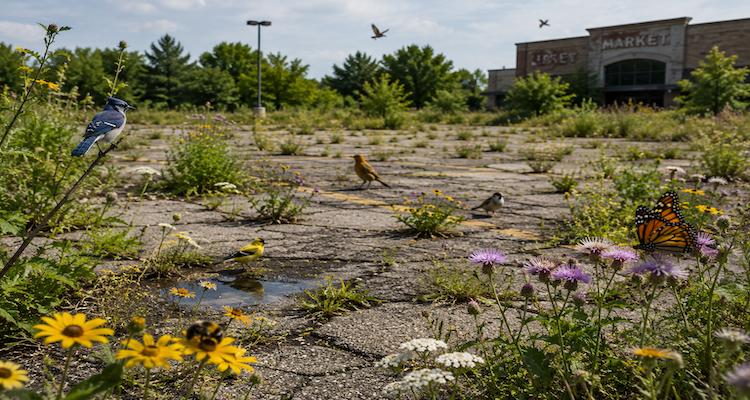
A parking lot is usually seen as the final stage of urban development a stretch of asphalt built for convenience, traffic, and commerce. Yet in many places, these vast paved spaces are quietly taking on an entirely different role. As shopping habits change, office attendance fluctuates, and aging commercial properties sit underused, empty parking lots are becoming surprising refuges for wildlife.
The transformation is subtle. Cracks in neglected pavement fill with grasses. Rainwater collects in shallow depressions. Shrubs begin to emerge along neglected edges. Birds arrive first, followed by insects, small mammals, reptiles, and pollinators. What appears to be abandoned infrastructure to people can become a temporary ecosystem for nature. This unexpected shift reveals more than an environmental curiosity, t highlights how wildlife is adapting to a rapidly changing human landscape.
Urban Spaces Are Changing Faster Than Expected
The rise of e-commerce, hybrid work, and changing consumer behavior has reduced demand for parking in many cities. Large retail centers, former office complexes, and closed commercial properties often have expansive parking lots that now remain partially or completely unused for extended periods.
Unlike active parking areas that experience constant traffic, these quieter spaces receive less disturbance. While they are far from pristine habitats, they create opportunities for hardy plant species to establish themselves. Over time, these plants attract insects, which in turn draw birds and other animals looking for food and shelter.
This process resembles the early stages of ecological succession, where nature gradually begins reclaiming disturbed land. Although these habitats are usually temporary, they demonstrate the remarkable resilience of many species.
Small Changes Create Unexpected Ecosystems
Wildlife rarely waits for perfect conditions. Many species thrive by exploiting overlooked spaces rather than untouched wilderness.
An abandoned parking lot may provide:
- Warm surfaces favored by reptiles.
- Rain-filled depressions used by insects.
- Flowering weeds that attract bees and butterflies.
- Shrubby borders where birds can nest.
- Quiet corners where small mammals can hide from predators.
Even isolated patches of vegetation can become valuable “stepping stones” connecting fragmented habitats across cities. For birds, pollinators, and other mobile species, these green pockets help bridge the gaps between parks, rivers, and woodlands.
Researchers studying urban ecology increasingly recognize that biodiversity often depends on these overlooked spaces rather than only on designated parks.
Nature Is Adapting to Human Infrastructure
One of the most fascinating aspects of urban wildlife is its ability to adapt rather than retreat.
Many animals have learned to navigate environments built almost entirely by humans. Peregrine falcons nest on skyscrapers that resemble cliff faces. Foxes and coyotes travel along railway corridors. Bees forage in rooftop gardens.
Empty parking lots fit into this broader pattern of adaptation.
Instead of viewing cities as barriers, many species treat them as evolving landscapes containing both risks and opportunities. The ability to exploit these unconventional habitats often determines which species succeed in modern urban environments.
This adaptability is becoming increasingly important as natural habitats continue to face pressure from development and climate change.
Pollinators Often Arrive Before Larger Animals
One of the earliest signs of ecological recovery is usually the return of insects.
Wildflowers growing through pavement cracks may seem insignificant, but they can provide nectar for bees, butterflies, hoverflies, and other pollinators. These insects then support birds, spiders, and countless other organisms higher up the food chain.
Urban pollinator populations have become a growing focus for conservation efforts because healthy pollinator communities support both natural ecosystems and agriculture.
Even small flowering patches can contribute to larger networks of urban biodiversity when connected with parks, gardens, and roadside vegetation.
The lesson is simple: wildlife often responds quickly when even modest habitat opportunities appear.
Temporary Doesn’t Mean Unimportant
Some critics argue that abandoned parking lots are poor substitutes for natural habitats. They are right but that misses an important point.
Temporary habitats still matter.
Migrating birds may use them as short stopovers. Pollinators may depend on seasonal flowers before moving elsewhere. Small mammals may use them while traveling between larger green areas.
Ecologists increasingly view cities as mosaics of interconnected habitats rather than isolated green spaces. Every usable patch contributes to the overall ecological network.
This perspective has influenced urban planning in several regions, where vacant land is sometimes intentionally managed with native vegetation rather than being left completely barren.
What This Reveals About Cities
Perhaps the most interesting insight isn’t about wildlife at all, it’s about how cities themselves are changing.
Parking lots were once symbols of economic growth and automobile dependence. Their size reflected expectations of constant traffic, expanding retail, and busy commercial districts.
Today, many of those assumptions are shifting.
Online shopping reduces store visits. Public transportation investments continue in some cities. Hybrid work changes commuting patterns. Mixed-use neighborhoods reduce dependence on large parking areas.
As these trends evolve, some oversized parking lots may eventually be redeveloped into housing, parks, or community spaces. Others may remain unused long enough to become temporary ecological zones.
Nature is simply responding to changing patterns of human behavior.
A New Way to Think About Conservation
Conservation has traditionally focused on protecting forests, wetlands, and national parks. Those landscapes remain essential, but urban biodiversity is becoming an increasingly important part of environmental planning.
Cities now recognize the value of green roofs, rain gardens, wildlife corridors, restored riverbanks, and native landscaping.
Empty parking lots demonstrate another possibility: even highly engineered spaces can contribute to biodiversity under the right conditions.
Rather than viewing these areas solely as neglected infrastructure, planners and communities can ask whether some portions could be redesigned to support both people and wildlife. Small interventions—such as replacing sections of pavement with native plants, planting trees, or improving stormwater management can create healthier environments without eliminating practical uses.
Challenges Remain
Not every abandoned parking lot becomes a thriving habitat.
Some sites contain polluted runoff, invasive plant species, excessive heat, or hazardous debris that limit wildlife use. Others may eventually be redeveloped before ecological communities have time to establish themselves.
There is also a balance to maintain. Urban wildlife can occasionally create conflicts with nearby residents or businesses, particularly if certain species become overly dependent on human environments.
The goal is not to romanticize abandoned infrastructure but to recognize the ecological opportunities that sometimes emerge where people least expect them.
Looking Beyond the Asphalt
Empty parking lots remind us that nature is remarkably opportunistic. Given even small openings, life begins to return.
This quiet transformation challenges long-held assumptions about where biodiversity belongs. Conservation is no longer confined to remote wilderness. Increasingly, it unfolds in overlooked corners of cities, between buildings, beside warehouses, and across forgotten pavement.
As communities rethink how land is used in an era of changing transportation, commerce, and urban design, these unexpected habitats offer an important lesson. Spaces built entirely for human convenience can, under the right circumstances, become part of a broader ecological story.
The next time you pass an almost empty parking lot dotted with wildflowers, birds, or buzzing insects, it may be worth seeing it differently. Beneath the cracked asphalt and faded parking lines, a small but meaningful chapter of urban nature may already be unfolding.
This content is published for informational or entertainment purposes. Facts, opinions, or references may evolve over time, and readers are encouraged to verify details from reliable sources.