








How Artificial Lighting Is Changing Wildlife After Dark
The glow of artificial light has become so familiar that many people barely notice it anymore. Streets, buildings, sports fields, billboards, and residential neighborhoods remain illuminated long after sunset, creating a world where darkness is increasingly rare. Yet while humans often associate nighttime lighting with safety and convenience, wildlife experiences it very differently.
For countless species, darkness is not simply the absence of daylight, it is an essential environmental signal. It tells animals when to hunt, migrate, pollinate, reproduce, or avoid predators. As artificial lighting spreads across cities, suburbs, coastlines, and even rural landscapes, scientists are discovering that many animals are quietly changing their behavior to cope with a brighter night. These shifts are subtle, but together they are reshaping ecosystems in ways that extend far beyond individual species.
A Night That No Longer Looks Natural
For millions of years, wildlife evolved around predictable cycles of sunlight, moonlight, and seasonal changes. These natural rhythms influence biological clocks that regulate everything from sleep patterns to feeding schedules.
Artificial lighting interrupts those cues.
Bright LED streetlights, illuminated buildings, parking lots, advertising displays, and industrial facilities create what researchers often describe as “light pollution.” Unlike noise or air pollution, light pollution is invisible to many people because it blends into everyday life. Its ecological effects, however, can spread across surprisingly large areas.
Many nocturnal animals begin their active hours later or reduce activity altogether. Others move into darker habitats, even if those areas provide fewer food resources. Some species adapt successfully, while others struggle to compete.
Birds Are Changing Their Daily Routines
Birds are among the most visible examples of wildlife responding to artificial light.
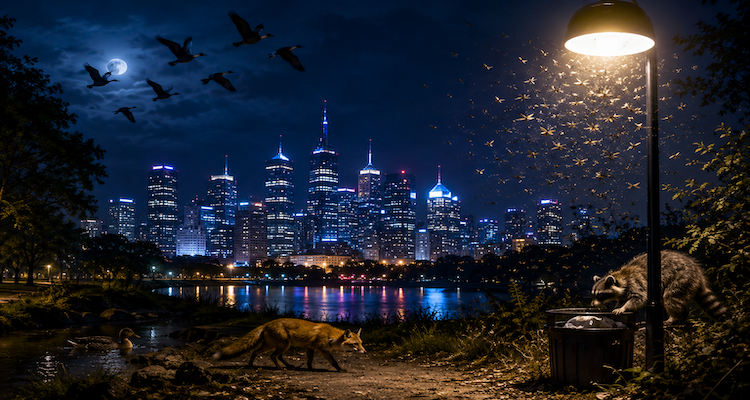
Many migratory birds rely on natural celestial cues for navigation during nighttime journeys. Bright urban skylines can disorient them, causing them to circle illuminated buildings, waste valuable energy, or collide with glass structures.
Artificial lighting can also influence birds long before migration begins. In some urban areas, birds have been observed singing earlier in the morning because nearby lights create the impression that dawn has already arrived. Extended lighting may also affect breeding cycles by altering seasonal signals that birds normally use to time reproduction.
These behavioral adjustments may appear minor, but over time they can influence survival, nesting success, and migration efficiency.
Insects Face an Unexpected Challenge
Perhaps no group illustrates the effects of nighttime lighting more dramatically than insects.
Many insects naturally navigate using the moon and stars. Bright artificial lights interfere with these orientation systems, attracting insects toward lamps where they often circle until exhaustion or become easy prey for predators.
This concentration of insects around artificial lights has ripple effects throughout ecosystems.
Pollinating insects may spend less time visiting nighttime flowers. Plants that depend on nocturnal pollinators can experience reduced pollination opportunities. Predators that feed on insects may temporarily benefit from abundant prey near lights, while other areas experience declining food availability.
Because insects occupy foundational positions in many food webs, even modest behavioral changes can influence numerous other species.
Predators and Prey Are Playing by New Rules
Artificial lighting changes more than visibility, it changes risk.
For prey animals, brighter environments may increase exposure to predators that hunt using sight. Some small mammals reduce nighttime foraging in illuminated areas, even when food is plentiful.
At the same time, certain predators exploit these conditions. Owls, foxes, and some urban-adapted species may take advantage of prey concentrated around lit environments. Other predators that evolved to hunt in complete darkness may become less successful if their prey shifts activity to darker locations.
The result is not simply more or less predation but an entirely different landscape of opportunities and dangers.
In ecological terms, artificial lighting alters the balance that species have developed over thousands of generations.
Marine Wildlife Is Also Feeling the Effects
The influence of nighttime lighting extends well beyond cities.
Coastal lighting affects numerous marine species that depend on darkness during critical life stages.
One widely recognized example involves sea turtle hatchlings. Newly emerged hatchlings typically move toward the brightest natural horizon, which historically was the moonlit ocean. Artificial beachfront lighting can confuse this instinct, causing hatchlings to move inland instead of toward the sea.
Other marine organisms also respond to nighttime illumination. Fish behavior, feeding activity, and predator interactions may change around brightly lit harbors and waterfront developments.
These examples demonstrate that artificial lighting is not merely a terrestrial issue but one affecting ecosystems across land and water.
Cities Are Becoming Evolutionary Experiments
Perhaps the most fascinating aspect of artificial lighting is that some species are adapting remarkably well.
Urban wildlife often displays surprising flexibility.
Certain birds alter feeding schedules. Some mammals become active later at night to avoid human activity. Insects may shift habitats, while predators learn to exploit illuminated environments.
Cities are effectively becoming large-scale experiments in behavioral adaptation.
However, adaptation does not necessarily mean improvement.
Species that adjust successfully may expand, while others decline because they cannot respond quickly enough. Over time, this may reshape local biodiversity, favoring adaptable generalists over more specialized species.
That shift matters because healthy ecosystems depend on a wide variety of interacting plants and animals rather than a handful of highly adaptable survivors.
Why This Matters Beyond Conservation
Artificial lighting might seem like an issue only for ecologists, but its implications reach much further.
Cities around the world are investing in energy-efficient LED lighting, expanding infrastructure, and increasing nighttime visibility. These improvements bring undeniable benefits for people, yet they also present new design challenges.
Urban planners, architects, transportation authorities, and businesses are increasingly exploring lighting strategies that reduce unnecessary skyglow while maintaining public safety.
Simple measures such as directing light downward, reducing excessive brightness, limiting overnight illumination where appropriate, and using warmer-colored lighting in sensitive ecological areas can help reduce ecological disruption without eliminating the benefits of outdoor lighting.
The conversation is gradually shifting from whether lighting is necessary to how it can be designed more thoughtfully.
A Different Way to Think About the Night
One of the most important insights emerging from this field is that darkness itself has ecological value.
Modern society often treats darkness as something to eliminate. Yet for countless species, darkness functions as critical habitat in much the same way forests, wetlands, rivers, and coral reefs do.
Recognizing darkness as a natural resource encourages a different perspective on development and environmental planning. Instead of viewing lighting solely through the lens of human convenience, communities can consider how nighttime environments support biodiversity.
As research continues, artificial lighting is becoming a powerful example of how everyday technologies can unintentionally reshape the natural world. Unlike many environmental challenges, however, this is one where relatively small design choices may produce meaningful ecological benefits.
The night may never return to its entirely natural state in many parts of the world, but understanding how wildlife responds to artificial light offers an opportunity to create landscapes that better serve both people and nature. Sometimes, protecting biodiversity begins not with adding something new but with allowing darkness to exist where it still can.
This content is published for informational or entertainment purposes. Facts, opinions, or references may evolve over time, and readers are encouraged to verify details from reliable sources.