










Why Climate Refuges May Become Nature’s Most Valuable Strongholds
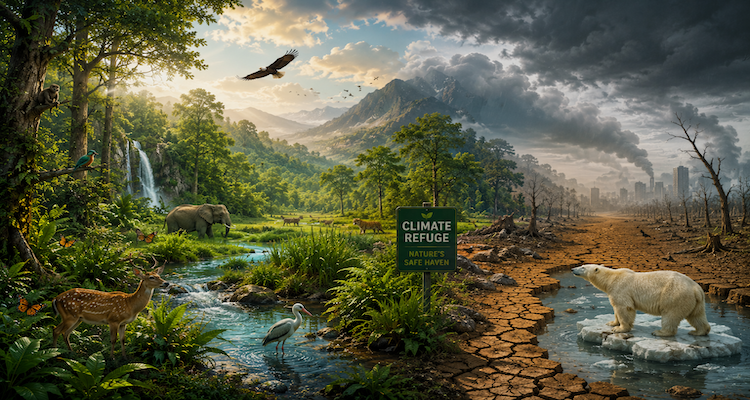
The idea of protecting nature has long centered on saving places that are already under threat. But a quieter shift is changing the conversation among conservationists and ecologists. Instead of focusing only on ecosystems in decline, attention is increasingly turning toward places where plants and animals still have a chance to thrive despite a warming world. These areas are known as climate refuges natural landscapes that remain relatively stable even as surrounding environments experience rapid environmental change.
Climate refuges are becoming more important because they represent something increasingly rare: resilience. As temperatures rise, rainfall patterns shift, and extreme weather events become more frequent in many regions, some valleys, forests, wetlands, mountains, and coastal zones continue to provide the conditions that species need to survive. Rather than resisting change everywhere, nature is finding pockets where it can adapt, persist, and sometimes even recover.
This emerging perspective is reshaping how scientists, policymakers, and local communities think about conservation—not simply as preserving the past, but as preparing ecosystems for an uncertain future.
What Exactly Is a Climate Refuge?
A climate refuge is an area where environmental conditions remain more stable than in surrounding landscapes despite broader climatic shifts. These locations may stay cooler, retain more moisture, experience fewer extreme weather events, or benefit from unique geographical features that buffer environmental stress.
Examples vary widely. Mountain valleys can trap cooler air during heatwaves. Dense forests may maintain lower ground temperatures than nearby open land. Springs fed by underground water can continue supplying freshwater even when rivers shrink. Coastal wetlands sometimes protect wildlife from increasingly severe storms.
These places become safe havens where species struggling elsewhere can continue breeding, feeding, and maintaining healthy populations.
Importantly, climate refuges are not permanent shelters immune to environmental change. Rather, they buy valuable time—giving ecosystems a greater opportunity to adapt while broader efforts to address climate change continue.
Nature Is Already Moving
One of the biggest misconceptions about wildlife is that species remain tied to fixed habitats. In reality, many organisms constantly adjust their ranges in response to changing environmental conditions.
Bird migration routes have shifted in several parts of the world. Marine species have expanded toward cooler waters. Mountain plants have gradually appeared at higher elevations. Forest insects, pollinators, and mammals are also altering their distributions where suitable habitats remain available.
Climate refuges often become the destinations or critical stepping stones in these natural movements.
Rather than viewing migration as a sign of ecological collapse, scientists increasingly recognize it as one of nature’s oldest survival strategies. The challenge today is that human development frequently interrupts these movements with highways, cities, agricultural expansion, and fragmented landscapes.
Why These Places Matter More Than Ever
Climate refuges serve multiple ecological functions beyond simply sheltering wildlife.
They preserve genetic diversity by allowing populations to survive long enough to reproduce and evolve. They maintain ecological relationships between predators, prey, pollinators, and plants. They also help stabilize essential ecosystem services such as water filtration, soil protection, and carbon storage.
When a refuge supports an entire food web instead of a single species, it becomes disproportionately valuable.
This is why some conservation strategies are shifting away from protecting isolated species alone and toward safeguarding entire landscapes that naturally resist environmental stress.
The concept reflects an important change in thinking: protecting resilience may be just as important as protecting rarity.
The Hidden Geography of Survival
Climate refuges are not always found inside famous national parks or remote wilderness areas.
Sometimes they exist in surprisingly ordinary places a shaded urban woodland, a small wetland surrounded by farmland, or a stretch of river that remains cool because of underground springs.
Microclimates created by local terrain can dramatically influence survival. North-facing slopes often receive less direct sunlight than south-facing ones. Deep canyons may trap cool air. Ancient forests create humid environments beneath dense canopies.
These subtle differences become increasingly significant as regional climates become more variable.
This means conservation opportunities may exist much closer to communities than many people realize.
A New Way of Thinking About Conservation
Traditional conservation often focused on preserving ecosystems exactly as they existed historically. Climate refuges encourage a more flexible approach.
Instead of asking how to freeze landscapes in time, researchers increasingly ask how ecosystems can remain functional despite inevitable environmental change.
This shift influences decisions about land management, restoration projects, protected area planning, and wildlife corridors that connect habitats across larger regions.
Some restoration efforts now prioritize reconnecting fragmented habitats so species can move between climate refuges as environmental conditions evolve.
Rather than resisting every ecological change, conservation increasingly emphasizes enabling healthy adaptation.
Communities Benefit Too
The importance of climate refuges extends beyond wildlife.
Healthy forests moderate local temperatures, reduce wildfire intensity under certain conditions, protect watersheds, and improve air quality. Wetlands reduce flood risks while supporting fisheries and agriculture. Coastal ecosystems help buffer storm surges and reduce erosion.
Communities living near resilient ecosystems often experience environmental benefits that become increasingly valuable during periods of climatic stress.
This creates an important overlap between biodiversity conservation and human well-being.
Protecting climate refuges is therefore not only about safeguarding rare species it is also about maintaining natural systems that quietly support everyday life.
An Emerging Economic Perspective
Businesses are beginning to recognize environmental resilience as an economic consideration rather than solely an environmental concern.
Insurance companies, infrastructure planners, agricultural sectors, and tourism industries increasingly evaluate how stable ecosystems reduce long-term risks.
Nature-based tourism often depends on healthy forests, wetlands, coral reefs, and wildlife populations. Water-intensive industries benefit from protected watersheds. Agriculture relies on pollinators and stable local ecosystems.
As environmental uncertainty grows, climate refuges may become valuable natural assets that contribute to economic resilience alongside ecological resilience.
This broader perspective reflects a growing understanding that environmental stability underpins many sectors of modern economies.
The Challenge Ahead
Identifying climate refuges is only the beginning.
Many of these landscapes remain poorly mapped or inadequately protected. Others face pressures from urban expansion, mining, intensive agriculture, or infrastructure development before their ecological importance is fully understood.
Scientists continue improving climate models, satellite monitoring, and ecological mapping to identify areas likely to remain resilient over coming decades. However, future environmental conditions remain uncertain, and no refuge can be assumed to remain permanently protected from change.
This uncertainty reinforces the importance of protecting diverse ecosystems rather than relying on a handful of locations.
The broader lesson is one of flexibility. Conservation strategies that embrace adaptation alongside preservation may prove better equipped for a changing world.
Why Climate Refuges Matter Beyond Conservation
Perhaps the most significant insight behind climate refuges is that they change how we define environmental success.
For decades, environmental discussions often emphasized preventing every ecological change. Climate refuges suggest another goal: helping nature remain capable of adapting.
That distinction matters.
A resilient ecosystem does not remain frozen in its original state. Instead, it continues functioning, supporting biodiversity, and recovering from disturbances even as conditions evolve.
This perspective mirrors challenges facing human societies as well. Cities redesign infrastructure for rising temperatures, businesses diversify supply chains against disruption, and communities prepare for increasingly variable weather. Nature is pursuing its own version of resilience through climate refuges.
Recognizing and protecting these natural strongholds may become one of the defining conservation priorities of the coming decades—not because they stop environmental change, but because they offer life its best opportunity to endure it.
This content is published for informational or entertainment purposes. Facts, opinions, or references may evolve over time, and readers are encouraged to verify details from reliable sources.