










When Powerful Cinema Becomes a Platform for Persuasion
Key Takeaways
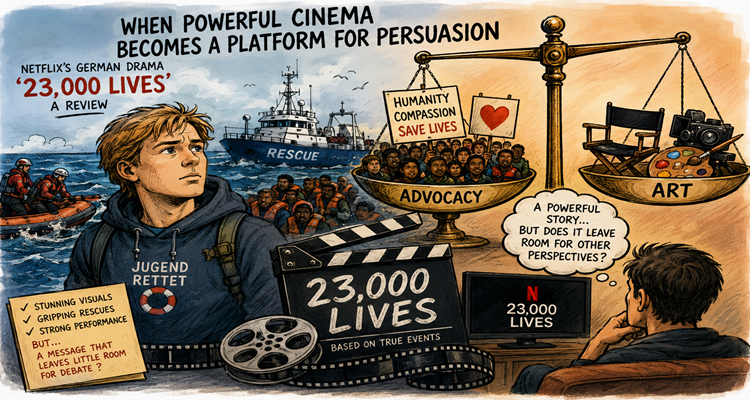
- Netflix’s 23,000 Lives combines striking cinematography with emotionally intense storytelling centered on Mediterranean refugee rescue missions.
- The film raises difficult humanitarian questions but presents migration largely through a single narrative perspective rather than multiple viewpoints.
- Louis Hofmann delivers one of the strongest performances of his recent career, anchoring the emotional weight of the story.
- The movie highlights a growing trend in socially conscious filmmaking where advocacy can sometimes compete with dramatic storytelling.
- Its reception reflects wider audience expectations for films that encourage thoughtful discussion instead of prescribing conclusions.
Introduction
Few contemporary issues are as emotionally charged or as politically divisive as migration. When filmmakers choose to explore such subjects, they face a delicate balancing act: telling deeply human stories while leaving enough space for audiences to interpret events through their own perspectives.
Netflix’s German drama 23,000 Lives enters that challenging territory by dramatizing the work of civilian volunteers rescuing migrants crossing the Mediterranean. Visually ambitious and emotionally intense, the film aims to spotlight acts of compassion carried out under extraordinary circumstances.
Yet the conversation surrounding the film extends beyond its technical achievements. Rather than focusing solely on its narrative, many viewers are discussing a broader question: how much should a film guide public opinion? That debate has become almost as significant as the story itself, making 23,000 Lives an interesting case study in the evolving relationship between cinema, social issues, and audience expectations.
Understanding the Development
A Story Inspired by Humanitarian Rescue Efforts
At its center is Lukas, portrayed by Louis Hofmann, who leaves behind a stable life to volunteer with a humanitarian rescue organization operating in the Mediterranean Sea. The mission is straightforward in principle- to prevent people attempting dangerous sea crossings from drowning, but the legal and political realities surrounding these operations are far more complicated.
The volunteers eventually become the focus of legal scrutiny, illustrating how humanitarian actions can intersect with national laws, immigration policies, and international politics. Instead of presenting the rescue missions simply as dramatic events, the film frames them as moral choices carrying personal and legal consequences.
Strong Craftsmanship Elevates the Viewing Experience
From a filmmaking perspective, 23,000 Lives demonstrates considerable technical skill.
The Mediterranean becomes more than a backdrop. Expansive ocean photography creates both beauty and danger, while rescue sequences generate genuine suspense without relying excessively on visual effects. These moments immerse viewers in the uncertainty faced by both rescuers and those attempting perilous crossings.
Louis Hofmann provides emotional consistency throughout the film. His restrained performance avoids melodrama, allowing viewers to connect with Lukas through subtle expressions rather than dramatic speeches.
Director Markus Goller also deserves recognition for constructing rescue sequences that feel immediate and authentic, maintaining tension even when the audience knows the humanitarian objective.
Why This Matters
Films About Real Issues Carry Greater Responsibility
Stories inspired by real-world events inevitably influence public understanding.
Unlike fictional adventures, films centered on migration, conflict, healthcare, or climate often become part of broader public conversations. For many viewers, they may even serve as an introduction to subjects they have not previously explored.
Because of that influence, audiences increasingly expect nuanced storytelling that acknowledges complexity instead of simplifying contentious issues into clear moral binaries.
The Audience Is Becoming More Critical
Modern viewers consume information from documentaries, journalism, podcasts, academic research, and social media alongside entertainment.
As a result, audiences are becoming more comfortable questioning whether a film presents a balanced perspective or primarily advances a particular viewpoint. Rather than rejecting advocacy altogether, many viewers appreciate narratives that trust them to evaluate competing ideas independently.
This shift reflects growing media literacy rather than political preference.
What Is Changing
Socially Conscious Cinema Is Becoming More Common
Over the past decade, streaming platforms have significantly expanded international filmmaking.
Many productions now focus on climate change, migration, inequality, mental health, racial justice, and humanitarian crises. These subjects naturally carry ethical dimensions that filmmakers often feel compelled to address directly.
The challenge emerges when storytelling begins serving the message instead of allowing characters, events, and emotional experiences to communicate themes organically.
Emotional Storytelling Alone Is No Longer Enough
Audiences still respond to powerful emotional moments, but they also value intellectual engagement.
When every scene reinforces the same conclusion, viewers may feel their role shifts from participant to observer, receiving a predetermined lesson. That perception can reduce dramatic tension because uncertainty, one of storytelling’s strongest tools, gradually disappears.
The most enduring films often encourage discussion long after the credits roll because they leave meaningful questions unresolved.
The Bigger Picture
Cinema Has Long Reflected Political and Social Debates
Films have always responded to the issues shaping their eras.
War, civil rights, economic hardship, technological change, and environmental concerns have repeatedly found their way onto cinema screens. Great films often emerge from these moments because they capture both individual experiences and broader historical forces.
However, the productions remembered most fondly typically avoid reducing complicated debates into single conclusions. Instead, they invite audiences into difficult conversations.
Migration Remains One of the Most Complex Global Topics
Migration combines humanitarian concerns with questions involving national security, international law, economic policy, labor markets, and public opinion.
No single film can comprehensively represent every perspective surrounding such a multifaceted issue.
Nevertheless, audiences increasingly appreciate stories acknowledging that compassionate intentions and legitimate policy debates can coexist, even when they lead to uncomfortable questions.
Opportunities and Challenges
What the Film Does Well
The strongest achievement of 23,000 Lives lies in humanizing people frequently discussed only through statistics.
By focusing on individuals rather than numbers, the film reminds audiences that migration involves real lives, personal decisions, fear, hope, and extraordinary resilience.
Its production quality also demonstrates the growing strength of European filmmaking within global streaming platforms.
Where It Divides Opinion
The principal criticism concerns narrative balance.
Some viewers may welcome the film’s clear moral position, believing urgent humanitarian issues deserve direct advocacy rather than neutrality.
Others may argue that presenting alternative viewpoints could have created richer characters, more compelling conflicts, and ultimately stronger dramatic storytelling.
Neither perspective is inherently incorrect. Instead, they reflect differing expectations about what audiences seek from socially engaged cinema.
What Comes Next
Expect More Debate Around Purpose-Driven Entertainment
Streaming services continue investing in stories inspired by real social issues because audiences increasingly seek meaningful entertainment alongside escapism.
This trend is unlikely to slow.
However, filmmakers may face growing pressure to balance advocacy with narrative openness, especially as global audiences become more diverse and more accustomed to evaluating media critically.
Success May Depend on Audience Trust
The future of issue-driven cinema may rest on a simple principle: trust viewers.
Rather than explaining every moral implication, films that allow audiences to wrestle with difficult questions themselves often leave a deeper and more lasting impression.
Whether viewers ultimately agree with a film’s perspective becomes less important than whether they feel invited into an honest conversation.
Conclusion
23,000 Lives succeeds on many artistic levels. Its cinematography captures both the beauty and danger of the Mediterranean, its rescue sequences maintain gripping tension, and Louis Hofmann delivers a performance that reinforces his reputation as one of Germany’s finest actors.
Yet the film also illustrates an increasingly relevant challenge for contemporary cinema. As filmmakers address complex global issues, audiences are looking not only for emotional impact but also for intellectual space, room to question, interpret, and reflect.
The conversation surrounding 23,000 Lives ultimately reaches beyond one Netflix release. It highlights an enduring question about modern storytelling: should films persuade us, or should they trust us to decide for ourselves? For many viewers, the answer may determine whether a socially conscious drama becomes merely memorable or truly enduring.
This content is published for informational or entertainment purposes. Facts, opinions, or references may evolve over time, and readers are encouraged to verify details from reliable sources.
Related News
- Netflix’s 2026 Book Options Reveal What Stories It May Be Betting On Next
- Why Video Game Adaptations Are Finally Winning Over Audiences
- From Fan Fiction to Blockbusters: How Online Communities Are Changing Storytelling
- The Death of Channel Surfing: How Streaming Changed the Way We Discover Entertainment