









Why the Most Valuable AI Skills Have Nothing to Do With Coding
A quiet shift is taking place in workplaces, classrooms, and boardrooms. As artificial intelligence becomes easier to use, the advantage is no longer reserved for people who know how to build AI systems. Increasingly, it belongs to those who know how to think alongside them.
This change challenges one of the most common assumptions about the AI era: that success depends primarily on technical expertise. Coding, machine learning, and data science remain important fields, but as AI tools become more accessible, a different set of skills is emerging as the real differentiator. The people gaining the most value from AI are often not the ones creating the technology. They are the ones asking better questions, making better decisions, and understanding where human judgment still matters most.
The future of work may be less about competing with machines and more about developing the uniquely human abilities that machines cannot easily replicate.
The New Reality of AI Accessibility
Only a few years ago, working with advanced AI required specialized knowledge. Today, powerful AI assistants can generate reports, summarize research, analyze documents, write code, create presentations, and brainstorm ideas through simple conversations.
This accessibility has changed the competitive landscape.
When sophisticated technology becomes available to millions of people, technical access stops being the primary advantage. The focus shifts to how effectively individuals use that technology. Just as spreadsheets did not make every employee a financial expert and search engines did not make everyone a researcher, AI tools do not automatically create expertise.
The quality of outcomes increasingly depends on the quality of human input.
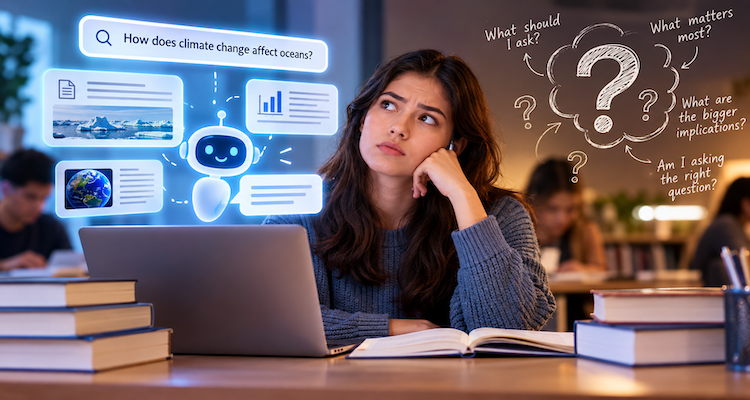
A poorly framed question often produces a poor answer, regardless of how advanced the AI system may be. Conversely, a thoughtful question can unlock insights, efficiency, and creativity that would otherwise remain hidden.
Critical Thinking Is Becoming More Valuable, Not Less
One of the most overlooked consequences of AI adoption is the growing importance of critical thinking.
AI systems can generate convincing responses in seconds. However, speed is not the same as accuracy. Information can be incomplete, outdated, biased, or simply incorrect. As organizations integrate AI into everyday workflows, the ability to evaluate outputs becomes increasingly essential.
Professionals who can assess evidence, identify flaws, recognize assumptions, and challenge conclusions provide value that automation cannot easily replace.
This creates an interesting paradox. The more capable AI becomes at producing answers, the more important it becomes for humans to judge whether those answers make sense.
The skill of questioning information may ultimately matter more than the skill of finding information.
Judgment Is Emerging as a Competitive Advantage
Many workplace decisions involve context, trade-offs, ethics, and uncertainty. These are areas where human judgment remains indispensable.
An AI system may recommend a strategy based on available data, but it cannot fully understand organizational culture, customer relationships, long-term reputation, or nuanced human motivations. Leaders must still decide which risks are acceptable, which opportunities align with broader goals, and when a recommendation should be ignored.
This is becoming evident across industries.
In healthcare, AI can assist with analysis and administrative tasks, but medical professionals must interpret results within the context of individual patients.
In business, AI can generate forecasts and market insights, but executives must evaluate broader strategic implications.
In education, AI can support learning, but teachers remain responsible for understanding student needs and guiding development.
The technology may provide options. Humans remain responsible for choices.
Communication Has Become an AI-Era Superpower
The rise of conversational AI has elevated communication from a soft skill to a strategic skill.
Effective communication now influences how well people collaborate not only with colleagues but also with intelligent systems. Clear instructions, precise objectives, and thoughtful feedback often determine whether AI delivers useful results.
Organizations are increasingly discovering that employees who can articulate problems clearly frequently outperform those with deeper technical knowledge but weaker communication abilities.
This trend extends beyond AI interactions.
As automation handles more routine tasks, uniquely human communication skills become more valuable in leadership, negotiation, collaboration, relationship building, and conflict resolution.
Machines can process language. Human beings create understanding.
Creativity Is Evolving Rather Than Disappearing
Concerns about AI replacing creative work have sparked widespread debate. Yet creativity itself may be becoming more important.
AI can generate ideas, designs, text, and concepts at remarkable speed. What it cannot easily do is determine which ideas are meaningful, culturally relevant, emotionally resonant, or strategically valuable.
Creative professionals are increasingly shifting from content production to content direction.
Instead of starting with a blank page, they begin with AI-generated possibilities and apply human insight to refine, combine, challenge, and improve them.
The most successful creators are not necessarily producing every element themselves. They are curating, shaping, and guiding the creative process.
This transformation resembles the way digital photography changed visual storytelling. Cameras became easier to use, but artistic vision remained the true differentiator.
The Hidden Skill That Connects Everything
Perhaps the most important AI-era skill is something broader than technical expertise, communication, or creativity.
It is adaptability.
The pace of AI development means that tools, workflows, and best practices are changing continuously. Technical skills can become outdated. Specific platforms may rise and fall. New capabilities emerge faster than many organizations can fully absorb them.
People who thrive in this environment tend to share a common characteristic: they are comfortable learning, experimenting, and adjusting.
They view technology as a moving target rather than a fixed destination.
This mindset may prove more valuable than mastery of any individual software platform or programming language.
Why This Moment Is Different
Previous waves of technological change often rewarded specialized technical knowledge. The AI era is unusual because the technology itself is becoming increasingly user-friendly.
As barriers to entry fall, differentiation shifts toward human capabilities.
This creates a surprising insight: AI may not reduce the importance of human skills. It may amplify them.
When everyone has access to powerful tools, success depends less on the technology and more on the decisions surrounding its use. The people who stand out will be those who combine AI efficiency with human wisdom, empathy, curiosity, and judgment.
The question is no longer whether someone can use AI.
The more important question is whether they can think effectively while using it.
The Future Belongs to Human-AI Collaboration
The conversation around AI often focuses on automation and replacement. Yet a more meaningful story may be unfolding beneath the headlines.
The greatest value may emerge not from machines working independently, but from humans and machines working together. AI can expand access to knowledge, accelerate routine tasks, and generate possibilities at scale. Human beings contribute context, purpose, ethics, creativity, and judgment.
The combination is more powerful than either operating alone.
As AI becomes a standard tool across industries, technical expertise will remain important for developers, engineers, and researchers. For everyone else, however, the skills that matter most may be surprisingly familiar.
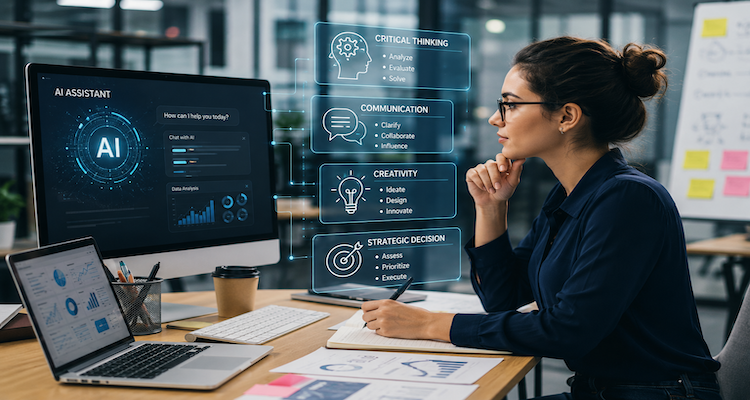
Critical thinking. Communication. Creativity. Judgment. Adaptability.
These are not the skills being replaced by AI. They are the skills becoming more valuable because of it.
This content is published for informational or entertainment purposes. Facts, opinions, or references may evolve over time, and readers are encouraged to verify details from reliable sources.