










How AI Is Redefining Productivity Beyond Speed and Efficiency
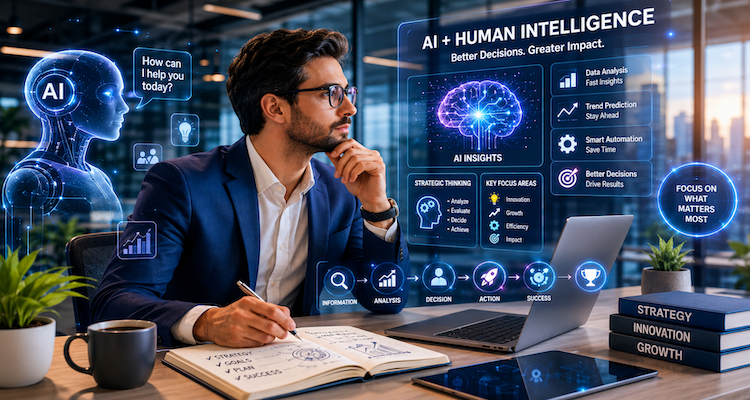
For decades, productivity was measured by a relatively simple formula: how much work a person could complete in a given amount of time. Faster output, fewer delays, and greater efficiency were considered clear indicators of success. But as artificial intelligence becomes a routine part of everyday work, that definition is beginning to change.
The shift is subtle but significant. AI can now draft emails, summarize meetings, generate reports, analyze data, and assist with research in minutes. Tasks that once consumed hours can often be completed with a few prompts. As a result, the conversation around productivity is moving away from how much work people do and toward something more complex: the value of the decisions, ideas, and outcomes they create.
This transformation is influencing workplaces, industries, and individual careers in ways that extend far beyond automation. The most important question is no longer whether work gets done faster. It is whether humans are spending their time on the work that matters most.
When More Output No Longer Means More Productivity
The traditional productivity model emerged during industrial and administrative eras when measurable output was the primary goal. Factories counted units produced. Offices tracked reports completed, calls made, or hours worked.
AI disrupts this logic because it can dramatically increase output without necessarily increasing value.
A marketing team, for example, can generate dozens of campaign concepts in a single afternoon using AI tools. A consultant can create multiple report drafts in a fraction of the usual time. A software developer can receive coding assistance that accelerates routine programming tasks.
Yet producing more content, more reports, or more code does not automatically create better results.
Organizations are increasingly discovering that productivity gains from AI depend less on the technology itself and more on how effectively people direct, evaluate, and improve what AI produces. In many cases, judgment becomes more valuable than execution.
The Rise of Decision-Based Productivity
One of the most important changes AI introduces is a shift from execution-focused work to decision-focused work.
When machines handle routine tasks, human effort moves toward defining goals, evaluating options, identifying risks, and making strategic choices.
Consider a manager reviewing AI-generated analyses. The challenge is no longer gathering information manually. Instead, it is determining which insights matter, which assumptions are flawed, and which actions should follow.
The same pattern appears across industries. Writers spend more time refining ideas than drafting first versions. Designers focus on creative direction rather than repetitive production tasks. Analysts concentrate on interpreting results rather than collecting raw data.
In this environment, productivity increasingly reflects the quality of decisions rather than the volume of activity.
Why Critical Thinking Is Becoming a Productivity Skill
A common assumption is that AI makes work easier. In many cases it does. However, it also creates a new responsibility: verification.
AI systems can generate convincing answers, summaries, recommendations, and content. But they are not infallible. Errors, outdated information, misunderstandings, and contextual mistakes can still occur.
This creates an unexpected reality. The more AI assists with work, the more important critical thinking becomes.
Employees who can question outputs, recognize weaknesses, and apply contextual understanding often create greater value than those who simply accept AI-generated results. Productivity is no longer about reducing human involvement. It is about applying human judgment where it matters most.
The organizations benefiting most from AI are often those that combine automation with strong review processes rather than relying entirely on machine-generated outcomes.
The Hidden Productivity Advantage: Cognitive Capacity
One underappreciated aspect of AI is its impact on mental workload.
Many professionals spend significant portions of their day managing administrative tasks, searching for information, organizing notes, scheduling meetings, and handling repetitive communications. These activities consume attention even when they are not particularly difficult.
AI has the potential to reduce some of this cognitive burden.
When routine tasks require less mental energy, people can devote greater focus to problem-solving, innovation, relationship building, and strategic thinking. The productivity gain is not merely faster task completion. It is the ability to allocate human attention more effectively.
This distinction matters because attention is becoming one of the most valuable resources in modern work. As information volumes continue to grow, the ability to focus on high-impact activities may become a stronger competitive advantage than the ability to process large amounts of information manually.
How AI Is Changing Workplace Expectations
The adoption of AI is also influencing how organizations evaluate performance.
Historically, visible effort often served as evidence of productivity. Long hours, busy schedules, and constant activity were frequently associated with high performance.
AI challenges that perception.
If a professional can complete a task in twenty minutes that previously required two hours, should productivity be measured by time spent or value delivered?
Many companies are beginning to reconsider traditional metrics. Results, creativity, adaptability, and strategic contribution may become more important indicators than workload volume alone.
This transition could reshape career advancement as well. Employees who effectively collaborate with AI may achieve stronger outcomes than those who rely solely on manual processes, even if both invest similar amounts of effort.
The Risk of Mistaking Convenience for Productivity
While AI offers substantial benefits, it also introduces a potential trap: confusing convenience with effectiveness.
Fast answers can discourage deeper investigation. Automated summaries can reduce engagement with original sources. AI-generated recommendations may create a false sense of certainty.
Over time, excessive dependence on automation could weaken skills that remain essential, including critical reasoning, creativity, communication, and independent analysis.
True productivity involves achieving meaningful outcomes, not simply reducing effort.
The challenge for individuals and organizations is finding the right balance. AI should enhance human capabilities rather than replace the development of expertise and judgment.
Those who maintain that balance are likely to benefit most from the technology’s long-term potential.
A New Productivity Equation
The broader trend revealed by AI is that productivity is evolving from a measure of activity into a measure of impact.
For much of modern history, productivity rewarded efficiency. In the AI era, efficiency increasingly becomes a baseline expectation. What differentiates people is their ability to ask better questions, make smarter decisions, solve complex problems, and create original value.
This represents a profound cultural shift. Success may depend less on how quickly someone completes tasks and more on how effectively they use the time that automation creates.
As AI continues to spread across workplaces, schools, and industries, the meaning of productivity will likely keep evolving. The most productive individuals may not be those who work the fastest. They may be those who use AI to amplify distinctly human strengths, curiosity, judgment, creativity, and strategic thinking.
In that sense, AI is not simply changing how people work. It is changing what productive work actually means.
This content is published for informational or entertainment purposes. Facts, opinions, or references may evolve over time, and readers are encouraged to verify details from reliable sources.