










Why People Are Quietly Turning AI Into Their Second Brain
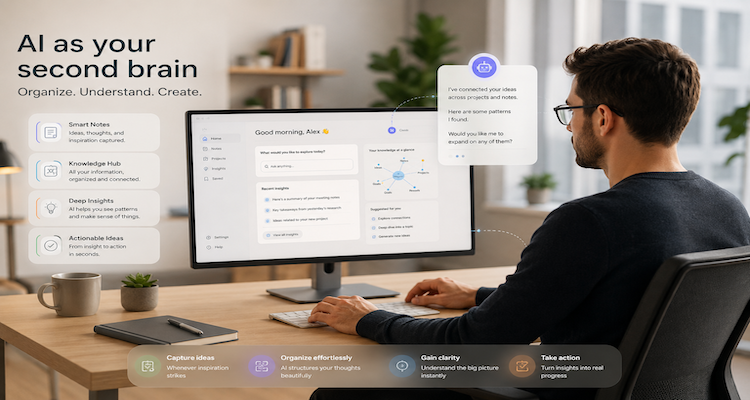
A growing number of people are using artificial intelligence for something far more personal than writing emails or generating images. They are relying on it to remember information, organize thoughts, make decisions, and even help them think through complex problems. In many cases, AI is becoming a kind of digital extension of the mind, a “second brain” that works alongside human memory.
This shift is happening quietly. It is not always visible in workplace reports or technology headlines. Yet it is becoming embedded in daily routines. Students use AI to summarize research notes. Professionals ask it to organize meeting insights. Entrepreneurs use it to capture ideas before they disappear. Individuals turn to AI to plan trips, track goals, and recall information they would otherwise forget.
What began as a productivity tool is evolving into something much more significant: a cognitive companion.
The Rise of Information Overload
The modern knowledge worker faces an unusual challenge. The problem is no longer finding information, it is managing it.
Emails, documents, articles, messages, videos, podcasts, and online discussions generate more information than most people can reasonably process. Valuable insights often disappear beneath an endless stream of new content.
Traditional productivity systems attempted to solve this problem through notebooks, calendars, task managers, and note-taking apps. While useful, these tools still require users to organize and retrieve information manually.
AI changes the equation.
Instead of simply storing information, modern AI systems can help interpret it. They can summarize lengthy documents, identify patterns across notes, answer questions about stored information, and connect ideas that might otherwise remain isolated.
For many users, this feels less like using software and more like consulting an external memory system.
Why AI Feels Different From Earlier Productivity Tools
The concept of a “second brain” is not new. Knowledge management methods have existed for decades. What makes AI different is its ability to interact with information conversationally.
Rather than searching through folders and files, users can ask direct questions:
“What were my main takeaways from last month’s meetings?”
“Can you summarize everything I learned about this topic?”
“What ideas have I explored related to this project?”
The interaction feels natural because it mirrors human conversation.
This reduces friction. People spend less time managing information and more time using it.
The result is a subtle but important behavioral change: individuals begin trusting AI to handle cognitive tasks that once required significant mental effort.
A New Relationship With Memory
Throughout history, technology has changed how humans remember things.
Writing reduced dependence on oral memory. Printing expanded access to knowledge. Search engines made information retrieval nearly instantaneous.
AI represents another step in that evolution.
Instead of memorizing facts, many people increasingly focus on understanding concepts while allowing digital systems to manage details. This does not necessarily make people less intelligent. Rather, it changes where mental energy is invested.
The ability to remember everything has never been the defining characteristic of expertise. Knowing how to interpret, evaluate, and apply knowledge often matters more.
AI is pushing that distinction into sharper focus.
The Hidden Shift From Information Retrieval to Thought Partnership
One of the most overlooked developments in AI adoption is that people are not merely using AI to find answers. They are using it to think.
Writers use AI to explore multiple perspectives before drafting an article. Managers test ideas before important meetings. Developers use AI to examine different technical approaches. Researchers employ it to identify gaps in their reasoning.
This behavior reveals an important insight: AI’s greatest impact may not be automation but augmentation.
The most valuable use cases often emerge when AI serves as a sounding board rather than a replacement for human judgment.
In practice, users are creating a feedback loop between their own thinking and machine-generated insights. The process can accelerate learning, clarify ideas, and expose blind spots.
That dynamic explains why many people describe AI less as a tool and more as a collaborator.
The Workplace Is Already Adapting
Organizations are beginning to recognize this shift.
Knowledge-intensive industries such as consulting, software development, marketing, research, and finance increasingly depend on workers who can process large amounts of information quickly.
Employees who effectively integrate AI into their workflows often gain an advantage. They can summarize reports faster, extract insights more efficiently, and reduce time spent on repetitive cognitive tasks.
Yet the most successful users are not necessarily those who ask AI to do all the work.
Instead, they combine human expertise with AI assistance. They use AI to accelerate analysis while maintaining responsibility for final decisions.
This balance is becoming an important professional skill.
The future workplace may place less emphasis on remembering information and greater emphasis on directing, evaluating, and refining AI-generated outputs.
The Risks of Outsourcing Too Much Thinking
The growing popularity of AI as a second brain raises legitimate concerns.
Human memory serves purposes beyond information storage. It helps build understanding, intuition, and expertise. If people become overly dependent on AI for every task, they risk weakening the cognitive processes that support critical thinking.
There is also the question of accuracy.
AI systems can provide useful summaries and suggestions, but they are not infallible. Information can be incomplete, outdated, or occasionally incorrect. Users who rely on AI without verification may make poor decisions based on flawed outputs.
Privacy remains another consideration. Personal notes, business plans, research materials, and sensitive information require careful handling when integrated into AI-assisted workflows.
The challenge is not whether AI should be used as a second brain. The challenge is learning how to use it responsibly.
What This Trend Reveals About Human Behavior
Perhaps the most interesting aspect of this phenomenon is what it says about people.
For years, technology companies focused on helping users access information faster. The rapid adoption of AI suggests that many individuals now want something different.
They want help making sense of information.
The value is no longer just retrieval. It is interpretation.
This shift reflects a deeper reality of the digital age. Information abundance has created a new scarcity: attention.
People are increasingly willing to delegate organizational and analytical tasks to AI because it helps them focus on what matters most.
In that sense, AI is not replacing human intelligence. It is becoming a tool for navigating a world where information has become overwhelming.
The Future of the Second Brain
The idea of AI as a second brain is still evolving.
Future systems may become better at remembering personal preferences, connecting ideas across projects, organizing lifelong knowledge, and providing context-aware assistance. They may function less like search engines and more like personalized knowledge companions.
Whether that future proves empowering or problematic will depend largely on how people use the technology.
The most productive path is unlikely to involve handing over all thinking to machines. Instead, it will involve creating a partnership in which AI handles information management while humans provide judgment, creativity, ethics, and context.
The quiet rise of AI as a second brain signals more than a technological trend. It reveals a broader shift in how people interact with knowledge itself. As information continues to expand, the ability to think with AI rather than simply use it may become one of the defining skills of the coming decade.
The information presented in this article is based on publicly available sources, reports, and factual material available at the time of publication. While efforts are made to ensure accuracy, details may change as new information emerges. The content is provided for general informational purposes only, and readers are advised to verify facts independently where necessary.