










Why Neighborhood Dependency Is Making a Quiet Comeback
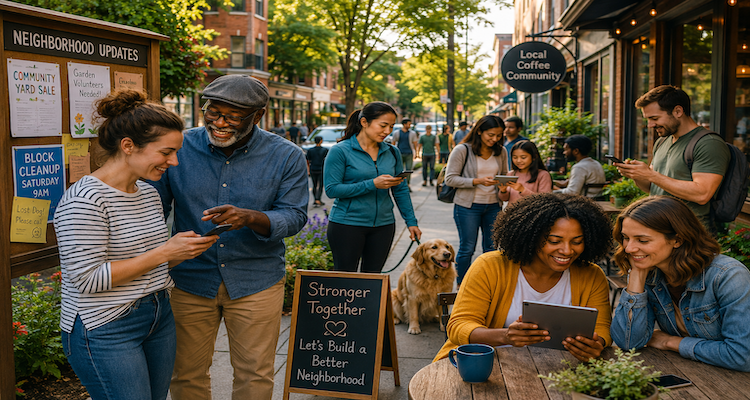
A curious contradiction is emerging in everyday life. People can communicate instantly across continents, order almost anything with a few taps, and access information at any hour. Yet many are finding themselves relying more not less on the people living nearby.
The shift is subtle enough to escape headlines. It does not look like a rejection of technology or a return to a pre-digital past. Instead, it reflects a growing recognition that convenience, resilience, and well-being often depend on local relationships that technology alone cannot replace.
From neighborhood messaging groups and community gardens to local parent networks and informal support systems, a renewed form of neighborhood dependency is taking shape. In a world that has never been more connected digitally, local human connections are quietly becoming valuable again.
The Limits of Infinite Connectivity
For years, technology promised greater independence. Food delivery reduced the need to know local shopkeepers. Remote work made proximity to colleagues less important. Online marketplaces expanded access beyond local businesses.
These developments undoubtedly created new freedoms. Yet they also revealed an unexpected limitation: digital connectivity does not always create practical support.
A social media network may connect thousands of people, but it cannot help carry groceries up several flights of stairs, keep an eye on a package during a vacation, or check on an elderly resident during a power outage. Many forms of assistance remain fundamentally local.
As people spend more time navigating complex economic, social, and environmental uncertainties, local relationships are increasingly viewed as valuable forms of security and support.
The Rise of Hyperlocal Communities
One of the strongest indicators of this shift is the growth of hyperlocal communities.
Neighborhood chat groups, community forums, local social networks, and resident associations have become common in many cities. While these platforms rely on technology, their purpose is distinctly local.
Residents use them to exchange recommendations, share resources, report safety concerns, organize events, and coordinate assistance. A missing pet, a borrowed tool, a childcare recommendation, or information about a nearby road closure often travels faster through neighborhood networks than through formal channels.
Technology, rather than replacing local communities, is increasingly acting as an infrastructure layer that helps neighborhoods function more effectively.
This represents an important change in how digital tools are being used. Instead of expanding connections endlessly outward, many people are using technology to strengthen connections closer to home.
Why Economic Pressures Are Reinforcing Local Dependence
Economic realities are also encouraging stronger neighborhood ties.
Rising living costs have pushed many households to seek practical ways of reducing expenses. Sharing resources within communities can offer meaningful advantages.
Carpooling, tool sharing, community buying groups, local marketplaces, and skill exchanges allow residents to access resources without purchasing everything individually.
A neighbor who knows plumbing, tutoring, gardening, or basic repairs can sometimes provide assistance more quickly and affordably than formal services.
This does not mean communities are replacing professional industries. Rather, they are creating complementary support networks that help people navigate economic uncertainty.
In many cases, neighborhood dependency is becoming less about necessity and more about efficiency.
Remote Work Has Changed the Geography of Relationships
The rise of remote and hybrid work has also reshaped social behavior.
For decades, many people’s strongest daily relationships were connected to workplaces. Colleagues often occupied more time than neighbors. Commutes created distance between professional and residential communities.
Remote work altered that pattern.
People spending more time near home naturally became more aware of their local surroundings. Coffee shops, parks, community centers, and neighborhood businesses gained new significance.
As daily life became more localized, opportunities for neighborhood interaction increased. Parents encountered other parents more frequently. Dog owners met during walks. Remote workers became regular customers at nearby establishments.
The result has been a gradual rebuilding of local familiarity that was often weakened during highly commute-oriented lifestyles.
Resilience Has Become a Community Asset
Perhaps the most important driver behind renewed neighborhood dependency is resilience.
Recent years have exposed vulnerabilities in highly interconnected systems. Supply disruptions, severe weather events, infrastructure challenges, and public emergencies have demonstrated that resilience often begins at the local level.
When larger systems face disruptions, nearby communities frequently become the first line of support.
Neighbors exchange information, share resources, assist vulnerable residents, and help maintain continuity during uncertain situations.
This reality has prompted many individuals, businesses, and urban planners to reconsider the value of community relationships.
Resilience is no longer viewed solely as an institutional responsibility. Increasingly, it is recognized as a social asset built through trust, familiarity, and cooperation among people living in close proximity.
The Hidden Shift: Trust Is Becoming More Local
One of the most significant yet underreported aspects of this trend involves trust.
For years, digital platforms encouraged people to think globally. Recommendations came from influencers, online reviews, and distant communities.
While those sources remain influential, many people are rediscovering the value of local trust networks.
A recommendation from a neighbor often carries a different level of credibility than an anonymous online review. Local knowledge tends to be context-specific, practical, and immediately relevant.
This shift suggests that trust may be evolving into a hybrid model. People still rely on digital information, but they increasingly validate decisions through local relationships.
The future may belong not to purely global networks or purely local communities, but to systems that combine both.
What This Means for Businesses and Communities
The return of neighborhood dependency carries implications beyond individual households.
Businesses that understand local relationships may find new opportunities for engagement. Community-oriented retail models, neighborhood events, local partnerships, and hyperlocal services can create stronger customer loyalty than purely transactional interactions.
Property developers and city planners are also paying greater attention to walkable neighborhoods, mixed-use developments, and public spaces that encourage social interaction.
The underlying goal is not nostalgia. It is functionality.
Communities that foster meaningful local relationships often create environments where people feel more supported, informed, and connected.
As urban populations continue to grow and digital technologies become even more sophisticated, the importance of physical community may increase rather than diminish.
A Connected Future That Feels Closer to Home
The return of neighborhood dependency does not signal a retreat from globalization or technology. It reflects an adjustment to the realities of modern life.
People are discovering that digital connectivity and local connection are not competing forces. In many cases, they strengthen one another.
Technology can introduce us to the world, but neighborhoods often help us navigate daily life.
The most interesting development may not be that people are reconnecting with their communities. It is that they are doing so while remaining more globally connected than any generation before them.
In a hyperconnected world, proximity is regaining value. The future may be increasingly digital, but it also appears likely to be more local than many expected.
This content is published for informational or entertainment purposes. Facts, opinions, or references may evolve over time, and readers are encouraged to verify details from reliable sources.