










Why Employers Are Asking Different Interview Questions Than Five Years Ago
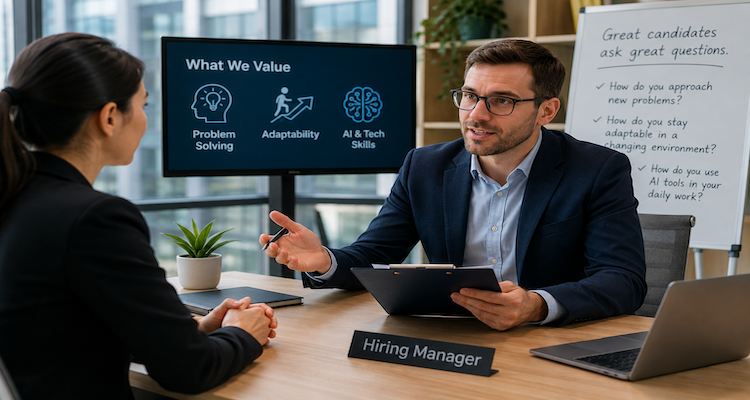
A candidate walks into an interview expecting familiar questions about strengths, weaknesses, and five-year career plans. Instead, they’re asked how they would use artificial intelligence to solve a routine problem, describe a time they changed their mind after receiving new evidence, or explain how they learn unfamiliar skills under pressure. The interview suddenly feels less like a test of preparation and more like a glimpse into how someone thinks.
This shift reflects a broader transformation in the workplace. As technology changes jobs faster than organizations can rewrite job descriptions, employers are becoming less interested in rehearsed answers and more interested in adaptability, judgment, and learning ability. The questions themselves reveal what businesses now value—and why yesterday’s interview strategies may no longer be enough.
Hiring for change instead of stability
Five years ago, many interviews focused heavily on experience. Employers wanted proof that candidates had already performed the same responsibilities they would handle in a new role. Experience still matters, but it is no longer the only measure of future success.
Many organizations now operate in environments where software, customer expectations, regulations, and business priorities evolve continuously. A role that exists today may look significantly different within a year. Hiring managers increasingly recognize that technical skills can become outdated, while curiosity, resilience, and problem-solving remain valuable across changing circumstances.
As a result, interview questions increasingly explore how candidates respond when there is no obvious answer. Employers want to understand how people think, not simply what they know.
The influence of artificial intelligence on interviews
The widespread adoption of AI has changed more than daily work, it has also changed hiring.
Recruiters know that applicants can use AI tools to improve résumés, draft cover letters, and even practice interview responses. That makes polished answers less reliable indicators of genuine ability.
Instead, interviewers often ask follow-up questions that require reflection rather than memorization. A candidate may be asked why they made a particular decision, how they evaluated conflicting information, or what assumptions they challenged while solving a problem.
In many knowledge-based roles, employers are also interested in how candidates work alongside AI rather than whether they use it at all. Someone who understands when to trust AI, and when to question its output—may be viewed more favorably than someone who simply knows how to generate impressive responses.
This subtle distinction reflects a larger workplace reality: technology increasingly amplifies human judgment rather than replacing it.
Behavioral questions are becoming more sophisticated
Behavioral interviewing is not new, but the focus has evolved.
Instead of asking candidates to describe leadership in broad terms, employers often explore how people handled uncertainty, conflict, changing priorities, or incomplete information.
Questions might revolve around situations such as:
- Managing a project when objectives suddenly changed.
- Learning a new skill under tight deadlines.
- Recovering from a significant mistake.
- Working effectively with people from different disciplines.
- Making decisions despite limited information.
These conversations provide insight into qualities that are difficult to measure on a résumé, including emotional intelligence, adaptability, accountability, and communication.
In an increasingly collaborative workplace, these qualities often determine long-term success more than technical expertise alone.
Employers are looking for evidence of continuous learning
One of the biggest changes in hiring is the growing emphasis on learning ability.
Organizations increasingly expect employees to acquire new skills throughout their careers rather than relying on qualifications earned years earlier. Certifications, online courses, side projects, and independent learning can all demonstrate a willingness to grow.
Interview questions now frequently explore how candidates stay informed, improve their skills, or approach unfamiliar challenges.
Rather than asking whether someone knows a particular software platform, an interviewer may ask how they learned previous technologies or adapted to major workplace changes.
This reflects an important shift in employer thinking. The capacity to learn may have become a stronger competitive advantage than existing knowledge alone.
Authenticity is replacing perfect answers
Many candidates still believe interviews reward flawless responses.
Ironically, experienced interviewers often become skeptical when every answer sounds perfectly rehearsed.
Employers increasingly appreciate candidates who acknowledge uncertainty, explain how they overcame setbacks, and demonstrate thoughtful self-awareness.
Discussing mistakes, lessons learned, or moments of professional growth can create greater credibility than presenting an unrealistic image of constant success.
This does not mean interviews have become informal. Instead, they have become more conversational, allowing employers to evaluate character alongside competence.
The rise of values-based hiring
Technical ability may secure an interview, but organizational culture increasingly influences hiring decisions.
Many companies now ask questions designed to understand personal motivations, collaboration style, ethical judgment, and alignment with workplace values.
For example, candidates may be asked how they respond when they disagree with leadership, balance competing priorities, or support colleagues during stressful situations.
These discussions help employers determine whether someone is likely to contribute positively to team dynamics rather than simply complete assigned tasks.
As remote and hybrid work continue across many industries, trust and communication have become even more important because managers cannot observe every interaction directly.
The hidden shift: Employers are evaluating decision-making, not just knowledge
Perhaps the most significant change is one that many candidates never notice.
Interview questions are increasingly designed to reveal the quality of a person’s decisions.
Knowledge has become more accessible than ever. Search engines, AI assistants, and workplace knowledge bases can provide information almost instantly. What cannot be outsourced as easily is the ability to evaluate that information, prioritize competing options, recognize risks, and make sound judgments.
This represents a profound shift in hiring philosophy.
Instead of asking, “Do you know the answer?” employers increasingly ask, “How would you figure it out?”
That subtle difference changes everything. It places greater value on reasoning, curiosity, adaptability, and practical judgment than on memorized facts.
Preparing for the next generation of interviews
Candidates who succeed in today’s interviews often prepare differently from those in the past.
Rather than memorizing dozens of standard responses, they reflect on meaningful experiences that demonstrate growth, resilience, collaboration, and learning. They practice explaining how they approached difficult situations instead of simply describing the outcome.
They also stay informed about industry developments, understand how AI affects their profession, and think critically about the role technology plays in decision-making.
The strongest interviews increasingly resemble professional conversations rather than formal examinations.
Looking ahead
Interview questions will continue evolving as work itself changes.
Emerging technologies, shifting business models, and changing employee expectations are reshaping what organizations value most. While technical expertise remains important, employers increasingly recognize that future success depends on qualities that are harder to automate: judgment, adaptability, communication, ethical reasoning, and continuous learning.
For job seekers, this change offers an important opportunity. The interview is becoming less about delivering perfect answers and more about demonstrating how they think, learn, and grow. In a workplace defined by constant change, those qualities may ultimately matter more than any single skill listed on a résumé.
The information presented in this article is based on publicly available sources, reports, and factual material available at the time of publication. While efforts are made to ensure accuracy, details may change as new information emerges. The content is provided for general informational purposes only, and readers are advised to verify facts independently where necessary.