









Why Dharma Is Finding New Relevance in an Age of Career Uncertainty
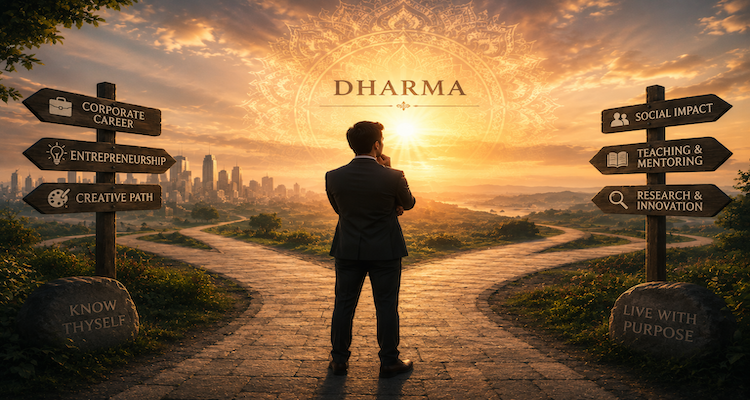
Career advice has never been more accessible, yet many people feel more uncertain about their professional paths than ever before. Young graduates face an overwhelming number of options. Mid-career professionals question whether success alone brings fulfillment. Even experienced executives increasingly speak about purpose, meaning, and alignment rather than promotions and salary growth.
This growing sense of career confusion is not simply a labor market issue. It reflects a deeper question: how should a person decide what kind of work is worth doing in the first place?
Surprisingly, an ancient concept from Indian philosophical traditions is re-entering modern conversations for precisely this reason. The idea of dharma, often loosely translated as duty, purpose, or right conduct—is gaining renewed relevance as people search for direction in a world where traditional career maps no longer exist.
The End of the Predictable Career Path
For much of the twentieth century, career progression followed a relatively clear structure. Education led to employment. Employment led to advancement. Advancement often brought financial stability and social recognition.
That model has weakened.
Industries transform rapidly. New technologies reshape job roles. Artificial intelligence is changing expectations across sectors. Workers are switching careers more frequently than previous generations. Skills that were valuable five years ago may need updating today.
The result is not merely economic uncertainty. It is psychological uncertainty.
Many people no longer struggle with a lack of opportunities. Instead, they struggle with an excess of possibilities. When countless career choices exist, deciding what to pursue becomes increasingly difficult.
This is where the concept of dharma offers an interesting lens.
Dharma Was Never Just About Religion
One reason dharma is often misunderstood is that it is frequently discussed only in religious contexts. Historically, however, the concept extends far beyond ritual or belief.
Across various Indian philosophical traditions, dharma has been understood as living in alignment with one’s responsibilities, nature, values, and role within a broader social and moral framework.
Rather than asking, “What job will make me successful?” dharma encourages a different question:
“What work allows me to contribute meaningfully while remaining true to my abilities and principles?”
That distinction may seem subtle, but it changes how career decisions are approached.
Success becomes one factor among many rather than the sole destination.
Why Career Confusion Is Fueling Interest in Purpose
A noticeable shift is taking place across workplaces, educational institutions, and professional development circles.
Career discussions increasingly include concepts such as purpose, values, impact, meaning, and personal alignment. Employees are not only evaluating compensation packages; many are also evaluating whether their work reflects who they want to become.
This trend helps explain why ancient ideas are resurfacing.
Dharma provides a framework that connects professional life with personal identity. Instead of treating work as separate from meaning, it suggests that meaningful work emerges when actions, responsibilities, and values become aligned.
For someone choosing between multiple career opportunities, this perspective offers a different decision-making tool. The question is no longer limited to income, prestige, or status. It expands to include contribution, fulfillment, and long-term sustainability.
The Hidden Problem of Infinite Choice
One of the most underreported causes of career anxiety is what psychologists and behavioral researchers often describe as the burden of excessive choice.
Digital platforms expose people to countless success stories every day. One person builds a startup. Another becomes a content creator. Someone else leaves corporate life to travel the world. Each path appears attractive from a distance.
The result is a constant comparison cycle.
Many individuals feel pressured to optimize every career decision, fearing they might miss a better opportunity elsewhere.
The ancient concept of dharma offers an alternative to endless comparison. It suggests that not every path is meant for every person.
What is right for one individual may not be right for another.
Viewed through this lens, career success becomes less about copying external models and more about understanding one’s own strengths, responsibilities, and circumstances.
That perspective can reduce the paralysis that often accompanies modern career decision-making.
A Shift From Achievement to Alignment
An important cultural shift is quietly unfolding.
For decades, achievement was often measured through visible markers such as job titles, income levels, and organizational status. While those factors remain important, many professionals now seek something more enduring.
Burnout discussions have become common. Conversations about work-life balance continue to evolve. Employees increasingly question whether constant productivity should be the primary measure of a successful life.
Dharma introduces the idea of alignment.
Alignment does not mean abandoning ambition. Rather, it means ensuring that ambition serves a purpose beyond accumulation.
A person may still pursue leadership, entrepreneurship, innovation, or financial growth. The difference is that these goals become connected to a broader sense of responsibility and meaning rather than existing solely for personal advancement.
What Makes This Moment Different
Ancient wisdom has often been revisited during periods of social transition. What makes the current moment distinctive is the scale of uncertainty people face simultaneously.
Technological disruption, shifting workplace expectations, remote work, gig economies, and changing educational pathways have all contributed to a rethinking of professional identity.
Many people are no longer asking, “What career should I choose?”
They are asking, “How should I live?”
That broader question naturally creates space for concepts like dharma.
Unlike conventional career advice, dharma does not offer a checklist or formula. Instead, it encourages ongoing reflection about responsibilities, talents, ethics, relationships, and contribution.
In a rapidly changing world, that flexibility may be one reason the concept continues to resonate.
Practical Lessons for Modern Professionals
The growing relevance of dharma does not require adopting a specific religious worldview. Its practical value lies in the questions it encourages people to ask.
Before making major career decisions, individuals might consider:
- Does this work align with my core values?
- Am I developing strengths that feel authentic to me?
- Does my work contribute something meaningful to others?
- Am I pursuing success according to my own definition or someone else’s expectations?
- Will this path remain meaningful beyond short-term rewards?
These questions cannot eliminate uncertainty. Few career decisions come with guarantees.
However, they can help individuals navigate complexity with greater clarity.
The Future of Career Guidance May Look Surprisingly Ancient
As workplaces continue to evolve, career guidance is also changing. Technical skills, networking, and professional development remain essential, but many people now seek deeper frameworks for making decisions.
This may explain why concepts that originated centuries ago continue to attract attention.
Dharma does not promise certainty in an uncertain world. What it offers is something potentially more valuable: a way of thinking about work that connects achievement with meaning, ambition with responsibility, and personal growth with contribution.
In an era defined by endless options, that perspective may be precisely why an ancient idea feels unexpectedly modern.
This content is published for informational or entertainment purposes. Facts, opinions, or references may evolve over time, and readers are encouraged to verify details from reliable sources.
Related News
- Why Mark Zuckerberg Visited Kainchi Dham: The Neem Karoli Baba Connection Behind a Silicon Valley Story
- Kainchi Dham: How a Himalayan Ashram Became a Global Spiritual Landmark
- How Religious Architecture Continues to Shape Human Emotions Long After Belief Fades
- The New Search for Silence and Why It Is Becoming a Spiritual Movement