










Why AI Fluency Is Becoming the New Digital Divide
A generation ago, the digital divide was easy to identify. Some people had access to the internet, while others did not. Governments, schools, and businesses spent decades working to close that gap through infrastructure, affordable devices, and digital literacy programs.
Today, a different divide is emerging, one that is far less visible but potentially more consequential. Internet access is no longer the primary differentiator. Increasingly, the advantage belongs to people who know how to work with artificial intelligence, while those who do not risk falling behind in education, employment, and everyday decision-making.
The shift is subtle because both groups may appear equally connected. They use the same devices, browse the same websites, and participate in the same digital economy. Yet one group is learning how to amplify its productivity, creativity, and knowledge through AI tools, while the other is using technology much as it did five years ago. The difference between those experiences is beginning to reshape opportunities in ways that many people have not fully recognized.
Access Is No Longer the Main Barrier
For years, discussions about digital inequality focused on physical access to technology. The logic was straightforward: if people had reliable internet and a device, they could participate in modern society.
That assumption is becoming less complete.
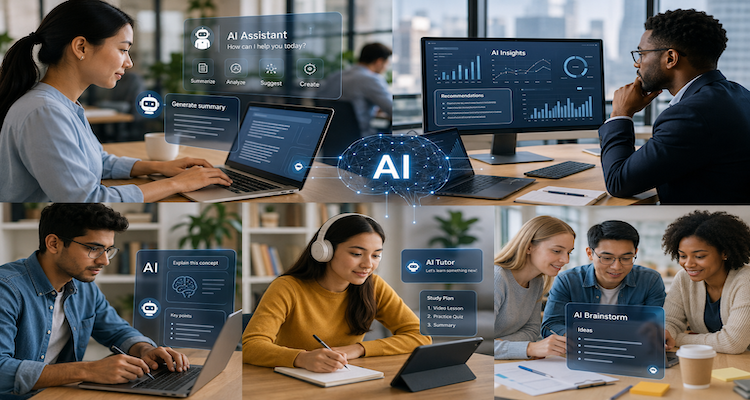
AI systems are changing how information is found, analyzed, and applied. Instead of searching through dozens of webpages, users can ask an AI assistant to summarize complex topics, generate ideas, explain difficult concepts, draft documents, or help solve problems. The value is no longer simply reaching information, it is knowing how to collaborate with intelligent tools to make better use of that information.
Two people can have identical internet access, yet achieve dramatically different outcomes depending on their ability to use AI effectively.
This is where the new divide begins.
What AI Fluency Actually Means
AI fluency is often misunderstood as technical expertise. In reality, most people do not need to become programmers or machine-learning engineers.
AI fluency is the ability to understand what AI can do, what it cannot do, and how to use it strategically.
It includes skills such as:
- Asking effective questions
- Evaluating AI-generated information critically
- Identifying errors and biases
- Combining human judgment with machine assistance
- Using AI tools to improve productivity and learning
- Understanding when AI should and should not be trusted
These skills increasingly resemble traditional forms of literacy. Just as reading and writing became essential for economic participation, AI fluency may become a foundational skill for navigating modern life.
The Workplace Is Already Rewarding AI Users
One of the clearest signs of this divide is appearing in workplaces.
Across industries, professionals are using AI to draft reports, analyze data, create marketing materials, summarize meetings, write software, conduct research, and streamline administrative tasks. Employees who understand how to integrate these tools into their workflows can often complete tasks faster and devote more time to higher-value work.
The advantage is not necessarily about replacing jobs. In many cases, it is about augmenting human capabilities.
A marketing specialist who knows how to use AI may produce more campaign concepts. A teacher may create customized lesson materials more efficiently. A small business owner may gain access to capabilities that once required an entire team.
The gap between AI-assisted workers and non-users can therefore become a productivity gap. Over time, productivity gaps often evolve into career and income gaps.
Education May Be Facing an Even Bigger Challenge
Schools and universities are confronting a complex question: should students use AI, and if so, how?
Some institutions initially treated AI primarily as a threat to academic integrity. Yet a growing number are recognizing that ignoring the technology may leave students unprepared for the environments they will eventually enter.
The challenge is that access alone does not guarantee meaningful use.
Students who understand how to use AI as a learning companion can receive explanations, explore ideas, practice skills, and accelerate research. Students who lack those skills may either avoid the technology entirely or use it in ways that undermine learning.
The result could be a new educational inequality, not based on devices or connectivity, but on the ability to leverage intelligent tools effectively.
The Hidden Shift From Information Scarcity to Information Leverage
One of the most important changes often goes unnoticed.
For decades, success in the digital age was linked to finding information. Search engines, databases, and online resources rewarded people who knew where to look.
AI changes that equation.
The emerging advantage comes from transforming information into action. The critical skill is no longer simply locating knowledge but interpreting, refining, and applying it with AI assistance.
This represents a profound shift in digital behavior.
The people who thrive may not be those with access to the most information. They may be those who can best combine human insight with machine-generated support.
That distinction helps explain why AI fluency feels different from traditional digital literacy. It is less about consumption and more about collaboration.
Why the Divide Could Become Self-Reinforcing
Perhaps the most significant concern is that AI fluency can compound over time.
Individuals who use AI effectively often learn faster, complete tasks more efficiently, and gain confidence experimenting with new technologies. Those benefits create additional opportunities to develop their skills.
Meanwhile, people who avoid AI or lack confidence using it may miss out on similar learning experiences. The gap gradually widens.
This pattern resembles previous technological transitions. Early adopters often gain advantages that become difficult to replicate later. The difference today is the speed at which AI capabilities are evolving.
As AI becomes embedded in search engines, productivity software, customer service systems, educational platforms, and creative tools, fluency may increasingly influence how people interact with nearly every aspect of digital life.
Businesses and Governments Cannot Ignore This Trend
Organizations are beginning to recognize that AI adoption is not simply a technology issue, it is a skills issue.
Companies investing heavily in AI tools may see limited benefits if employees lack the knowledge to use them effectively. Similarly, public investments in digital inclusion may become less effective if they focus only on connectivity while overlooking AI literacy.
Future workforce development programs may need to treat AI fluency as a core competency alongside reading, writing, digital literacy, and critical thinking.
The challenge is not ensuring that everyone uses AI. The challenge is ensuring that people have the opportunity to understand it well enough to make informed choices about how it fits into their lives.
The Most Important Skill May Still Be Human Judgment
Despite concerns about the growing divide, AI fluency is not simply about becoming dependent on technology.
In fact, the most valuable skill may be the ability to know when AI is wrong.
AI systems can generate convincing mistakes, incomplete answers, and misleading conclusions. Users who blindly trust outputs may create new risks for themselves and their organizations.
This is why AI fluency ultimately combines technical familiarity with human judgment. Critical thinking, creativity, communication, ethics, and contextual understanding remain essential.
The future is unlikely to belong exclusively to people who use AI or exclusively to those who rely on human expertise. It will belong to those who can combine both effectively.
A Divide That Deserves More Attention
The digital divide has not disappeared. It has evolved.
Access to technology remains important, but the next phase of inequality may be determined less by who can get online and more by who can navigate an AI-powered world with confidence and skill.
That shift carries implications for education, employment, economic mobility, and social participation. It also raises a broader question: if AI becomes a fundamental layer of modern life, should AI fluency be considered a basic form of literacy?
The answer may shape how societies prepare people for the next decade. The individuals, institutions, and communities that recognize this transition early are likely to be better positioned for a future where the most valuable resource is not access to technology, but the ability to use it wisely.
This content is published for informational or entertainment purposes. Facts, opinions, or references may evolve over time, and readers are encouraged to verify details from reliable sources.