









The Shift From Energy Efficiency to Energy Adaptability
For decades, the energy conversation was built around a simple goal: use less. Businesses upgraded equipment, households replaced inefficient appliances, and governments promoted conservation as the pathway toward a more sustainable future.
But the energy landscape is becoming more unpredictable. Extreme weather events, growing electricity demand, renewable energy integration, and the rise of digital infrastructure are changing the question. The challenge is no longer only about consuming fewer resources, it is about building systems that can adjust when conditions change.
The next phase of energy innovation may not be defined by maximum efficiency alone. It may be defined by adaptability: the ability to respond, recover, and operate intelligently in a world where energy availability, pricing, and demand are constantly shifting.
Why Energy Efficiency Is No Longer the Complete Solution
Energy efficiency transformed the way industries and consumers approached power consumption. Better insulation, efficient lighting, smart appliances, and advanced manufacturing systems helped reduce wasted energy and lower operational costs.
However, efficiency has a limitation: it assumes a relatively stable environment.
A highly efficient building can still struggle during a power outage. A factory designed to minimize energy use may face challenges when electricity prices fluctuate suddenly. A city with advanced energy-saving infrastructure may still experience pressure when demand rises faster than expected.
Efficiency answers the question: How can we use less energy?
Adaptability asks a broader question: How can we continue functioning when energy conditions change?
This difference is becoming increasingly important as energy systems become more complex.
The Rise of a More Flexible Energy World
Traditional energy systems were built around predictable patterns. Large power plants generated electricity, grids distributed it, and consumers used it according to established demand cycles.
Today, that model is evolving.
Renewable energy sources such as solar and wind introduce variability because generation depends on environmental conditions. Digital services, artificial intelligence systems, electric vehicles, and data centers are creating new forms of electricity demand. At the same time, climate-related disruptions are putting additional pressure on energy infrastructure.
The result is an energy environment where flexibility has become a valuable capability.
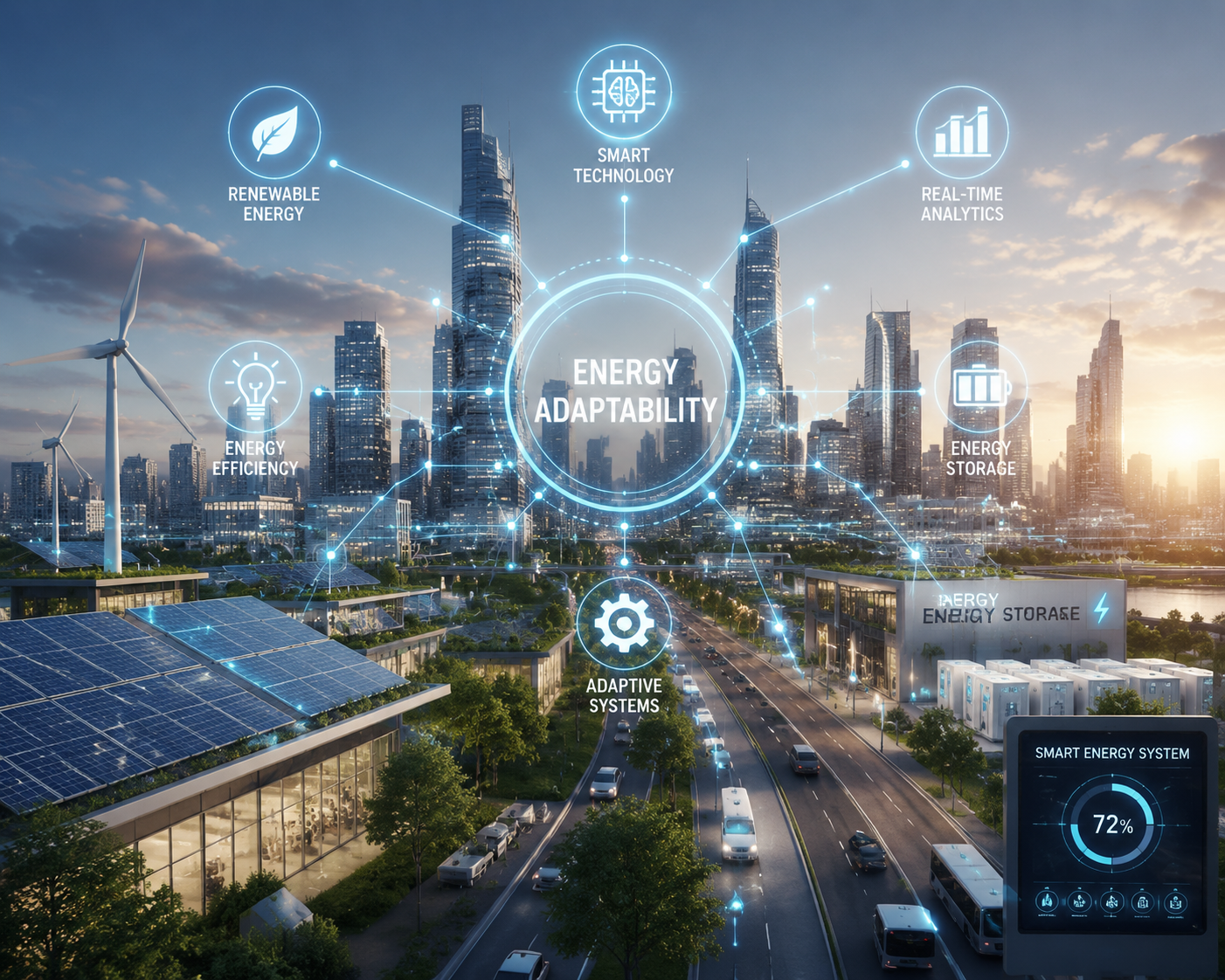
Energy adaptability means buildings, companies, and communities can adjust their behavior based on changing circumstances. This may involve shifting electricity usage during peak demand periods, storing energy for later use, using smart management systems, or combining multiple energy sources.
The goal is not simply to reduce consumption. It is to create resilience.
Businesses Are Rethinking Energy as a Strategic Asset
For many companies, energy was historically treated as an operational expense—something to manage and reduce.
That mindset is changing.
Manufacturers, technology companies, and large-scale infrastructure operators increasingly view energy management as part of business strategy. Reliable energy access can influence productivity, competitiveness, and long-term planning.
A company with adaptable energy systems may have advantages during periods of supply uncertainty. It can adjust operations, use stored power, or optimize consumption without completely disrupting business activities.
This shift is particularly important for industries that depend heavily on continuous electricity, including data centers, advanced manufacturing, healthcare facilities, and logistics networks.
Energy is becoming less like a fixed utility and more like a strategic resource that requires active management.
The Consumer Role in the New Energy Landscape
Energy adaptability is not only an industrial issue. It is also changing everyday consumer behavior.
Smart homes, connected devices, and energy management platforms are giving households more control over how and when they use electricity. Consumers may increasingly make decisions based on energy availability, pricing patterns, and environmental conditions.
For example, charging an electric vehicle during lower-demand periods or using stored household energy during peak times represents a shift from passive consumption to active participation.
The deeper change is behavioral.
People are moving from seeing energy as something that simply arrives through a wall socket to understanding it as a dynamic system they can influence.
This mirrors broader digital trends where users have gained more control over finances, communication, entertainment, and personal data. Energy may follow a similar path.
Artificial Intelligence and Automation Are Accelerating Adaptability
One of the biggest drivers behind energy adaptability is the growing role of intelligent systems.
Artificial intelligence and automation technologies can analyze energy patterns, predict demand, optimize equipment performance, and help organizations make faster decisions.
In commercial buildings, intelligent energy systems can adjust heating, cooling, and electricity use based on occupancy and conditions. In industrial environments, automated monitoring can identify inefficiencies and optimize operations.
However, technology alone cannot solve every challenge. Adaptable energy systems require investment, reliable infrastructure, cybersecurity protections, and thoughtful planning.
The future will likely depend on a combination of human decision-making and intelligent automation rather than technology replacing energy management entirely.
The Hidden Shift: From Saving Energy to Designing Resilience
The most important change may be philosophical.
Energy efficiency was largely about optimization getting the same results while using fewer resources.
Energy adaptability is about resilience maintaining performance despite uncertainty.
This represents a broader transformation happening across society. Organizations are increasingly valuing flexibility over rigid optimization. Supply chains are being redesigned for resilience. Workplaces are becoming more adaptable. Digital systems are being built to handle unexpected demand.
Energy is following the same pattern.
A system that operates perfectly under normal conditions may not be enough. The strongest systems are those that can adjust when normal conditions disappear.
Cities and Infrastructure Will Face the Biggest Test
Urban areas will play a central role in the transition toward adaptable energy systems.
Cities consume significant amounts of electricity and must manage growing populations, transportation changes, and climate-related challenges. Future urban planning may increasingly focus on energy flexibility alongside traditional infrastructure development.
Buildings may become more interactive with the grid. Transportation networks may influence electricity demand. Local energy generation and storage solutions may become more common.
The city of the future may not simply be energy-efficient. It may be energy-responsive.
What Comes Next for the Energy Transition
The move from efficiency to adaptability does not mean efficiency has become irrelevant. Reducing waste remains essential for affordability and sustainability.
Instead, adaptability represents the next layer of progress.
The future energy system will likely combine efficient technologies with flexible thinking. Businesses will need systems that can respond quickly. Consumers will need greater awareness of energy choices. Governments and infrastructure planners will need strategies that account for uncertainty.
The biggest advantage may belong to those who understand that energy is no longer just about consumption.
It is about readiness.
As the world becomes more connected and energy demands become more complex, the ability to adapt may become the defining feature of successful energy systems. The question of the future may not be who uses the least energy, but who can respond best when energy itself changes.
The information presented in this article is based on publicly available sources, reports, and factual material available at the time of publication. While efforts are made to ensure accuracy, details may change as new information emerges. The content is provided for general informational purposes only, and readers are advised to verify facts independently where necessary.
Related News
- The Energy Paradox of Efficiency: Why Using Less Electricity Does Not Always Mean Using Less Energy
- Why Extreme Weather Is Turning Electricity Resilience Into an Everyday Consumer Issue
- Why Energy Independence Is Becoming a Household Decision, Not Just a National Strategy
- The Hidden Energy Cost of Keeping Everything Available Instantly