










The Internet’s New Folklore: How Digital Legends Are Replacing Traditional Ghost Stories
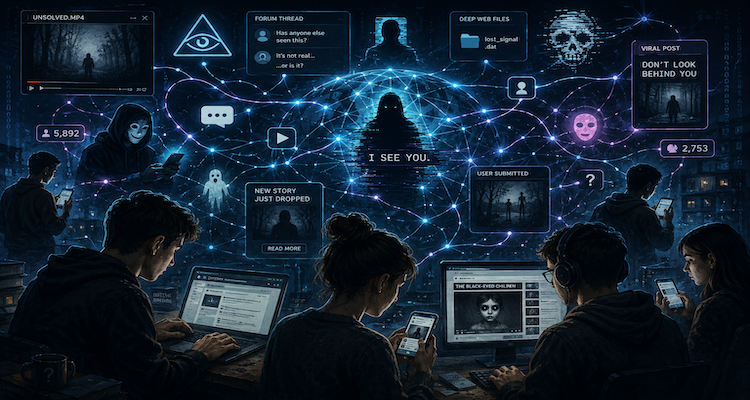
A generation ago, ghost stories traveled through families, neighborhoods, and late-night conversations. They were tied to abandoned houses, local legends, and places that seemed to hold secrets. Today, many of those stories still exist, but a different kind of folklore has emerged. It spreads not through campfires or community gatherings but through social media feeds, forums, video platforms, and group chats.
The internet has become a vast storytelling ecosystem where mysterious figures, unexplained events, and unsettling narratives can appear, evolve, and spread across the globe within hours. What once belonged to local culture now belongs to digital culture. And increasingly, these online legends are serving the same purpose that ghost stories once did: helping people make sense of uncertainty, fear, and the unknown.
The shift reveals something deeper than changing technology. It highlights how human beings continue to create myths, even in an age defined by information.
The Rise of Digital Mythmaking
Every culture develops stories that sit somewhere between fact and fiction. Traditional folklore often emerged to explain strange events, warn against danger, or reinforce social values. Ghosts, monsters, and mysterious creatures reflected collective fears and beliefs.
The internet has not eliminated this tendency. Instead, it has accelerated it.
Online communities frequently create narratives around unexplained videos, anonymous posts, strange websites, unusual sounds, or mysterious online personalities. Some begin as jokes. Others emerge from misunderstandings or creative fiction. Yet many evolve into shared stories that thousands—or even millions, of people participate in shaping.
Unlike traditional folklore, digital legends are rarely tied to a specific location. Their setting is often the internet itself. A mysterious account, an unexplained image, or a disturbing piece of content can become the modern equivalent of a haunted house.
The result is a form of storytelling uniquely suited to the digital age: collaborative, constantly evolving, and globally accessible.
Why People Are Drawn to Online Legends
The popularity of digital folklore is not simply about entertainment. It reflects several psychological and cultural needs.
Humans are naturally attracted to mystery. Unanswered questions create curiosity, and curiosity drives engagement. Online legends often thrive because they leave room for interpretation. People enjoy investigating clues, debating explanations, and contributing their own theories.
There is also a social element. Participating in a shared mystery creates a sense of belonging. Online communities form around unexplained phenomena much as previous generations gathered around local stories and urban legends.
Perhaps most importantly, digital legends provide a way to explore uncertainty in a controlled environment. They allow people to confront fear, ambiguity, and the unknown without facing real-world danger.
In that sense, the function of folklore has changed far less than its delivery mechanism.
From Campfire Stories to Algorithms
One of the most significant differences between traditional and digital folklore is how stories spread.
Historically, legends moved slowly. Stories were passed from one person to another, often changing slightly with each retelling. Geographic boundaries limited their reach.
Today, recommendation algorithms can amplify mysterious content almost instantly. A strange video uploaded by an unknown creator may attract global attention within days. Platforms reward engagement, and mystery naturally encourages comments, speculation, and sharing.
This creates an environment where legends can evolve at unprecedented speed.
A story no longer needs decades to become part of popular culture. It can emerge, peak, transform, and fade within a matter of weeks. Yet despite this rapid cycle, some digital legends develop remarkable staying power, becoming recognizable cultural references for years.
The speed of distribution has changed. The underlying storytelling impulse remains remarkably familiar.
The Blurred Line Between Fiction and Reality
Digital folklore introduces a challenge that traditional ghost stories rarely faced on the same scale: distinguishing fiction from reality.
In earlier eras, many listeners understood that local legends occupied a gray area between belief and storytelling. Online environments, however, often blur these boundaries more aggressively.
Sophisticated editing tools, artificial intelligence, anonymous publishing, and viral sharing can make fictional narratives appear authentic. At the same time, genuine mysteries can become exaggerated through speculation.
This ambiguity is part of what makes digital legends so compelling. Audiences are often less interested in definitive answers than in the possibility that an answer exists somewhere just beyond reach.
The phenomenon reflects a broader cultural shift. In an era of information abundance, uncertainty has become a form of entertainment.
What Digital Folklore Reveals About Modern Society
The most revealing aspect of internet folklore is not the stories themselves but what they say about the people who create and share them.
Traditional ghost stories often reflected fears of isolation, death, wilderness, or social disruption. Modern digital legends frequently reflect concerns about surveillance, artificial intelligence, online identity, misinformation, and technological change.
The monsters have changed because the anxieties have changed.
Stories involving mysterious algorithms, hidden online communities, unexplained digital behavior, or strange AI-generated content often resonate because they tap into contemporary uncertainties. People are trying to understand technologies that increasingly shape daily life but remain largely invisible.
This makes digital folklore a surprisingly useful cultural lens. It reveals the questions society is asking, even when clear answers are unavailable.
The Business of Mystery
Another feature that separates modern folklore from its historical predecessors is commercialization.
Content creators, streaming platforms, podcast networks, and social media personalities have discovered that mystery generates attention. Investigative storytelling, unexplained phenomena, and internet mysteries frequently attract highly engaged audiences.
This has created an ecosystem where folklore is not only shared but also monetized.
The trend reflects a broader shift in digital media. Audiences increasingly seek participatory experiences rather than passive consumption. They want to investigate, discuss, theorize, and contribute.
Mystery-driven content encourages exactly that behavior.
For media companies and creators, digital folklore demonstrates how storytelling remains one of the internet’s most powerful engagement tools.
The Hidden Insight: Folklore Never Disappeared
A common assumption is that scientific progress and technological advancement gradually replace myths and legends. The rise of digital folklore suggests something quite different.
Technology has not removed humanity’s need for storytelling. It has simply provided new environments in which stories can flourish.
In many ways, the internet functions like the world’s largest village square. People gather, exchange experiences, share warnings, create narratives, and collectively interpret events they do not fully understand.
The most important change is not that folklore survives online. It is that folklore has adapted to the architecture of digital life.
The internet has become both the storyteller and the setting.
What Comes Next for Digital Legends?
As artificial intelligence, virtual reality, and immersive digital spaces become more common, the next generation of folklore may look even more complex.
Future legends could emerge from synthetic media, AI-generated characters, virtual environments, or entirely digital experiences that blur the boundaries between participation and observation.
At the same time, growing public awareness of misinformation may make audiences more skeptical and more sophisticated in how they evaluate mysterious claims.
The tension between belief and skepticism is likely to remain central.
What seems certain is that folklore itself is unlikely to disappear. Human beings continue to seek stories that explain uncertainty, provoke curiosity, and create shared experiences.
The setting may have changed from dark forests and abandoned houses to servers, platforms, and digital networks. Yet the underlying impulse remains strikingly familiar.
The internet’s newest legends are not replacing folklore. They are becoming folklore.
This content is published for informational or entertainment purposes. Facts, opinions, or references may evolve over time, and readers are encouraged to verify details from reliable sources.