








Beneath the Surface: How Cave Wildlife Thrives in Earth’s Darkest Ecosystems
The fascination is understandable. Caves represent some of Earth’s most extreme habitats: perpetually dark, often nutrient-poor, and remarkably isolated. Yet these environments support an astonishing diversity of species that have evolved remarkable adaptations over millions of years. Their existence is reshaping our understanding of resilience, evolution, and the hidden interconnectedness of ecosystems.
What happens in these underground worlds matters far beyond cave entrances.
Life Without Light
Sunlight powers most ecosystems on Earth. Plants convert solar energy into food through photosynthesis, forming the foundation of nearly every terrestrial food web.
Caves operate differently.
Deep cave zones exist in permanent darkness, a region scientists call the aphotic zone. Here, photosynthesis is impossible. Organisms survive through alternative energy pathways, relying on organic material washed in by water, nutrients carried by animals such as bats, or microbial communities capable of deriving energy from chemical reactions.
This scarcity has produced some of nature’s most extraordinary specialists.
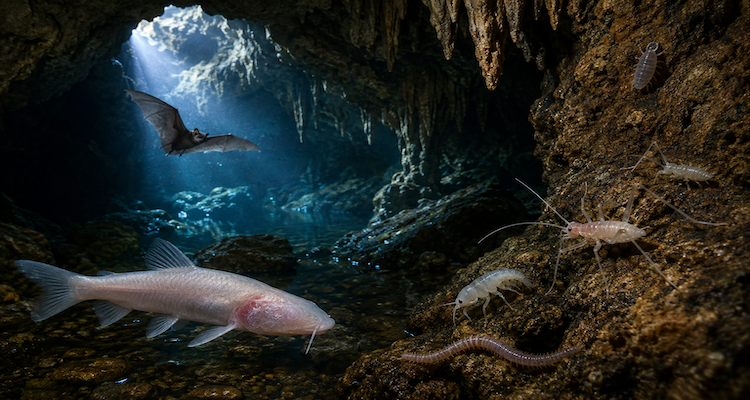
Many cave-dwelling animals, known as troglobites, have abandoned traits unnecessary for survival underground. Eyes may shrink or disappear entirely. Pigmentation often fades, leaving species translucent or ghostly white. In contrast, other senses become highly refined. Enhanced touch, smell, vibration detection, and chemical sensing allow these animals to navigate complete darkness with remarkable precision.
Blind cave fish, cave salamanders, spiders, crustaceans, and insects exemplify this evolutionary trade-off. Rather than becoming “less evolved,” these species demonstrate evolution’s ability to optimize survival under radically different conditions.
Evolution in Isolation
Caves function like natural laboratories of evolution.
Separated by rock barriers and isolated for thousands, or sometimes millions, of years, cave populations often evolve independently. Even neighboring cave systems may harbor species found nowhere else on Earth.
This extreme isolation makes subterranean biodiversity exceptionally unique and exceptionally vulnerable.
The olm, a rare aquatic salamander native to parts of southeastern Europe, has become an icon of cave adaptation. Living in underground waters for decades, the species can survive extended periods with little food and possesses sensory capabilities adapted to perpetual darkness.
Similarly, numerous cave fish species across Asia, the Americas, and Australia exhibit convergent evolution, developing similar traits despite evolving independently. Such patterns provide scientists with valuable insights into genetics, adaptation, and evolutionary processes.
Researchers studying cave organisms have even explored how the loss of eyesight occurs at the genetic level, offering broader clues about developmental biology and inherited traits.
The Hidden Engineers of Underground Ecosystems
When people imagine cave wildlife, bats often come to mind first, and for good reason.
Bats serve as ecological engineers in many cave systems. Their guano, or accumulated droppings, forms the nutritional foundation for entire subterranean food webs. Beetles, fungi, microbes, worms, and numerous invertebrates depend directly or indirectly on these nutrient deposits.
Without bats, many cave ecosystems would collapse.
This relationship illustrates a powerful ecological principle: seemingly isolated environments often depend on connections to the outside world.
Water infiltration, seasonal flooding, surface vegetation, and animal movements all influence cave biodiversity. Disturbances above ground—such as deforestation, agricultural runoff, mining, or urban expansion, can rapidly alter underground habitats.
The health of cave wildlife therefore reflects the health of surrounding landscapes.
Why Interest in Cave Wildlife Is Growing
Scientific interest in cave ecosystems has intensified for several reasons.
First, caves remain among the least explored habitats on Earth. New species continue to be discovered regularly, even in regions considered well studied. Advances in DNA analysis, remote sensing, and environmental sampling are revealing biodiversity that traditional surveys often missed.
Second, caves offer clues about life in extreme environments elsewhere in the universe.
Astrobiologists studying Mars and icy moons such as Europa have identified underground habitats as potential refuges for microbial life. Because cave microorganisms on Earth survive with limited energy, high mineral concentrations, and complete darkness, they provide valuable analogues for extraterrestrial research.
The search for life beyond Earth may depend partly on lessons learned underground.
Third, cave ecosystems are emerging as important indicators of environmental change. Because many subterranean species are highly specialized and sensitive to disturbance, shifts in cave biodiversity can signal broader ecological problems, including groundwater contamination and climate-driven alterations in water availability.
A Conservation Challenge Hidden in Plain Sight
Despite their importance, cave ecosystems face growing pressure.
Tourism has introduced both awareness and risk. Popular cave destinations can experience habitat disturbance from artificial lighting, infrastructure development, noise, and increased human traffic. Even seemingly minor changes in temperature or humidity may affect sensitive species.
White-nose syndrome, a fungal disease devastating bat populations across North America, has highlighted how quickly subterranean ecosystems can be disrupted. Declines in bat populations affect not only caves but also agriculture and natural pest control systems above ground.
Groundwater extraction presents another challenge. Many cave species depend on stable underground water systems. Excessive pumping, pollution, and changing rainfall patterns can transform habitats that evolved over geological timescales.
One underappreciated reality is that cave conservation is inseparable from water conservation. Protecting aquifers, forests, wetlands, and surrounding landscapes often provides the greatest benefit to subterranean biodiversity.
What Cave Wildlife Reveals About Humanity
Perhaps the most profound lesson from cave ecosystems is philosophical rather than biological.
Humans tend to value what we can see. Forests, coral reefs, and charismatic wildlife attract attention because they are visible and familiar. Cave ecosystems challenge that instinct. Entire communities of organisms exist beyond ordinary human experience, quietly performing ecological functions that sustain broader environmental systems.
Their existence reminds us that much of Earth’s biodiversity remains hidden.
As environmental pressures intensify globally, the fate of cave wildlife underscores an increasingly important truth: ecosystems do not operate in isolation. What happens on the surface reverberates underground, and what happens underground can ultimately shape the health of landscapes, water resources, and species above.
In Earth’s darkest places, life has evolved not only to survive, but to flourish. Understanding that resilience may prove essential as humanity navigates its own uncertain environmental future.
This content is published for informational or entertainment purposes. Facts, opinions, or references may evolve over time, and readers are encouraged to verify details from reliable sources.