










Why Smaller, Smarter AI Models Could Shape the Next Era of Technology
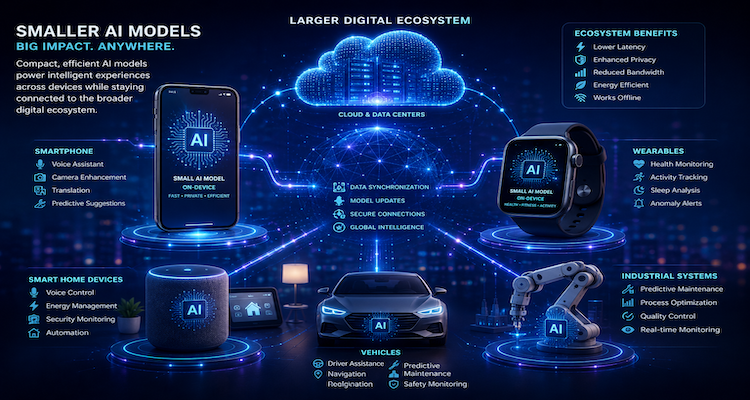
A quiet shift is taking place in artificial intelligence. For the past few years, attention has largely focused on building bigger models with more data, more computing power, and increasingly impressive capabilities. The race toward scale became a defining feature of the AI industry, with companies competing to create systems that could process vast amounts of information and perform an ever-expanding range of tasks.
Yet a different trend is beginning to emerge. Instead of asking how large AI models can become, researchers, businesses, and developers are increasingly asking how small they can be while still delivering meaningful results. That change in thinking could have profound implications for the future of technology.
The next major chapter of AI may not belong to the largest systems in giant data centers. It may belong to smaller, smarter models designed to run efficiently, respond quickly, and solve specific problems closer to where people actually use technology.
The Growing Limits of Bigger AI
Large AI models have demonstrated remarkable capabilities. They can generate text, create images, write code, summarize documents, and assist with complex decision-making tasks. Their success has helped accelerate AI adoption across industries.
However, scale comes with challenges.
Training and operating massive AI systems requires significant computing resources, energy consumption, and infrastructure investment. For many organizations, the cost of deploying large models at scale remains a major obstacle. Even when access is available through cloud services, latency, privacy concerns, and ongoing operational expenses can limit practical applications.
As AI becomes more integrated into everyday products, efficiency is becoming just as important as capability.
A smartphone user does not necessarily need a model capable of handling every conceivable task. A factory sensor may only need to detect equipment failures. A medical device might require rapid analysis of a specific type of data. In many cases, highly specialized intelligence can deliver greater value than a general-purpose system.
Why Smaller Models Are Gaining Momentum
Advances in AI architecture, training methods, and optimization techniques have made it possible for smaller models to achieve performance levels that were once associated only with much larger systems.
Developers are finding ways to compress knowledge, improve efficiency, and focus models on particular tasks. Rather than attempting to know everything, these models are trained to excel in narrower domains.
This shift mirrors a broader pattern in technology history.
Early computers occupied entire rooms. Over time, innovation focused not only on increasing power but also on making devices smaller, cheaper, and more accessible. Smartphones eventually placed capabilities once limited to powerful desktop systems into people’s pockets.
AI appears to be entering a similar phase.
Instead of concentrating intelligence exclusively in centralized cloud systems, companies are increasingly exploring how AI can operate directly on personal devices, industrial equipment, vehicles, and edge computing systems.
The Rise of On-Device Intelligence
One of the most significant advantages of smaller AI models is their ability to run locally.
When AI operates directly on a device, several benefits emerge. Responses can be faster because information does not need to travel to remote servers. Privacy can improve because sensitive data remains on the device. Reliability may also increase because certain functions can continue even without a stable internet connection.
This approach is becoming increasingly relevant as consumers grow more aware of how their personal information is collected and processed.
Smartphones, laptops, wearable devices, and smart home products are beginning to incorporate AI features that work locally rather than relying entirely on cloud-based systems. The result is a more responsive and potentially more private user experience.
For businesses, local AI can also reduce cloud computing costs and improve operational efficiency.
A Different Kind of Competitive Advantage
One of the most overlooked developments in AI is that the future may not be determined solely by who builds the largest model.
Competitive advantage could increasingly come from who builds the most useful model.
A smaller AI system designed specifically for legal research, industrial maintenance, financial analysis, or customer support may outperform a larger general-purpose model in its area of expertise. Organizations are beginning to recognize that effectiveness often depends on context rather than scale alone.
This creates opportunities for startups, specialized software providers, and industry-specific innovators.
Instead of competing directly with technology giants, smaller companies can focus on solving highly specific problems with targeted AI systems. That may lead to a more diverse and competitive AI ecosystem than many observers anticipated.
The Hidden Insight: AI Is Becoming Infrastructure
Perhaps the most important shift is not technological but conceptual.
Many people still think of AI as a product they interact with directly. Increasingly, AI is becoming infrastructure.
Just as internet connectivity quietly powers countless services without users constantly thinking about it, future AI may operate in the background. It could optimize logistics networks, manage energy consumption, personalize educational experiences, enhance cybersecurity systems, and support healthcare workflows without drawing attention to itself.
Smaller models accelerate this transition because they can be embedded into devices, applications, and business processes more easily than massive cloud-dependent systems.
In other words, the future of AI may be less visible but far more widespread.
What This Means for Consumers
For consumers, smaller AI models could make technology feel more natural and less intrusive.
Devices may become faster, more personalized, and more capable of functioning independently. Features such as voice assistants, predictive tools, language translation, accessibility services, and productivity applications could operate with greater speed and privacy.
The change may also help expand access to AI.
Large-scale cloud infrastructure is expensive and not equally available around the world. Efficient models that run on modest hardware could make advanced AI capabilities accessible to a much broader population, including regions where computing resources are limited.
That democratization could become one of the most important long-term impacts of the smaller-model movement.
Challenges Still Remain
Smaller models are not a universal solution.
Large AI systems will continue to play an important role in research, scientific discovery, enterprise applications, and highly complex tasks requiring extensive reasoning and broad knowledge.
The challenge for developers is finding the right balance between capability and efficiency.
In some cases, hybrid approaches may become common. Large models could handle demanding workloads in centralized environments while smaller models manage everyday tasks on devices and at the network edge.
This layered approach would allow organizations to benefit from both power and efficiency.
The Future May Be Defined by Intelligent Efficiency
The history of technology often rewards solutions that combine performance with practicality. AI is unlikely to be an exception.
While headlines frequently focus on the race to build larger and more powerful systems, a parallel race is emerging, one centered on efficiency, accessibility, and real-world usability. Smaller AI models are becoming increasingly capable, and their ability to operate where people live, work, and interact with technology may prove transformative.
The most influential AI systems of the next decade may not be the ones with the largest parameter counts. They may be the ones that fit seamlessly into everyday life, solve specific problems exceptionally well, and deliver intelligence wherever it is needed.
If that trend continues, the future of technology may depend less on how big AI becomes and more on how intelligently it can be scaled down.
The information presented in this article is based on publicly available sources, reports, and factual material available at the time of publication. While efforts are made to ensure accuracy, details may change as new information emerges. The content is provided for general informational purposes only, and readers are advised to verify facts independently where necessary.