







Why Seeing a Place Before It Was Built Can Feel So Strange
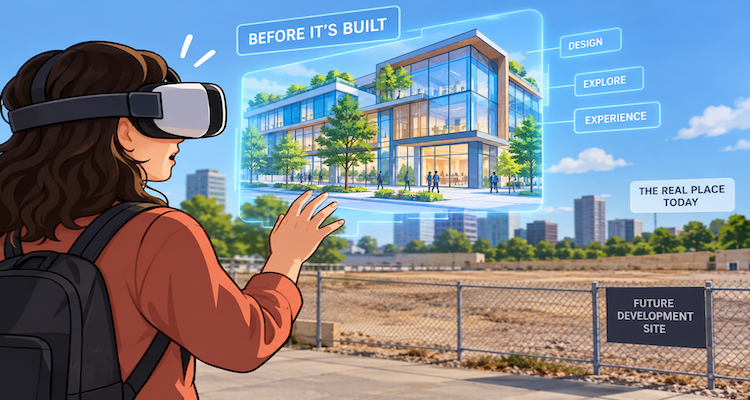
A building can exist as a set of drawings, measurements and computer files long before anyone can walk through it. Yet increasingly, people can experience that future space as though they are already standing inside it.
Architectural visualization, virtual reality (VR), 3D environments and increasingly AI-assisted design tools can turn an unbuilt apartment, hotel, office, museum or neighborhood into something that feels surprisingly present. You can look around, judge distances, imagine where furniture would sit and develop a sense of what it might feel like to move through the finished place.
That experience can produce a peculiar psychological tension: you know the place does not exist yet, but parts of your perception begin treating it as a place that already exists.
Research on virtual environments helps explain why. The phenomenon is not simply about increasingly realistic graphics. It involves spatial perception, mental imagery, movement, expectation and what researchers call presence the subjective feeling of being somewhere even when technology is generating the environment.
The interesting consequence is that digital representations of buildings are no longer merely pictures of future spaces. In the right conditions, they can become temporary experiences of those spaces.
Key Takeaways
- Virtual environments can make an unbuilt place feel spatially present before construction begins.
- The feeling depends on movement, sensory cues and interaction, not visual realism alone.
- Research shows immersive VR can improve understanding of three-dimensional architectural designs.
- Knowing an environment is artificial does not necessarily prevent the brain from responding to it as a place.
- AI and real-time 3D tools are making future spaces increasingly easy to explore before they physically exist.
The Strange Part Is Not That We Believe It
Most people wearing a VR headset do not literally believe the virtual building has suddenly appeared around them.
The strange sensation is subtler.
A person can simultaneously understand, intellectually, that they are standing in a room or sitting at a desk wearing a headset while experiencing the virtual environment from a first-person perspective. Research into VR has long described this as presence, the subjective sensation of being located within the depicted environment.
That distinction matters.
If someone sees a photograph of an unfinished building, they remain clearly outside it. A 3D model viewed interactively is different. The viewer can turn, walk, change position and inspect the relationship between objects.
The representation begins behaving less like an image and more like a space.
That is particularly important for architecture because buildings are experienced through movement. A floor plan can tell you that a corridor is three metres long. A perspective rendering can show what it looks like. But walking through a simulated version can give you another kind of information: how the corridor relates to your body and what becomes visible as you move.
Research comparing immersive and non-immersive virtual environments has found evidence that immersive VR can improve three-dimensional perception and produce stronger experiences of presence during design review.
Your Brain Does Not Need the Building to Exist
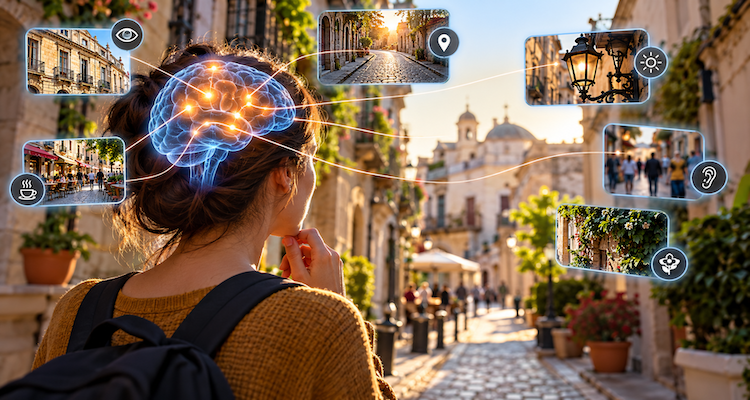
One reason this experience can feel so convincing is that perception is not simply a passive recording of the physical world.
The brain continually combines incoming sensory information with expectations, movement and prior knowledge. Researchers studying presence in virtual environments have proposed that the experience depends partly on how well the system’s sensory and motor signals correspond with what a person expects when moving through a space.
That helps explain why interaction matters.
Suppose you see a virtual doorway. If you can move toward it, turn your head and see the surrounding walls change perspective naturally, the environment provides a collection of cues associated with ordinary spatial experience.
The computer does not have to convince you philosophically that the room is real.
It only has to provide enough consistent information for your perceptual systems to operate as they normally would in a spatial environment.
This is one reason VR researchers distinguish between knowing something is artificial and experiencing it as present. Mel Slater’s influential work separated the feeling of “being there” place illusion from the feeling that the events occurring in the environment are plausible.
The two can coexist with conscious knowledge that the experience is simulated.
Why an Unbuilt Building Can Feel Familiar
There is another layer to the phenomenon: mental imagery.
Humans routinely construct internal representations of places they are not currently seeing. We can imagine a childhood bedroom, picture the route through an unfamiliar building, or visualize how a sofa might look against a wall.
Virtual environments externalize some of that process.
Instead of holding the imagined space entirely in the mind, the viewer receives a continuously changing visual representation that can be explored.
Research examining individual differences in mental imagery has specifically investigated the relationship between imagery ability and presence in immersive VR.
This creates an interesting bridge between imagination and perception.
A conventional architectural drawing asks the viewer to interpret information and construct a spatial understanding.
An immersive environment supplies much more of the spatial scene directly.
That does not make the virtual version identical to the finished building. It means the cognitive task can become different: rather than asking only What will this look like?, the viewer can begin asking How will I move through this?
That is a much more embodied question.
Why Realism Alone Does Not Explain the Effect
It is tempting to assume that the more photorealistic the virtual environment becomes, the more real it will feel.
The research is more complicated.
A 2023 study of VR-reconstructed architecture found no association between three-dimensional perception and presence across the immersive and non-immersive systems tested. The authors concluded that high levels of presence may depend on factors other than simply adding more sophisticated stereoscopic depth.
That is an important qualification for the technology industry.
A highly detailed model can still feel artificial if its interaction, scale, movement or environmental cues are wrong. Conversely, an environment does not necessarily require perfect photorealism to provide useful spatial understanding.
Recent work in architectural VR has reinforced the importance of environmental richness. A 2025 study involving construction practitioners found that adding contextual elements such as social activity, terrain, climatic cues and environmental details increased presence compared with a more bare virtual construction environment.
In other words, a convincing place is not necessarily the same thing as a highly detailed picture.
The environment has to make sense as a place.
This Changes How We Evaluate Buildings Before Construction
The practical importance becomes clearer when the technology is used for design rather than entertainment.
Architects, developers, contractors and future occupants can use immersive models to examine spaces before they are physically constructed. Instead of relying entirely on plans, elevations, static renders and physical models, stakeholders can explore proposed environments at approximately human scale.
A 2006 study comparing employees’ experiences of a virtual model of their future office with the completed building found that the VR model was useful for decision-making about the future workplace.
More recent architectural research has similarly explored immersive VR combined with Building Information Modeling (BIM), allowing future users and investors to experience proposed residential environments before construction. One 2025 pilot study involved 23 participants across 10 single-family house projects and described VR as a way to let users experience unbuilt environments from a human-scale perspective. The researchers also explicitly described the work as a pilot requiring further research.
This distinction is important.
VR does not eliminate uncertainty from architecture. It changes the type of uncertainty people can investigate.
A client may discover that a room feels smaller than expected. A designer may notice an awkward sightline. A future occupant may recognize that a circulation route does not feel intuitive.
Those observations can be difficult to obtain from a conventional drawing.
The Technology Is Moving From Rendering to Simulation
This is where today’s technology becomes particularly interesting.
Real-time 3D platforms can already support architectural visualization, interactive environments, VR and collaborative design workflows. Unreal Engine, for example, provides dedicated architectural visualization and VR-related workflows, including tools for interactive design environments and collaborative viewing.
The significance is not simply that computers can render attractive buildings.
The larger shift is from showing a proposed place toward allowing people to interact with a proposed place.
That distinction becomes even more consequential as AI-assisted tools make it easier to generate, modify and explore 3D environments.
Instead of producing one final rendering, future design workflows can increasingly involve rapidly generating alternatives: different layouts, materials, lighting conditions, furniture arrangements or spatial configurations.
The result could be a design process in which people experience multiple possible futures before choosing one.
That is fundamentally different from looking at a finished architectural illustration.
But the Virtual Place Can Also Mislead
The psychological strength of these environments is also their limitation.
A convincing simulation can make a proposed space feel more certain than it actually is.
The finished building may have different acoustics, lighting, temperatures, materials, smells, surface textures, construction tolerances or surrounding activity. A rendering can also omit inconvenient details simply because they were not modeled.
Even immersive VR cannot reproduce every physical property of a future building.
This is why researchers have emphasized the need to establish whether information gathered in immersive environments corresponds sufficiently to real-world environments before relying on it for design and operational decisions. Studies comparing immersive virtual and physical built environments have found promising similarities for some tasks, but they do not establish that virtual experience is universally equivalent to physical experience.
There is another important limitation: presence is subjective.
People do not all experience virtual environments in exactly the same way. Mental imagery ability, previous VR experience, interaction design and sensory characteristics can influence the experience.
So a virtual walkthrough should be treated as another source of design information not as a perfect preview of the future.
Why the Experience Can Stay With You
The most intriguing part may come after the headset is removed.
Once a person has explored a virtual building from a first-person perspective, the place can become mentally easier to imagine. The person has not merely seen an image; they have performed movements within a spatial representation.
Research has even investigated whether people can construct coherent spatial knowledge of architecture through virtual exploration without physically being present. In one study involving auditory virtual reality, participants who were blind were able to construct spatial mental maps of simulated architectural environments, although differences between virtual and real navigation remained.
That finding points toward a broader idea.
A place does not have to be physically occupied for a person to begin building a mental model of it.
Once that happens, the boundary between imagining a place and remembering a place you have never physically visited can become surprisingly thin.
The Future of “Seeing Before It Exists”
The most useful way to think about this technology is not that computers are making fake places look real.
They are making future places experienceable.
That distinction matters for architecture, construction, tourism, education, entertainment and many other fields. A destination can be previewed before travel. A building can be evaluated before construction. A workplace can be tested before employees move in. A proposed environment can be examined from the perspective of the people who will eventually use it.
Research into presence also suggests that the feeling of reality in virtual environments is more complicated than simply distinguishing “real” from “fake.” A 2026 paper argues that the sense of presence and the broader experience of reality may share interacting perceptual and cognitive mechanisms, while emphasizing that this remains an area of active research.
That does not mean virtual and physical reality have become interchangeable.
It means something more subtle has happened: our experience of a place can begin before the place itself does.
And as immersive systems become easier to build and AI makes alternative environments faster to create, the unusual feeling of visiting somewhere that does not yet exist may become an ordinary part of how humans design, evaluate and imagine the physical world.
Conclusion
Seeing an unbuilt place can feel strange because the mind does not require physical construction before it can begin forming a spatial experience.
A sufficiently interactive representation can provide perspective, movement, sensory cues and environmental relationships that allow a person to experience a future space from within. The conscious mind can know that the building is still only a model while perception responds to it as an environment.
That is the real significance of immersive architectural visualization.
It is not simply producing a better picture of tomorrow’s building. It is giving people an opportunity to encounter a possible future before deciding to build it.
For architects, developers and users, that may be the more important technological shift: the ability to test not only what a future place will look like, but what it may feel like to inhabit.
This content is published for informational or entertainment purposes. Facts, opinions, or references may evolve over time, and readers are encouraged to verify details from reliable sources.