










What Arjuna’s Crisis Before the Battle Teaches About Leadership Under Pressure
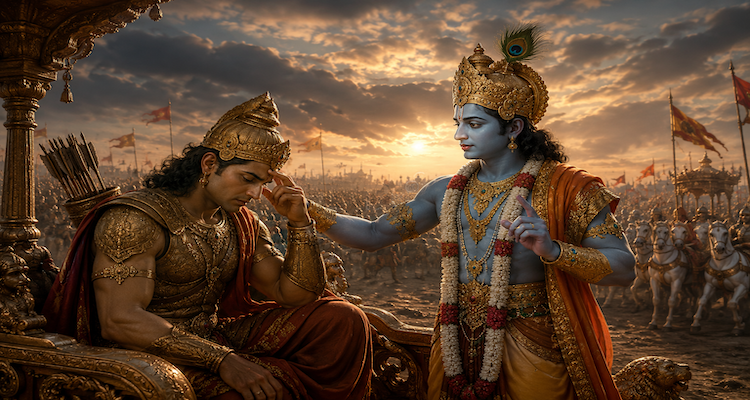
Leadership is often associated with confidence, decisiveness, and the ability to inspire others. Yet one of the most enduring leadership lessons in human history begins with something very different: hesitation.
Moments before the great battle of Kurukshetra in the ancient Indian epic, the Bhagavad Gita, Arjuna, the most skilled warrior among the Pandavas, experiences a profound crisis. Standing between two armies, he is overwhelmed by doubt, emotional conflict, and moral uncertainty. He questions not only the battle before him but also his role within it.
At first glance, Arjuna’s hesitation may appear to be a sign of weakness. Yet viewed through a modern leadership lens, his crisis reveals something far more valuable: the hidden challenges that emerge when responsibility, ethics, and human emotion collide.
As organizations, governments, and communities face increasingly complex decisions, Arjuna’s dilemma feels surprisingly contemporary.
The Unexpected Reality of Leadership: Clarity Does Not Always Come First
Many people imagine effective leaders as individuals who immediately know what to do. Reality is often different.
Executives making difficult business decisions, managers handling layoffs, healthcare leaders facing life-and-death choices, and public officials responding to crises frequently encounter situations where no option feels entirely right.
Arjuna’s conflict stems from precisely this problem. The battle is not simply a military confrontation. It involves family members, teachers, friends, and relatives standing on opposing sides. Victory itself carries emotional and moral consequences.
His hesitation highlights an uncomfortable truth: leadership challenges are rarely about choosing between good and bad. More often, they involve choosing between competing responsibilities.
This distinction remains relevant today because many leadership failures occur not from a lack of intelligence but from an inability to navigate conflicting values.
Why Self-Awareness Matters Before Action
One of the most remarkable aspects of Arjuna’s crisis is that he does not suppress his emotions.
He openly expresses fear, confusion, grief, and uncertainty. In many modern workplaces, leaders still feel pressure to project unwavering confidence. Vulnerability is often mistaken for incompetence.
Yet contemporary leadership thinking increasingly recognizes that self-awareness is a strength rather than a weakness.
Arjuna’s willingness to confront his internal conflict prevents him from acting impulsively. Instead of charging into battle without reflection, he pauses to examine the deeper implications of his decisions.
The lesson is significant: leaders who understand their emotions are often better equipped to manage them.
Self-awareness does not eliminate difficult choices. It helps ensure those choices are made consciously rather than reactively.
The Hidden Cost of Decision Avoidance
While reflection is valuable, Arjuna’s story also reveals the dangers of becoming trapped in indecision.
His emotional struggle reaches a point where he considers abandoning his responsibilities altogether. He contemplates walking away from the battlefield despite the larger consequences that such a decision would create.
This tension mirrors a challenge found across modern organizations.
Leaders frequently encounter situations where uncertainty encourages delay. Decisions are postponed, difficult conversations are avoided, and strategic changes are deferred because the risks feel uncomfortable.
However, leadership often requires recognizing that inaction is itself a decision.
One of the central themes of the Gita is not blind action but purposeful action. Arjuna is encouraged to move forward only after understanding his responsibilities and aligning them with a broader sense of duty.
The message remains relevant because organizations rarely suffer only from poor decisions. They can also suffer from decisions that were never made.
Duty Versus Personal Preference
Modern leadership discussions often focus on personal ambition, influence, and achievement.
Arjuna’s crisis introduces a different perspective.
His struggle is not about personal success. It is about duty.
The Sanskrit concept of dharma, often interpreted as responsibility, purpose, or righteous duty, forms the foundation of the dialogue between Arjuna and Krishna.
The conversation suggests that leadership is not merely about what a person wants to do. It is also about what circumstances require them to do.
This idea can feel uncomfortable in a culture that often prioritizes personal fulfillment above collective responsibility.
Yet many respected leaders earn trust precisely because they act in service of something larger than themselves. Whether leading a company, a team, or a community, credibility grows when decisions are guided by principles rather than convenience.
A Leadership Insight That Feels Increasingly Relevant
One of the most overlooked lessons in Arjuna’s story concerns mental overload.
His breakdown occurs because multiple identities collide at once. He is simultaneously a warrior, student, family member, friend, and moral individual.
Modern professionals experience similar pressures.
A manager may also be a parent. An entrepreneur may also be a caregiver. A corporate leader may be balancing shareholder expectations with employee wellbeing and social responsibility.
The result is a phenomenon that many workplaces now recognize: decision fatigue caused by competing identities and expectations.
Arjuna’s crisis can therefore be understood not only as a spiritual struggle but also as an early illustration of cognitive overload.
The broader insight is that leadership challenges increasingly arise from complexity rather than capability. Many leaders know how to solve problems. The harder task is determining which responsibilities deserve priority when multiple obligations compete for attention.
The Difference Between Confidence and Conviction
A common misunderstanding about leadership is that confidence should always come first.
Arjuna’s story suggests the opposite.
Throughout the dialogue, the objective is not to make Arjuna fearless. It is to help him develop conviction.
Confidence often depends on certainty. Conviction depends on values.
Leaders who rely solely on confidence can become vulnerable when circumstances change. Leaders guided by conviction can adapt because their actions are rooted in principles rather than predictions.
This distinction explains why some individuals remain effective during periods of uncertainty. They may not know exactly what will happen next, but they understand what they stand for.
In an era marked by rapid technological change, economic disruption, and social transformation, conviction may be becoming a more valuable leadership trait than confidence itself.
Why Arjuna’s Crisis Continues to Resonate
Thousands of years after it was first told, Arjuna’s dilemma continues to attract readers, executives, educators, and leadership thinkers because it addresses a universal challenge.
Every meaningful leadership journey eventually encounters uncertainty.
The question is not whether leaders will face moments of doubt. The question is how they respond when those moments arrive.
Arjuna’s crisis demonstrates that hesitation can be a source of insight, self-awareness can strengthen judgment, and ethical reflection can improve decision-making. Most importantly, it reminds us that leadership is not the absence of inner conflict.
It is the ability to move forward responsibly despite it.
The enduring power of the Bhagavad Gita lies in this paradox. One of history’s most influential leadership lessons begins not with certainty, but with a leader questioning everything. And perhaps that is precisely why it remains relevant today.
This content is published for informational or entertainment purposes. Facts, opinions, or references may evolve over time, and readers are encouraged to verify details from reliable sources.