










Decision-making has quietly become one of the most exhausting parts of modern life.
Most people are not making life-changing choices every day, yet many still end their evenings mentally drained. The cause is not necessarily workload, complexity, or pressure. It is often the sheer volume of decisions that now compete for attention, from responding to messages and choosing what to consume online to managing careers, finances, relationships, and personal goals.
Psychologists describe this phenomenon as decision fatigue, a state in which the quality of decisions can decline after a long period of choice-making. While the concept is widely discussed in business, productivity, and behavioral science, an unexpected source of insight is attracting renewed attention: the Bhagavad Gita.
Written thousands of years ago and set on the battlefield of Kurukshetra, the Bhagavad Gita is commonly viewed as a spiritual text. Yet its enduring appeal may lie in something surprisingly practical. At its core, it is a conversation about uncertainty, responsibility, and the burden of making difficult choices when the consequences matter.
As modern life generates more options than ever before, some readers are discovering that the Gita offers a framework not for making every decision easier, but for reducing the mental strain that surrounds them.
The Hidden Cost of Too Many Choices
For much of human history, daily life involved relatively limited choices. Social roles, occupations, and community expectations often provided clear structures.
Today, the opposite is true.
People are encouraged to optimize nearly everything. Career paths can change multiple times. Entertainment choices are virtually endless. Social media constantly exposes individuals to alternative lifestyles, opinions, and opportunities. Even routine decisions can feel loaded with significance.
This abundance of options creates a paradox. More freedom often means more uncertainty.
The result is a cycle many people recognize: endless comparison, fear of making the wrong choice, second-guessing decisions already made, and mental exhaustion before meaningful action even begins.
The Bhagavad Gita approaches this challenge from an angle rarely emphasized in contemporary productivity advice.
Arjuna’s Crisis Was Not a Lack of Information
The central figure of the Gita, Arjuna, faces a profound dilemma before the battle of Kurukshetra. He is overwhelmed, conflicted, and unable to act.
Importantly, his problem is not ignorance.
He understands the situation. He knows the people involved. He recognizes the stakes.
What paralyzes him is the emotional weight of the decision.
This distinction feels remarkably relevant today.
Many modern decision-makers are not struggling because they lack information. In fact, they often have too much of it. Research, reviews, expert opinions, social commentary, and endless online advice can create a state where clarity becomes harder rather than easier to achieve.
The Gita suggests that information alone does not resolve uncertainty. A person also needs a framework for understanding responsibility, values, and purpose.
Without that framework, more information can simply create more confusion.
The Principle That Changes the Conversation
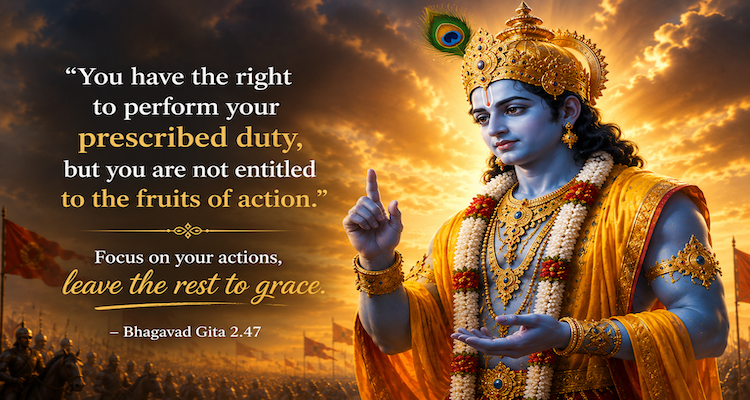
One of the Gita’s most discussed teachings is the idea of focusing on action rather than attachment to outcomes.
This concept is often misunderstood as indifference toward results. In reality, it encourages commitment to responsible action while recognizing that not every outcome can be controlled.
This distinction matters because much of decision fatigue stems from trying to predict and manage every possible future consequence.
Should someone change careers?
Start a business?
Move to a new city?
Invest in a new skill?
Many people become trapped not by the decision itself but by the endless attempt to guarantee a perfect outcome.
The Gita proposes a different perspective: focus on making the most thoughtful decision possible based on values, responsibilities, and available knowledge. Then direct energy toward action rather than obsessive prediction.
For many readers, this shift can reduce the mental burden of decision-making because it separates what can be controlled from what cannot.
Why This Teaching Feels Increasingly Relevant
Interest in ancient philosophical and spiritual traditions has grown alongside concerns about stress, burnout, and information overload.
This is not necessarily a rejection of modern psychology or neuroscience. Instead, many people appear to be combining contemporary knowledge with older frameworks that address meaning and human behavior.
The Bhagavad Gita fits naturally into this trend because it deals with questions that remain surprisingly unchanged:
How should people act when values conflict?
How can they move forward despite uncertainty?
What responsibilities matter most?
How can they avoid being overwhelmed by fear of failure?
These questions are as relevant in corporate boardrooms, startup environments, educational settings, and family life as they were in ancient narratives.
A Lesson for the Age of Infinite Optimization
Perhaps the most overlooked insight from the Bhagavad Gita is its challenge to the modern obsession with optimization.
Many contemporary systems encourage people to seek the perfect choice.
The perfect job.
The perfect relationship.
The perfect investment.
The perfect strategy.
The search itself can become exhausting.
The Gita points toward a different standard: alignment rather than perfection.
Instead of asking whether a decision guarantees success, the deeper question becomes whether it aligns with one’s responsibilities, principles, and long-term purpose.
This subtle shift can transform how decisions are approached.
A person no longer needs certainty before acting. They need sufficient clarity about what matters most.
That difference may seem small, but it changes the psychological experience of decision-making.
What This Means for Everyday Life
The practical value of the Bhagavad Gita is not that it provides direct answers to modern dilemmas.
It does not tell someone which career to choose or where to invest money.
Its contribution is more foundational.
It encourages people to identify their responsibilities clearly, understand their motivations honestly, and avoid becoming consumed by outcomes beyond their control.
Applied to daily life, this might mean:
Choosing a course of action based on values rather than external validation.
Accepting that uncertainty cannot be eliminated entirely.
Reducing endless comparison with alternative paths.
Recognizing when additional information is no longer improving a decision.
Acting with commitment once a thoughtful choice has been made.
These ideas are neither exclusively spiritual nor strictly philosophical. They are practical habits that can influence how individuals navigate an increasingly complex world.
Beyond Productivity: A Different Definition of Clarity
The growing interest in decision fatigue often focuses on efficiency. How can people make faster decisions? How can they preserve mental energy?
Those are useful questions.
The Bhagavad Gita introduces another one: how can people make decisions with greater inner clarity?
This may be why the text continues to resonate across cultures, professions, and generations. Its enduring relevance is not tied to a particular era or technology. Instead, it addresses a timeless human challenge, the tension between uncertainty and action.
Modern life may offer more choices than ever before, but the deeper struggle remains familiar. People still seek confidence, direction, and peace of mind when facing difficult decisions.
The Bhagavad Gita does not eliminate uncertainty. What it offers is a way to live and act within it.
And in an age defined by endless options, that wisdom may be more practical than many realize.
This content is published for informational or entertainment purposes. Facts, opinions, or references may evolve over time, and readers are encouraged to verify details from reliable sources.