







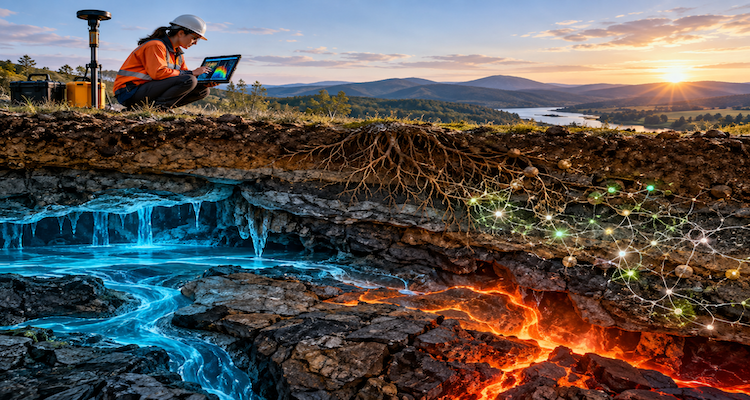
The New Science of Nature’s “Invisible Infrastructure”
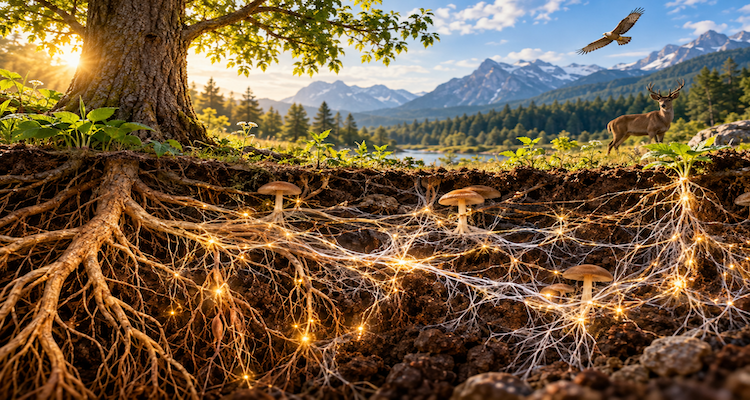
Walk through a forest and the most obvious structures are above ground: trunks, leaves, streams, flowers and animals. Yet many of the processes that keep that landscape functioning happen where almost nothing is visible.
Beneath the surface, roots interact with fungi and microorganisms, soil animals reshape the physical environment, organic matter is decomposed and nutrients are recycled. These processes influence plant productivity, carbon cycling, water movement and the ability of ecosystems to withstand environmental stress. Scientists increasingly describe such relationships as part of the ecological infrastructure that supports life.
The idea is not that nature has secretly built an engineered system beneath our feet. Rather, modern ecology is revealing that ecosystems depend on interconnected biological structures and processes that have historically been difficult to observe, measure and protect.
Recent research is making that hidden infrastructure easier to study and is also forcing scientists to reconsider some of the popular stories surrounding it.
Key Takeaways
- Soil biodiversity helps drive nutrient cycling, decomposition, plant productivity and other ecosystem functions.
- Mycorrhizal fungi form extensive underground networks that connect with plant roots and exchange resources.
- New imaging techniques are revealing how fungal networks actively build and organize themselves.
- Global mapping suggests important reservoirs of mycorrhizal fungal diversity remain poorly represented in protected areas.
- Popular claims about fungi acting as a universal “internet” between trees remain more uncertain than their public image suggests.
- Understanding hidden ecological infrastructure could change how agriculture, restoration and conservation are managed.
Nature’s Infrastructure Is Mostly Invisible
Infrastructure is usually associated with things humans build: roads, power grids, drainage systems and communication networks. Ecology has a different kind of infrastructure one created through relationships among organisms and the physical environment.
Soils are a particularly important example.
A 2026 review in Nature Reviews Biodiversity describes soil biodiversity as a key driver of ecosystem functions including nutrient cycling, decomposition of organic matter, plant productivity, climate regulation and pathogen control. The authors emphasize that research has increasingly connected small-scale interactions among plants, microorganisms and soil animals with ecosystem-level processes.
This changes the way soil can be understood.
It is not simply a material in which plants happen to grow. It is a living environment containing enormous biological diversity, chemical interactions and physical structures that collectively influence what happens above ground.
A 2025 PLOS Biology essay similarly describes soil organisms as supporting a wide range of ecosystem functions, including soil fertility and carbon sequestration, while noting that these communities are vulnerable to pressures associated with global environmental change.
The infrastructure metaphor is therefore useful—but only if it is understood as a scientific description of interconnected ecological functions rather than as evidence of a deliberately designed natural machine.
The Underground Partnership Between Roots and Fungi
Among the most fascinating components of this hidden system are mycorrhizal fungi.
Many plants form symbiotic relationships with these fungi. Fungal hyphae extend through soil beyond the immediate reach of plant roots, while the plant supplies carbon to the fungus. The fungal partner can help acquire nutrients and interact with the surrounding soil environment.
Research published in Nature in 2025 provided a striking new look at how one group of mycorrhizal fungi constructs its underground networks.
Researchers developed a specialized imaging system capable of tracking more than 500,000 fungal nodes and measured approximately 100,000 trajectories of cytoplasmic flow. They found that the fungi build their networks through self-regulating travelling waves, with growing fungal tips expanding the network while internal flows help transport resources.
That finding matters because it moves the discussion beyond the familiar image of fungal threads simply forming a passive web.
The network itself has dynamic structure.
The researchers found that fungal networks could maintain transport efficiency while adding loops and changing the dimensions of hyphal pathways. In engineering language, the system displays characteristics associated with exploration, connectivity and efficient transport but these properties arise from biological processes rather than deliberate engineering.
It is an example of how modern biological imaging is turning something previously almost impossible to see into something scientists can observe and quantify.
The “Wood-Wide Web” Needs a Scientific Reality Check
The underground fungal world has also generated one of ecology’s most popular metaphors: the “wood-wide web.”
The metaphor suggests that forests may contain fungal networks through which trees exchange resources or information. Some experiments have investigated such connections, and fungal networks linking plant roots are a genuine biological phenomenon.
But the broader claims have become more complicated.
A 2024 systematic review of research on common mycorrhizal networks found substantial gaps in the evidence. The researchers noted that relatively few studies met stringent experimental criteria and that much of the existing work has been conducted under controlled conditions rather than in complex field ecosystems.
A separate 2025 meta-analysis found no overall evidence that being connected through an intact arbuscular mycorrhizal network increased the biomass of linked plants compared with severed-network controls, although some other effects were observed and the available evidence remains limited.
That distinction is important.
There is strong evidence that mycorrhizal fungi form biologically important relationships with plants. It is a much bigger claim to say that forests operate as a coordinated underground communication network in which trees routinely “talk” to one another.
The first statement is well established. The second requires much more careful qualification.
This is precisely where the new science of invisible infrastructure becomes interesting: researchers are discovering that the real system may be more complex than the popular metaphor.
A Global Map of an Underground World
One of the biggest changes in ecological research is the ability to study hidden biological systems at global scale.
In 2025, researchers published a global analysis of mycorrhizal fungal diversity in Nature. The study used 25,000 geolocated soil samples containing more than 2.8 billion fungal DNA sequences to predict the distribution of mycorrhizal fungal richness and rarity across terrestrial ecosystems.
The researchers identified areas containing particularly diverse or endemic fungal communities and compared those areas with protected regions.
Their analysis estimated that less than 10% of predicted mycorrhizal fungal richness hotspots currently fall within protected areas.
This does not mean that 90% of all underground fungal diversity is unprotected. The finding concerns predicted richness hotspots, and the researchers themselves describe global knowledge of fungal distributions as incomplete.
But the result illustrates a major conservation problem: protecting what can be easily seen is not necessarily the same as protecting the biological systems that make ecosystems function.
A forest reserve can protect trees while still leaving important belowground ecological processes poorly measured.
Soil Animals Are Engineers Too
Fungi and microorganisms are not the only hidden builders.
Earthworms, termites, ants and other soil invertebrates physically alter the environments around them. Their tunnels, nests, feeding activity and movement can change soil structure and influence the movement of water, organic matter and nutrients.
A 2025 Nature study examined the global ecosystem effects of these “soil engineers.” The researchers investigated how structures created by termites, ants and earthworms contribute to ecosystem functions and examined the factors controlling those effects at global scale.
This expands the infrastructure analogy again.
A termite mound or earthworm tunnel is not infrastructure in the human sense. But biological activity can create physical structures that alter how an ecosystem works.
The important point is not the metaphor itself. It is the mechanism: organisms modify their environment, those modifications affect other organisms, and the combined effects can scale from microscopic interactions to landscape-level processes.
Why Scientists Are Looking Underground More Closely
There is also a practical reason for this growing interest.
If ecosystem function depends partly on biological communities that are poorly monitored, environmental management may miss important forms of degradation.
A 2025 Nature Reviews Biodiversity perspective noted that soil biodiversity has historically received less attention in conservation policy and highlighted barriers including limited monitoring infrastructure, expertise, data storage and data sharing. The authors also pointed to the inclusion of soil health within the Kunming-Montreal Global Biodiversity Framework as an important policy development.
Another 2025 paper in Nature Ecology & Evolution described the Global Soil Biodiversity Observatory initiative, which aims to develop standardized indicators and strengthen national monitoring of soil biodiversity.
The significance is straightforward: what cannot be measured is difficult to manage systematically.
For decades, biodiversity monitoring has often concentrated on visible organisms. Advances in DNA sequencing, imaging, computational modelling and standardized sampling are now making it increasingly possible to investigate biological systems hidden in soil.
From Forests to Farms
The implications extend beyond conservation.
Agriculture depends heavily on soil biological processes. Nutrient availability, decomposition, plant–microbe interactions and soil structure all influence agricultural productivity.
Recent research has therefore begun examining whether knowledge of mycorrhizal systems can be translated into agricultural practices.
A 2025 review in Plant Communications examined arbuscular mycorrhizal networks and discussed their potential roles in nutrient acquisition, plant stress responses and agricultural resilience. The authors also emphasized that important aspects of fungal plant communication and network functionality remain poorly understood.
That qualification matters.
It is tempting to move directly from “fungi influence plants” to “farmers can engineer fungal networks to solve agricultural problems.” Science has not established such a simple pathway.
Instead, the emerging opportunity is more measured: understanding soil communities may allow land managers to design practices that preserve or support useful biological functions rather than treating soil primarily as an inert growing medium.
The Next Infrastructure We Learn to See
The deeper lesson from this research is not that nature has a hidden internet beneath every forest.
It is that ecosystems are built from relationships that are easy to overlook.
A fungal hypha, a microbial community, an earthworm tunnel or a root–fungus association may appear insignificant when viewed individually. Yet networks of such interactions can influence nutrient movement, decomposition, plant performance, carbon cycling and ecosystem resilience.
Modern science is giving researchers increasingly powerful tools to investigate these systems from DNA sequencing and global biodiversity databases to automated microscopy and computational modelling.
The result is a change in perspective.
Conservation may increasingly have to ask not only which species are present, but also which biological relationships and processes keep an ecosystem functioning.
That is the real significance of nature’s “invisible infrastructure.” It is not a secret world hidden from science. It is a measurable biological foundation that science is only now learning to observe at the scale necessary to understand and potentially protect it.
Conclusion
Much of Earth’s ecological infrastructure does not have a visible shape.
It exists in the microscopic interactions of soil organisms, the branching structures of fungal hyphae, the activity of underground animals and the relationships connecting roots with their biological surroundings. New research is making some of these systems increasingly measurable, while simultaneously challenging simplified stories about how they work.
The most useful shift may therefore be conceptual: ecosystems should not be judged only by what appears above the ground.
The health of a forest, farm or landscape may depend just as much on the living systems beneath it and protecting those systems will require learning to see infrastructure that nature never built with concrete, steel or cables.
This content is published for informational or entertainment purposes. Facts, opinions, or references may evolve over time, and readers are encouraged to verify details from reliable sources.