








The Hidden Cost of AI Convenience and the Skills People May Stop Practicing
The appeal of artificial intelligence often comes down to one simple promise: less effort. Need an email drafted? AI can write it. Struggling to summarize a report? AI can condense it in seconds. Looking for ideas, answers, or even creative inspiration? AI is increasingly becoming the first stop.
That convenience is reshaping how people work, learn, and make decisions. Yet beneath the productivity gains lies a quieter question that receives far less attention: what happens to the skills we stop using when intelligent systems begin doing them for us?
History suggests that convenience rarely arrives without trade-offs. Calculators reduced the need for mental arithmetic. GPS navigation diminished the habit of reading maps. Streaming services changed how people discover and remember music. AI may represent the next—and perhaps most significant, shift in that pattern, affecting not just what people do, but how they think.
When Efficiency Becomes Dependence
The value of AI is undeniable. Businesses use it to accelerate workflows, students rely on it to organize information, and professionals employ it to streamline everything from coding to customer support.
The challenge emerges when assistance gradually becomes substitution.
Many everyday tasks involve more than producing an outcome. Writing an email requires organizing thoughts. Researching a topic involves evaluating sources. Brainstorming ideas demands exploration, reflection, and judgment. These activities build cognitive skills that often remain invisible until they begin to weaken.
If AI consistently performs the most mentally demanding parts of a task, people may still achieve the same result while engaging less deeply in the process.
The risk is not that humans become incapable overnight. Instead, skills can slowly erode through disuse, much like muscles that weaken when they are no longer exercised.
The Skills Most Vulnerable to Automation
Not every ability is equally at risk. Physical skills, emotional intelligence, and complex interpersonal communication remain deeply human strengths. However, several cognitive habits could face gradual decline.
Critical thinking is one example.
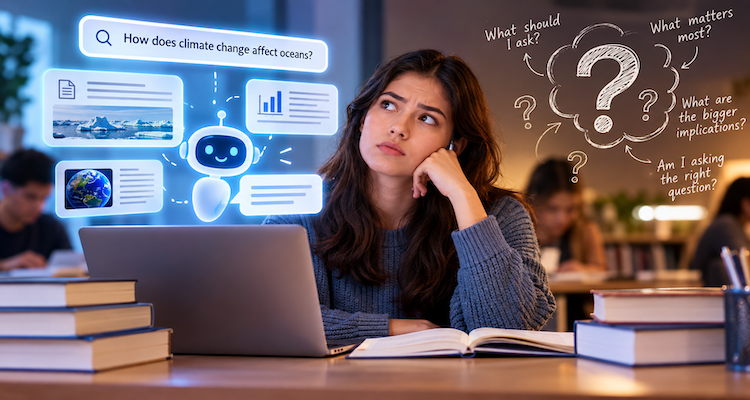
When AI generates persuasive answers instantly, users may become less likely to challenge assumptions, verify information, or explore alternative viewpoints. The convenience of receiving an answer can reduce the motivation to investigate whether it is the best answer.
Writing is another area of concern.
Many professionals now use AI to draft reports, presentations, emails, and marketing content. While this saves time, regular writing serves a broader purpose. It clarifies thinking, strengthens communication skills, and forces people to organize ideas logically. If AI handles most first drafts, individuals may practice those skills less frequently.
Problem-solving may also evolve.
Rather than working through challenges independently, people increasingly begin by asking AI for solutions. This approach is efficient, but it can shorten the struggle that often leads to deeper understanding and creativity.
The Hidden Shift from Knowing to Prompting
A subtle cultural change is emerging alongside AI adoption.
Traditionally, expertise was measured by what someone knew and how effectively they could apply that knowledge. Increasingly, value is shifting toward knowing how to access, direct, and refine information generated by intelligent systems.
This does not mean expertise becomes irrelevant. In fact, experts often use AI more effectively because they can evaluate outputs and recognize errors. However, it does change the nature of skill development.
A generation raised with AI may spend less time memorizing information and more time learning how to ask better questions.
That shift offers advantages, but it also creates a potential gap. If foundational knowledge becomes too shallow, people may struggle to recognize when AI-generated responses are incomplete, misleading, or simply wrong.
The ability to evaluate information may become more important than the ability to retrieve it.
Why This Moment Is Different from Past Technologies
Every major technology has altered human behavior. What makes AI different is its ability to imitate cognitive work rather than merely automate physical tasks.
Previous tools helped people do things faster. AI increasingly helps people think faster.
A calculator performs calculations. AI can draft arguments, generate strategies, summarize research, create content, and offer recommendations. The technology operates in areas traditionally associated with reasoning, communication, and creativity.
As a result, the trade-offs extend beyond productivity. They touch the very skills people have historically developed through practice and repetition.
This does not mean AI will replace human thinking. It does mean humans may need to become more intentional about preserving certain mental habits.
The Workplace Consequences Few Organizations Discuss
Many companies focus on how AI can improve efficiency, reduce costs, and increase output. These benefits are real and often substantial.
Yet organizations may face a longer-term challenge: maintaining expertise.
Junior employees traditionally learn through hands-on work. They draft documents, analyze data, conduct research, and solve smaller problems before advancing to more strategic responsibilities.
If AI assumes much of that foundational work, organizations may need new approaches to training and professional development.
A future workforce that relies heavily on AI-generated outputs could become highly productive in the short term while developing expertise more slowly over time.
This creates an interesting paradox. The tools designed to increase efficiency could also reduce opportunities for skill-building if used without careful oversight.
Forward-thinking organizations are beginning to recognize that AI should augment learning rather than replace it.
Creativity Is Changing, Not Disappearing
One common fear is that AI will make human creativity obsolete.
The reality appears more nuanced.
Creative work has always involved combining ideas, recognizing patterns, and refining concepts. AI can assist with many of these activities, generating drafts, concepts, and variations at remarkable speed.
However, creativity is not only about producing options. It is also about judgment, taste, context, and originality.
AI can suggest hundreds of ideas, but humans still determine which ideas matter, which align with cultural moments, and which resonate emotionally.
The future may belong less to those who create entirely without AI and more to those who know how to collaborate with it effectively.
In that sense, the challenge is not preserving creativity itself but preserving the human capabilities that make creativity meaningful.
The New Digital Literacy
Perhaps the most important insight is that society may be entering a new phase of digital literacy.
In the past, literacy involved reading and writing. Later, digital literacy included navigating computers, search engines, and online information.
The next stage may require something different: understanding when to rely on AI and when to think independently.
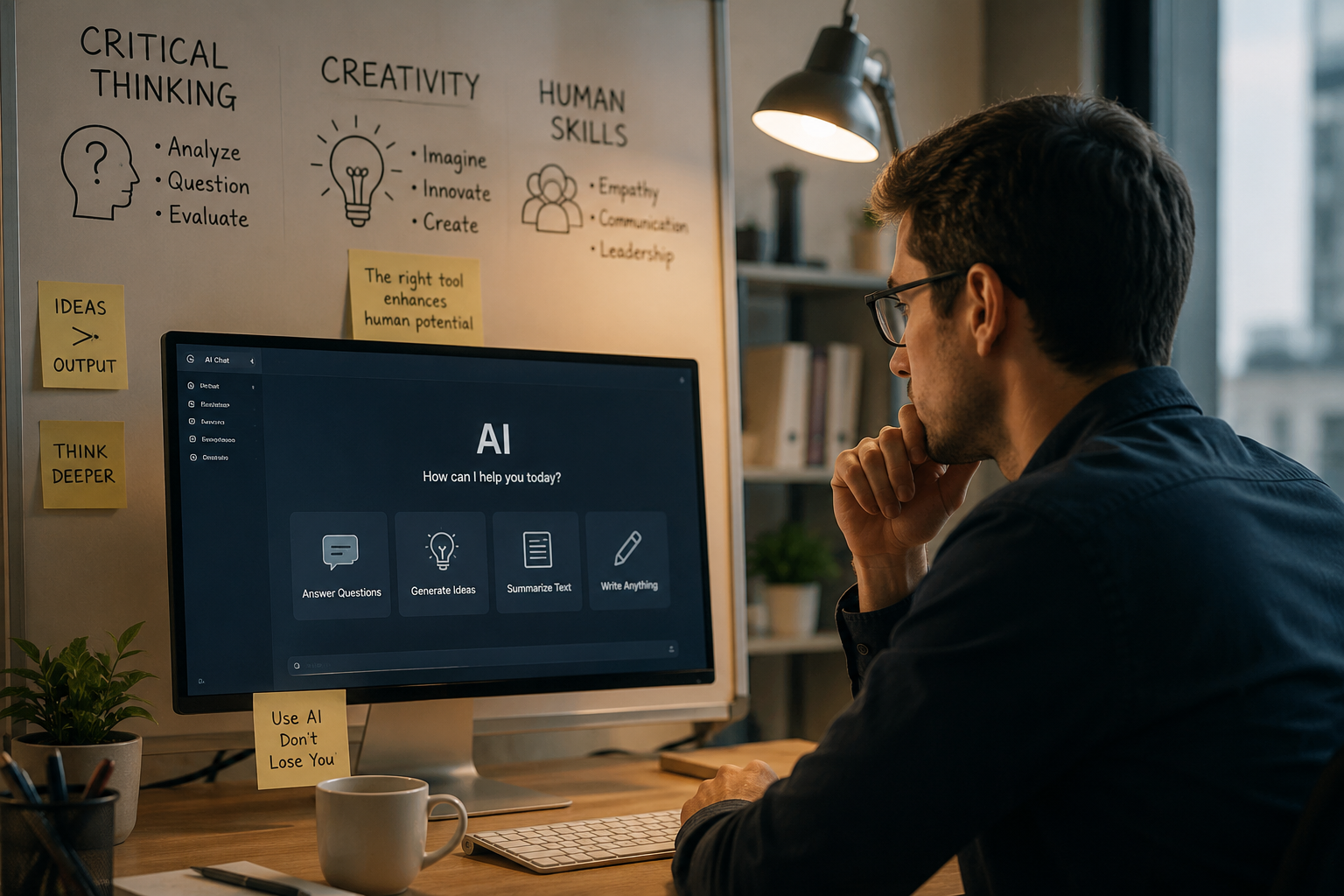
People who thrive in an AI-driven world may not be those who avoid the technology. They may be those who use it strategically while continuing to practice critical thinking, communication, analysis, and problem-solving.
The goal is not resistance. It is balance.
Convenience is valuable, but some forms of effort serve a purpose beyond productivity. They strengthen the very abilities that enable people to adapt, innovate, and make informed decisions.
A Future Worth Paying Attention To
AI is making knowledge more accessible and work more efficient than ever before. For many individuals and organizations, the benefits are already impossible to ignore.
Yet the conversation about AI often focuses on what the technology can do, not on what humans might stop doing as a result.
That distinction matters.
The most significant impact of AI may not be the tasks it automates, but the habits it changes. As convenience becomes increasingly abundant, the skills people choose to keep practicing could become some of their most valuable assets.
The future of AI may ultimately depend less on the intelligence of machines and more on the wisdom with which humans decide to use them.
This content is published for informational or entertainment purposes. Facts, opinions, or references may evolve over time, and readers are encouraged to verify details from reliable sources.