







Scientists Are Storing Movies in DNA, And India Is Watching Closely
Science and Environment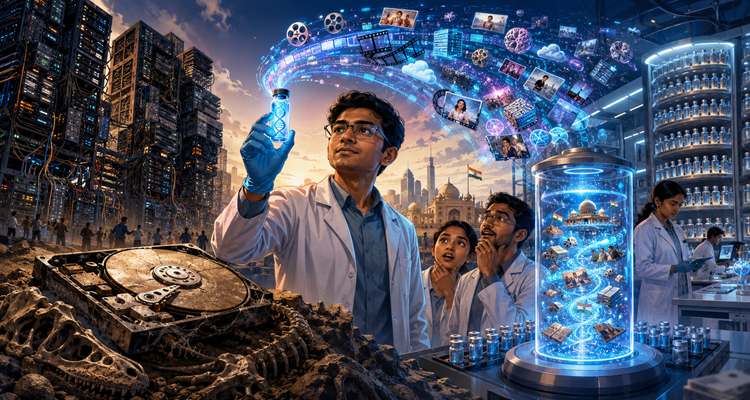
The hard drive in your laptop will look ancient in 10 years.
Researchers have already encoded an entire Bollywood film into synthetic DNA. Not as a gimmick. As a test. One gram of this material can hold 215 petabytes of data. That’s every movie on Netflix, stored in something smaller than a sugar cube.
The question isn’t whether it works. The question is what happens when data centers run out of room, and who gets to build the next generation of storage. For India, with its massive digital push and data localization laws, the timing could not be more interesting.
Key Takeaways
- The core shift: DNA can store 215 petabytes in 1 gram and last for thousands of years
- Why it matters now: Global data is doubling every 2 years, and current servers use too much power
- India’s angle: Govt archives and startups are exploring DNA for long-term data storage
- The catch: Writing data into DNA is still slow and expensive, but reading is getting faster
- What happens next: Commercial DNA storage could arrive for archives by 2030
What Is Actually Happening With DNA Storage
DNA storage isn’t new science fiction. It’s chemistry. Scientists convert 1s and 0s into the four DNA bases: A, T, C, G. Then they synthesize that sequence in a lab. To read it back, they use DNA sequencing, the same tech used in hospitals.
In 2024, a team at Harvard and Microsoft encoded 200MB of data, including images and video, into DNA and retrieved it with 100% accuracy. In 2025, European labs pushed it further by storing a full-length film. The data didn’t degrade. DNA, when kept dry and cold, can last over 2,000 years. Your SSD dies in 5.
The big advantage isn’t just density. It’s energy. Data centers today consume about 1% of global electricity. DNA storage uses almost no power once the data is written. You just keep it in a tube.
Why Interest Is Spiking Right Now
Three forces are colliding.
First, AI. Every ChatGPT prompt, every generated image, every model training run creates terabytes of data. Companies are paying billions to store data they may never look at again, but can’t legally delete.
Second, space. By 2030, we’ll generate 175 zettabytes of data per year. We are running out of physical room for server farms, especially in dense countries.
Third, longevity. Governments and film studios don’t want to migrate archives every 5 years. The US Library of Congress and film preservation groups have been testing DNA for this exact reason.
Who This Affects, And Why India Matters
This isn’t just for Google and Meta.
Governments need cold storage for legal records, tax data, and scientific research. India’s Digital India mission and Data Protection Act require data to be stored locally for decades. DNA could cut costs and floor space.
Media companies have a different problem. A 4K Bollywood film is 300GB. Studios have hundreds of them. Migrating archives is expensive. DNA is a one-time write.
Startups are already moving. In the US, companies like Catalog and Twist Bioscience are building DNA writing machines. In India, research groups at IIT Bombay and IISc have published papers on low-cost DNA synthesis. The goal isn’t to replace your phone storage next year. It’s to replace tape drives and LTO archives in 5-7 years.
The Hidden Insight Nobody Talks About
Here’s what most articles miss: DNA storage flips who controls data.
Right now, data needs power, cooling, and constant maintenance. That means big tech companies and cloud providers win by default. DNA storage is passive. Once written, it needs nothing. A shoebox of DNA could hold a nation’s archives.
That changes geopolitics. Countries with less infrastructure but strong biotech could leapfrog. It also changes security. You can’t hack a test tube. But you can lose it, or contaminate it. The future of data security may look more like a biology lab than a cybersecurity firm.
What Makes This Moment Different
We’ve had the theory for a decade. What changed in 2024-2026 is cost and speed.
Reading DNA used to take days. New nanopore sequencers do it in hours. Writing is still the bottleneck, costing thousands per megabyte. But the cost is dropping 30% per year, similar to how solar panels did.
Microsoft has already demoed an automated DNA storage system. They’re not selling it yet. They’re waiting for the price to cross a threshold where enterprises say yes.
Practical Implications For The Next 5 Years
You won’t buy a DNA SSD. But you will feel the effects.
- Cloud bills may drop for companies that move cold data to DNA
- Data centers will get smaller in cities where real estate is expensive
- New regulations will appear around who can synthesize and store DNA data
- India’s IT sector has an opportunity to lead in DNA data services for the Global South
The moment to watch: when the first government puts official records into DNA. That will signal it’s ready for prime time.
What Could Happen Next
By 2030, expect DNA storage to be standard for archives. By 2035, it may be used for AI training data that needs to be kept but rarely accessed.
The risk is overhyped. This won’t replace RAM or SSDs. It’s too slow for that. The opportunity is specialization. Just like we have HDDs for bulk and SSDs for speed, we’ll have DNA for permanence.
For wiobs.com readers, the takeaway is simple. The next big tech shift might not be a new app. It might be a new material. And biology is the material.
The views and opinions expressed in this article are those of the author and are intended for informational and educational purposes only. While every effort is made to ensure accuracy, Wiobs does not guarantee the completeness, reliability, or timeliness of the information presented. Readers are encouraged to verify facts independently and use their own judgment before making decisions based on this content.
Stay Connected with Wiobs
Explore more insights on technology, artificial intelligence, science, business, and innovation. Follow Wiobs and never miss an update.