










When Privacy Became a Feeling Instead of a Boundary
A closed bedroom door once carried a simple message: this space is private. A conversation held in person stayed within the people who heard it. Personal thoughts were written in journals, stored in drawers, and rarely seen by anyone else.
That understanding of privacy is becoming harder to define.
Many people still believe privacy is about controlling who can access information. Yet modern life has introduced a more complicated reality. Personal experiences, habits, locations, opinions, and even emotions now move through digital platforms, connected devices, workplaces, and social networks. As a result, privacy is no longer just a legal or technical concept. It has become a feeling, one that often changes depending on context.
The shift is subtle but significant. Instead of asking whether something is truly private, people increasingly ask whether it feels private enough.
The New Privacy Trade-Off
Modern convenience is built on sharing information.
Navigation apps know where people travel. Streaming services learn viewing habits. Fitness trackers monitor activity levels. Smart home devices respond to voice commands. Online shopping platforms remember preferences and purchasing history.
Most users understand that data is being collected, at least in broad terms. Yet many continue using these services because the benefits are immediate and visible while the privacy costs often feel distant and abstract.
This has created a new kind of trade-off. Rather than protecting privacy at all costs, people frequently exchange pieces of it for convenience, personalization, speed, or access.
The result is a society where privacy is rarely surrendered all at once. Instead, it is gradually negotiated through thousands of small decisions made every day.
Why Context Matters More Than Ever
One of the most interesting changes is that privacy expectations now depend heavily on context.
A person may willingly share vacation photos with hundreds of followers online while feeling uncomfortable if a retailer tracks their shopping behavior. Someone might discuss personal experiences on a podcast yet avoid sharing similar details at work.
The information itself is not always the issue. The audience, purpose, and perceived control often matter more.
This explains why debates about privacy have become increasingly complex. People are not simply deciding what information is public or private. They are deciding who should know it, when they should know it, and why.
In many cases, privacy has become less about secrecy and more about managing relationships and expectations.
The Rise of Ambient Visibility
Another major shift is the growth of what could be called ambient visibility.
In previous generations, people actively chose when to reveal information. Today, information often emerges automatically.
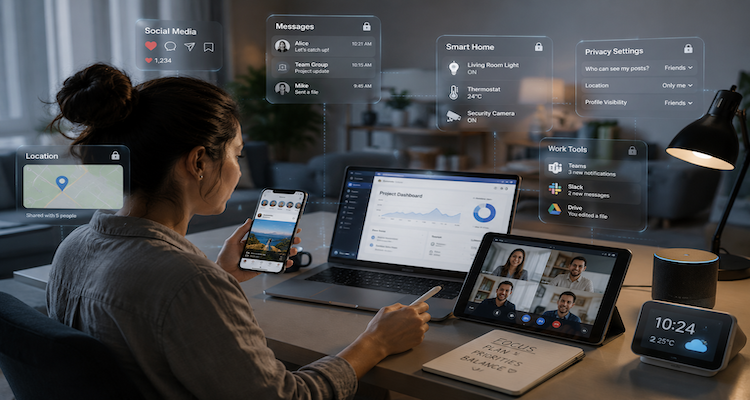
Online status indicators show when someone is available. Smartphones can reveal location data. Collaboration tools display activity patterns. Social media platforms preserve years of interactions. Recommendation algorithms can infer interests without explicit disclosure.
Even when individuals are not intentionally sharing details, digital systems may generate a surprisingly detailed picture of their lives.
This does not necessarily mean people are under constant surveillance. However, it does mean that visibility increasingly exists as a default condition rather than an exception.
For many individuals, the challenge is not hiding information but understanding how much is already visible.
How Work Is Reshaping Privacy Expectations
The workplace provides one of the clearest examples of changing privacy norms.
Remote work, hybrid teams, digital collaboration platforms, and productivity tools have transformed how professional life operates. Communication that once happened in hallways or meeting rooms now leaves searchable records.
Employees often navigate a complicated balance between transparency and personal boundaries. They may be expected to remain reachable, maintain online presence indicators, and participate in digital communication channels throughout the day.
At the same time, organizations increasingly recognize the importance of protecting personal time and respecting employee well-being.
This tension reveals a broader societal question: where does professional visibility end and personal privacy begin?
The answer varies widely across industries, cultures, and individual expectations, suggesting that privacy norms are still evolving.
Social Sharing Has Changed What Feels Personal
Social media has played a major role in redefining privacy.
Earlier concerns focused primarily on what people revealed publicly. Today’s reality is more nuanced. Many users carefully curate different versions of themselves across different platforms, audiences, and communities.
A post shared with close friends may feel private even when hosted on a public platform. A personal story told within a niche online community can create a sense of intimacy despite existing in a digital environment.
This highlights an important insight: privacy is increasingly tied to perceived social distance rather than physical or technological barriers.
People often judge privacy based on trust and context, not merely access.
In other words, something can technically be public yet emotionally feel private.
That distinction helps explain why certain privacy controversies generate strong reactions. When expectations and reality no longer align, trust breaks down.
The Privacy Generation Gap
Different generations often approach privacy differently, though not always in the ways people assume.
Younger generations are sometimes portrayed as caring less about privacy because they share more online. However, many younger users demonstrate sophisticated awareness of audience management, platform settings, and digital identity.
Rather than abandoning privacy, they may simply define it differently.
Older generations often associated privacy with restricting access. Younger users frequently focus on controlling context.
The difference is subtle but important. One model asks, “Who can see this?” The other asks, “Who is this intended for?”
As digital life continues to evolve, these perspectives are increasingly overlapping rather than competing.
The Hidden Cost of Constant Exposure
The redefinition of privacy has psychological implications as well.
Living in environments where actions can be documented, shared, stored, and revisited may influence behavior. People may become more cautious about experimentation, self-expression, or making mistakes.
Historically, many personal moments disappeared with time. Digital records often preserve them indefinitely.
This permanence can create pressure to manage personal identity continuously. The effort involved may not always be visible, but it shapes how people communicate, interact, and present themselves.
The challenge is not necessarily that people have less privacy than before. It is that maintaining privacy often requires more active effort.
What Privacy May Look Like Next
The future of privacy is unlikely to involve a return to older models.
Digital services, connected technologies, artificial intelligence systems, and personalized experiences are becoming deeply integrated into daily life. Most people are unlikely to abandon these benefits entirely.
Instead, the next phase may focus on giving individuals greater clarity and control.
Users increasingly want to understand how information is collected, how it is used, and what choices are available. Businesses that can provide transparency while respecting user expectations may gain a significant trust advantage.
Meanwhile, individuals may continue developing new social norms around what should remain personal, what can be shared, and what deserves stronger boundaries.
Privacy is no longer a fixed line separating public and private life. It is becoming a dynamic negotiation shaped by technology, culture, convenience, trust, and personal choice.
That may be the most important change of all. Modern life has not eliminated privacy, it has transformed it from a physical boundary into a constantly evolving human experience.
This content is published for informational or entertainment purposes. Facts, opinions, or references may evolve over time, and readers are encouraged to verify details from reliable sources.