










Why Shiva Is Called the Destroyer—and Why That Title Misses His Deeper Purpose
For many people encountering Hindu philosophy for the first time, one title stands out above all others: Shiva, the Destroyer. It is a label that often creates confusion. Why would one of the most revered deities in Hindu tradition be associated with destruction? In a world that typically celebrates creation and preservation, destruction sounds unsettling, even frightening.
Yet this popular description only tells part of the story. In fact, understanding Shiva solely as a destroyer misses one of the most profound ideas in Indian spiritual thought. Shiva’s role is not about destruction for its own sake. It is about transformation, renewal, liberation, and the necessary ending of what no longer serves life.
As interest in ancient wisdom traditions grows around the world, many readers are revisiting Shiva not merely as a religious figure but as a symbol of deeper psychological, cultural, and spiritual truths. What emerges is a far more complex and relevant understanding than the traditional title suggests.
The Misunderstood Meaning of Destruction
The word “destroyer” often carries negative connotations. It evokes images of loss, chaos, or violence. In Hindu philosophy, however, destruction is rarely viewed as purely negative.
Nature itself operates through cycles. Leaves fall before new growth appears. Old structures are removed to make room for stronger ones. Seasons change. Cells die and regenerate. Even stars eventually collapse, giving birth to new cosmic formations.
Within this framework, Shiva represents a universal principle: the dissolution of forms that have completed their purpose.
Rather than being opposed to creation, destruction becomes an essential part of creation itself. Without endings, there can be no beginnings. Without change, there can be no growth.
This perspective fundamentally changes how Shiva is understood. He is not the force that opposes life. He is the force that prevents stagnation.
Shiva’s Place in the Cosmic Cycle
Traditional Hindu thought often describes three fundamental cosmic functions: creation, preservation, and dissolution.
Creation brings existence into form.
Preservation sustains and nurtures that form.
Dissolution returns it to its source, allowing renewal to occur.
Shiva is associated with this third function. Yet dissolution is not annihilation. It is transformation.
A seed must cease being a seed to become a tree. Childhood must end for adulthood to emerge. Outdated beliefs must dissolve before new understanding can arise.
In this sense, Shiva represents the intelligence behind necessary change.
The deeper lesson is that life is not a straight line but a cycle. Clinging to permanence in an impermanent world often creates suffering. Shiva symbolizes the wisdom of accepting transformation rather than resisting it.
The Third Eye: Destroying Illusion, Not Reality
One of Shiva’s most recognizable symbols is the third eye.
Popular stories describe it as a source of immense power capable of reducing obstacles to ashes. Yet the symbolism runs deeper than supernatural destruction.
The third eye is often interpreted as representing higher awareness and insight. When it opens, it burns away ignorance, illusion, and false perception.
This idea remains surprisingly relevant today.
Modern life is filled with distractions, misinformation, social pressures, and carefully curated digital identities. Many people spend enormous energy maintaining images that may not reflect who they truly are.
From a symbolic perspective, Shiva’s third eye represents the ability to see beyond appearances.
The destruction associated with Shiva is therefore often internal rather than external. What is destroyed are illusions, ego-driven attachments, and limiting beliefs that prevent genuine growth.
Why Shiva Lives Outside Conventional Society
Unlike many divine figures associated with wealth, kingdoms, or luxury, Shiva is frequently depicted in mountains, forests, cremation grounds, and remote places.
These settings are not accidental.
They symbolize freedom from social conditioning and attachment to status.
Cremation grounds, in particular, carry powerful meaning. They remind individuals that worldly achievements, possessions, and identities are temporary. While this may sound unsettling, Hindu philosophy presents it as liberating rather than depressing.
When people recognize impermanence, they often become less controlled by fear, comparison, and anxiety.
This aspect of Shiva speaks directly to contemporary concerns. In an era shaped by social media metrics, constant competition, and external validation, Shiva represents an alternative vision of fulfillment rooted in self-awareness rather than public approval.
The Hidden Insight: Shiva’s Relevance in an Age of Constant Reinvention
One reason interest in Shiva continues to grow beyond traditional religious contexts is that his symbolism aligns with a defining feature of modern life: continuous transformation.
Careers change multiple times during a lifetime.
Industries are disrupted by new technologies.
Businesses must adapt or risk becoming obsolete.
Personal identities evolve as people move through different stages of life.
Many individuals struggle not because change is occurring but because they resist it.
This is where Shiva’s symbolism becomes unexpectedly practical.
His role suggests that growth often requires letting go before moving forward. Whether it is an outdated business model, a limiting mindset, or an unhealthy habit, transformation begins when something old is allowed to end.
The deeper message is not about destruction. It is about intelligent renewal.
In many ways, Shiva represents a principle increasingly relevant in a rapidly changing world: adaptability is not merely useful—it is essential.
Nataraja: The Cosmic Dance of Creation and Destruction
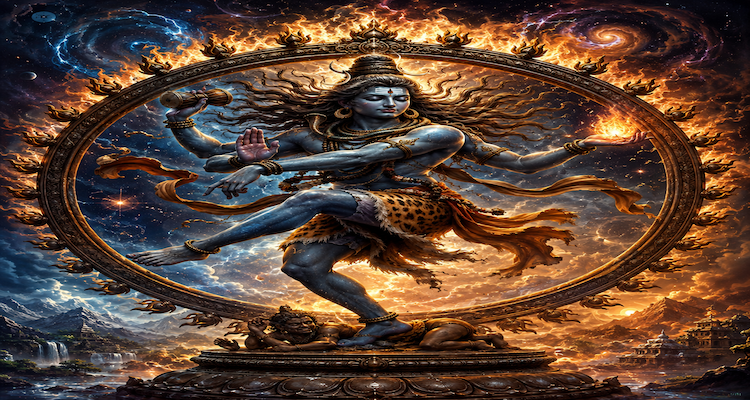
Perhaps the most sophisticated representation of Shiva is Nataraja, the Lord of the Dance.
In this form, Shiva dances within a ring of fire while balancing multiple symbolic elements at once.
The dance represents the rhythm of existence itself, creation, preservation, destruction, concealment, and liberation occurring simultaneously.
What makes this image remarkable is its refusal to separate opposites.
Creation and destruction are not enemies.
Order and change are not contradictions.
Endings and beginnings are interconnected parts of the same process.
For many scholars, artists, and philosophers, Nataraja remains one of humanity’s most profound visual representations of reality as a dynamic, ever-changing system.
Why the Destroyer Archetype Still Matters
The enduring appeal of Shiva lies in his ability to challenge assumptions.
Most people naturally seek comfort, stability, and permanence. Yet life repeatedly demonstrates that change is unavoidable.
Shiva does not promise a world without endings. Instead, he offers a different way of understanding them.
The loss of an old identity can become the beginning of self-discovery.
The collapse of a limiting belief can create space for wisdom.
The end of one chapter can open possibilities that were previously invisible.
This perspective transforms destruction from something to fear into something that can, under the right circumstances, enable growth.
Looking Beyond the Label
Calling Shiva “the Destroyer” is not incorrect, but it is incomplete.
The title captures only one dimension of a figure whose symbolism spans transformation, consciousness, liberation, and renewal. Shiva’s deeper role is not the destruction of life but the removal of what prevents life from evolving.
That idea may explain why Shiva continues to resonate across centuries and cultures. His symbolism speaks not only to ancient spiritual traditions but also to universal human experiences: change, loss, growth, and the search for meaning.
Seen through that lens, Shiva is far more than a destroyer. He is a reminder that every ending carries the possibility of a new beginning—and that transformation is often the hidden force behind renewal.
This content is published for informational or entertainment purposes. Facts, opinions, or references may evolve over time, and readers are encouraged to verify details from reliable sources.
Related News
- Why Shiva Remains Relevant Even Outside Traditional Religious Practice
- Shiva’s Cosmic Dance: Why Nataraja Represents Creation, Destruction and the Rhythm of Time
- What Shiva’s Meditation Reveals About the Hindu Idea of Inner Stillness
- The Meaning of Ardhanarishvara: When Shiva and Shakti Become One Form