









Why People Are Rebuilding Their Homes Around How They Feel, Not How They Look
For decades, home design was largely judged by appearance. Open kitchens, minimalist interiors, luxury finishes, and carefully styled rooms became symbols of taste and status. But a quieter shift is changing the way many people think about where they live: homes are increasingly being designed around emotional needs how a space supports calm, focus, comfort, connection, and everyday well-being.
This does not mean aesthetics no longer matter. Instead, homeowners, architects, and designers are increasingly treating appearance as only one part of a larger question: How does this space make people feel when they actually live in it?
The shift reflects growing interest in environmental psychology, wellness-focused design, remote work, changing family patterns, and a deeper awareness that physical surroundings can influence mood, behavior, and daily routines.
A beautiful room that creates stress, noise, distraction, or discomfort may no longer feel successful. A smaller, simpler space that helps someone rest, concentrate, or reconnect with family may offer greater value.
Key Takeaways
- Home design is shifting from visual presentation toward emotional comfort and daily experience.
- Research in environmental psychology shows that surroundings can influence stress, attention, and behavior.
- Remote work has changed how people evaluate the function of their living spaces.
- Wellness-focused features increasingly prioritize light, nature, acoustics, and flexibility.
- Emotional design does not reject beauty; it connects appearance with human needs.
The Rise of Emotion-Centered Home Design
The traditional idea of a dream home often focused on visible features: a large living room, expensive materials, impressive architecture, or a fashionable interior style. These elements remain important for many homeowners, but they are increasingly being balanced against less visible qualities.
People are asking different questions:
- Does this room help me relax?
- Does my home support my lifestyle?
- Can I focus here?
- Does the space reduce stress or add to it?
- Does it reflect who I am?
This change has been influenced by several social shifts. The growth of remote and hybrid work has made homes serve multiple purposes. A dining table may become an office, a bedroom may double as a quiet workspace, and outdoor areas may become important places for recovery and recreation.
The result is a move away from designing rooms only for occasional presentation and toward designing spaces for everyday emotional experience.
Why Psychology Is Becoming Part of Architecture
The connection between buildings and human behavior has been studied through fields such as environmental psychology and healthcare design.
Research has examined how factors including natural light, noise levels, access to nature, spatial organization, and crowding can affect human experiences. For example, studies in healthcare environments have explored how views of nature and better-designed surroundings may contribute to improved patient experiences.
One influential concept is biophilic design, which focuses on incorporating elements associated with nature into built environments. This can include natural materials, plants, daylight, views of outdoor spaces, and patterns inspired by natural forms.
The idea is not that every plant or wooden surface automatically creates happiness. Rather, design choices can influence how people interact with a space.
A room with excessive noise, poor lighting, and no sense of privacy may create daily friction. A well-planned environment can remove small stresses that accumulate over time.
The Home Has Become a Personal Wellness System
The wellness movement has expanded beyond fitness and nutrition into the spaces where people spend their time.
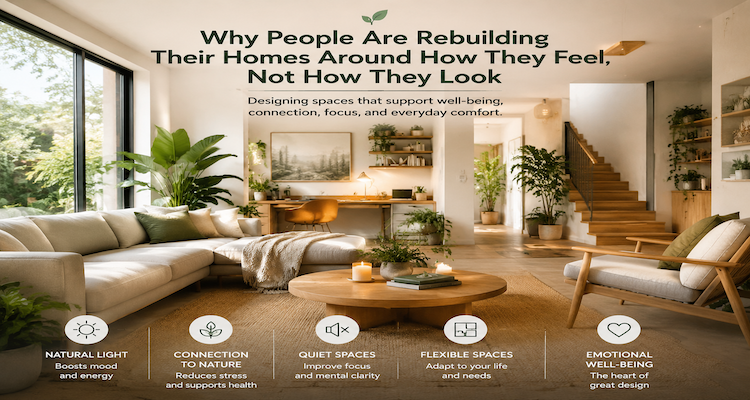
Modern homeowners are increasingly considering:
- Better daylight exposure
- Quiet areas for concentration
- Flexible rooms that adapt to changing needs
- Comfortable materials and textures
- Indoor air quality
- Connections to outdoor spaces
These choices reflect a broader understanding that health is not only shaped by medical decisions but also by everyday environments and habits.
Organizations such as the International WELL Building Institute have promoted standards focused on aspects of buildings that affect human health and well-being, including air, water, light, movement, comfort, and mental well-being.
However, wellness design also requires balance. A home does not need expensive technology or luxury features to support comfort. Simple decisions such as arranging furniture to improve movement, reducing unnecessary clutter, or creating a dedicated quiet area can have meaningful effects on daily life.
Remote Work Changed What People Expect From Their Homes
The pandemic accelerated a transformation already beginning in workplace culture: homes became places where people needed to work, learn, rest, and socialize simultaneously.
Before widespread remote work, many homes were designed around separation. Work happened elsewhere. Today, many people need flexibility.
This has changed priorities:
A spare room is no longer just a guest room.
It may become an office, creative studio, or learning space.
Lighting is no longer only decorative.
It affects video calls, concentration, and daily routines.
Sound management matters more.
Privacy and reduced noise have become important considerations in shared living environments.
The home has become less like a showroom and more like a personal operating environment.
Technology Is Helping Homes Adapt to Human Needs
Technology is also influencing emotion-focused design, although its role is often misunderstood.
Smart home systems can adjust lighting, temperature, security, and energy use according to preferences. Automated blinds, adaptive lighting systems, and connected climate controls are examples of technologies designed to make spaces more responsive.
However, technology alone does not create a better home.
A home filled with devices can still feel uncomfortable if it lacks thoughtful design. The most effective technology often works quietly in the background, reducing friction rather than demanding attention.
The goal is not a house that looks futuristic. It is a home that responds better to the people living inside it.
The Business of Designing for Feelings
The shift toward emotional design is also affecting the housing and design industries.
Architects, builders, furniture companies, and technology providers are increasingly incorporating concepts related to wellness and lifestyle into their products and services.
Real estate marketing has also changed. Many property listings now emphasize experiences: natural light, peaceful surroundings, outdoor connections, flexible spaces, and community features.
This reflects a broader consumer change. Buyers are not only evaluating what a property contains; they are considering how life inside that property may feel.
For businesses, this creates both opportunity and responsibility. Emotional design can become meaningful when it improves real living conditions, but it can become superficial when “wellness” is used only as a marketing label.
The Limits of Designing for Emotion
While the idea of emotional home design is gaining attention, it is important not to overstate what design can achieve.
A well-designed home cannot eliminate financial stress, relationship problems, health challenges, or broader social pressures. The environment influences experience, but it is only one factor among many.
Personal preferences also vary. One person may find a minimalist home calming, while another may feel more comfortable surrounded by books, artwork, and personal objects.
There is no universal emotional blueprint for every home.
The most successful designs recognize individuality rather than applying a single trend to everyone.
A New Definition of a Successful Home
The growing interest in emotion-centered design represents a change in how people measure the value of their surroundings.
A home is no longer judged only by how impressive it appears to visitors. Increasingly, its success is measured by how well it supports the people who live there.
The future of residential design may not be defined by bigger spaces or more expensive materials. It may be defined by smarter questions: Does this home help people rest? Does it support their relationships? Does it make daily life easier?
The most meaningful homes may be the ones that disappear into everyday life spaces that quietly help people feel better, think more clearly, and live more comfortably.
This content is published for informational or entertainment purposes. Facts, opinions, or references may evolve over time, and readers are encouraged to verify details from reliable sources.