










Why Biodiversity Loss May Hit Your Grocery Budget Before Climate Change Does
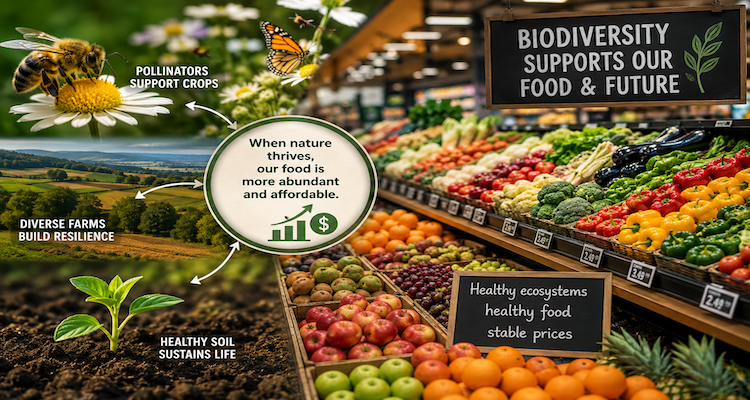
A rising grocery bill is often blamed on inflation, fuel costs, supply chain disruptions, or extreme weather. Yet another force is quietly reshaping what ends up on supermarket shelves, and how much consumers pay for it. That force is biodiversity loss.
While climate change has become a familiar part of public conversation, biodiversity decline remains less visible despite its direct connection to the food system. The disappearance of pollinators, shrinking genetic diversity in crops, degraded soils, and declining ecosystems are creating vulnerabilities that can affect food availability, quality, and price long before many climate-related impacts become obvious at the checkout counter.
The result is a shift that extends beyond environmental concerns. Biodiversity loss is increasingly becoming an economic issue, a food security issue, and ultimately a household budget issue.
The Hidden Infrastructure Behind Every Grocery Store
Most consumers rarely think about biodiversity while shopping for fruit, vegetables, coffee, rice, or cooking oil. Yet every item depends on a vast network of living organisms.
Pollinators such as bees, butterflies, birds, and bats help reproduce many crops. Healthy soils contain billions of microorganisms that support plant growth. Natural predators keep agricultural pests under control. Diverse ecosystems help regulate water cycles and maintain productive farmland.
These biological systems function as invisible infrastructure. Unlike roads, warehouses, or shipping networks, they rarely appear on balance sheets. But when they weaken, food production becomes more expensive and less reliable.
Farmers may need additional fertilizers, pesticides, irrigation, or labor to compensate for lost ecological services. Those costs often move through the supply chain and eventually reach consumers.
Why Biodiversity Loss Can Have Immediate Food Impacts
Climate change is often discussed as a long-term challenge, although many impacts are already being felt today. Biodiversity loss, however, can produce immediate consequences because it directly affects the biological foundations of agriculture.
Consider pollination. Many fruits, nuts, vegetables, and seed crops depend on pollinating species. When pollinator populations decline, farmers may experience lower yields or higher production costs. In some regions, growers have already turned to managed pollination services to compensate for ecosystem losses.
Similarly, reduced crop diversity can make food systems more vulnerable to disease outbreaks. If large agricultural regions depend heavily on a small number of genetically similar crop varieties, a single pest or disease can cause widespread disruption.
This creates a paradox: modern agriculture has become highly efficient, but efficiency sometimes comes at the expense of resilience.
The Cost of Putting Too Many Eggs in One Basket
One of the most underreported consequences of biodiversity loss is the narrowing of food diversity itself.
Global agriculture relies heavily on a relatively small number of crops. Wheat, rice, maize, and a handful of others supply a large share of human calories. Over time, many traditional crop varieties have disappeared from commercial production.
This concentration creates risk.
A diverse ecosystem functions much like a diversified investment portfolio. When one species or crop struggles, others may continue to thrive. But when diversity declines, shocks become harder to absorb.
If a disease affects a dominant crop variety or a key pollinator population collapses, food supplies can tighten quickly. Prices often respond faster than consumers expect.
The issue is not simply environmental preservation. It is risk management for the global food system.
Why Consumer Choices Are Becoming Part of the Story
An interesting shift is occurring in how food companies, retailers, and consumers think about sustainability.
For years, climate-related messaging focused heavily on carbon emissions. Increasingly, businesses are also examining biodiversity impacts across supply chains.
Large food producers, agricultural firms, and retailers are beginning to explore regenerative farming practices, habitat restoration, and more diverse sourcing strategies. These efforts are not purely environmental initiatives. They are increasingly viewed as ways to reduce long-term supply risks.
Consumers are also showing growing interest in where food comes from, how it is produced, and whether farming practices support ecosystem health.
This reflects a broader realization: environmental resilience and economic resilience are becoming closely connected.
The Grocery Bill Insight Most People Miss
The most important insight may be this: biodiversity loss does not simply make food scarcer. It can make food systems less predictable.
Consumers often focus on average prices. Food systems, however, are increasingly shaped by volatility.
When ecosystems become less resilient, supply disruptions can become more frequent. That means sudden shortages, unexpected price spikes, and greater uncertainty for producers and retailers.
In economic terms, biodiversity functions as a stabilizer. It helps absorb shocks before they reach markets.
When that stabilizer weakens, volatility increases.
For households, this can mean grocery budgets becoming harder to plan—not necessarily because every product becomes permanently expensive, but because price fluctuations become more common.
A Signal of a Larger Global Transition
The growing attention to biodiversity reflects a wider shift in how societies understand economic value.
Traditional economic models often treated nature as a background resource. Increasingly, governments, businesses, and investors are recognizing that ecosystems provide services that have real economic importance.
Healthy forests influence water systems. Wetlands reduce flood risks. Diverse agricultural landscapes support food production. Pollinators contribute to crop yields.
As awareness grows, biodiversity is moving from the margins of environmental discussions toward the center of economic planning.
This shift is likely to influence everything from agricultural policy and investment decisions to food branding and consumer behavior.
What Happens Next?
The future relationship between biodiversity and food prices remains complex. Technological innovation, agricultural research, improved land management, and conservation efforts could help reduce some risks.
At the same time, continued biodiversity decline could place additional pressure on food systems already facing population growth, resource constraints, and climate-related challenges.
What makes this moment different is that biodiversity is no longer viewed solely as a conservation issue. It is increasingly being understood as a practical issue that affects food security, economic stability, and everyday costs.
For consumers, that realization may change how environmental challenges are perceived.
Climate change will continue to shape the future of food. But biodiversity loss may prove to be the quieter force that reaches shopping carts first.
The next time a favorite fruit becomes harder to find, a coffee blend becomes more expensive, or seasonal produce experiences sudden price swings, the explanation may not begin with weather forecasts or fuel prices. It may begin with the health of ecosystems that most people never see but depend on every day.
This content is published for informational or entertainment purposes. Facts, opinions, or references may evolve over time, and readers are encouraged to verify details from reliable sources.