










When Your Home Becomes a Power Plant: The Energy Shift Taking Shape
For more than a century, homes have occupied a simple role in the energy system: they consume electricity produced somewhere else. Power plants generate it, utilities distribute it, and households pay for it.
That arrangement is beginning to change.
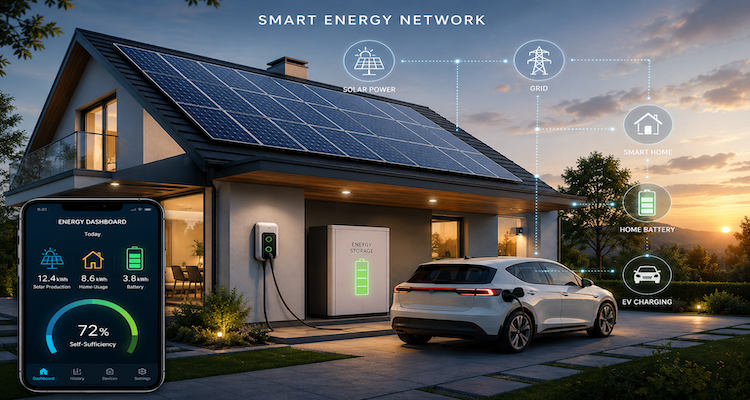
Across many parts of the world, rooftops are filling with solar panels, garages are housing increasingly sophisticated batteries, and electric vehicles are becoming mobile energy storage units. Individually, these developments may appear unrelated. Together, they point toward a much larger transformation, one in which ordinary homes could become active participants in energy production rather than passive consumers.
The idea of a home functioning as a miniature power plant may sound futuristic. Yet the technologies required for that future already exist in various forms. The question is no longer whether the concept is possible. The more interesting question is how quickly it becomes common.
The Rise of the Energy-Producing Household
Solar energy has played a major role in changing how people think about electricity. A rooftop covered with solar panels does more than reduce utility bills. It turns a property into a source of generation.
For decades, electricity flowed in one direction, from centralized power stations to consumers. Solar-equipped homes introduced a two-way relationship. During sunny hours, some households generate more electricity than they use, sending excess energy back into the grid.
This shift may seem modest, but it challenges one of the oldest assumptions in the energy industry: that generation and consumption happen in separate places.
As solar technology improves and installation costs continue to become more accessible in many markets, energy production is moving closer to where energy is actually used.
Batteries Are Changing the Equation
Solar panels alone cannot fully transform homes into power plants. The missing piece has long been storage.
Electricity generated at midday is most valuable when it can be used later in the evening, when demand often peaks. Home battery systems are increasingly addressing that challenge.
Rather than immediately exporting surplus electricity, households can store it for later use. During outages, batteries can provide backup power. During periods of high electricity prices, stored energy can reduce reliance on the grid.
This capability fundamentally changes the value of residential energy systems. A home is no longer simply producing electricity; it is managing and distributing it.
In many ways, batteries are becoming the energy equivalent of a household savings account—storing resources when conditions are favorable and drawing upon them when needed.
The Unexpected Role of Electric Vehicles
One of the most overlooked developments in the energy transition may be sitting in driveways.
Electric vehicles contain large batteries, often capable of storing significantly more energy than dedicated residential battery systems. Emerging vehicle-to-home and vehicle-to-grid technologies aim to allow electric cars to send electricity back to homes or utility networks when needed.
If widely adopted, this could transform millions of vehicles into distributed energy assets.
A car parked for much of the day could become part transportation tool, part backup generator, and part grid resource.
The implications are significant. Instead of building additional centralized infrastructure to meet peak demand, utilities may increasingly rely on networks of connected homes and vehicles that can collectively provide energy when required.
Why Utilities Are Paying Attention
The traditional utility model was built around large centralized generation facilities. Distributed energy resources introduce a different reality.
When thousands of homes generate and store electricity, they collectively create a decentralized energy network. Managing that network requires advanced software, smart meters, and intelligent coordination.
Utilities are beginning to explore “virtual power plants”, systems that connect solar panels, batteries, and electric vehicles across many properties and manage them as a single resource.
From the grid’s perspective, hundreds or thousands of homes working together can perform functions once reserved for conventional power plants.
The concept is important because energy demand is becoming more complex. Electrification of transportation, increasing digital infrastructure, and growing climate pressures are all creating new challenges for electricity systems. Distributed resources may help provide flexibility without requiring every solution to come from massive new power facilities.
The Real Shift Is Not Technological
The most important change may not involve hardware at all.
Historically, people have thought about energy as a utility service, something purchased when needed. The emerging model encourages households to think about energy as an asset that can be produced, stored, managed, and potentially shared.
This represents a significant behavioral shift.
Just as the internet transformed people from consumers of information into creators of content, distributed energy technologies could transform households from consumers of electricity into participants in energy markets.
That change alters decision-making. Homeowners may begin evaluating roofs differently. Vehicle purchases could become energy decisions as much as transportation decisions. Property value calculations may increasingly include generation and storage capacity.
The home itself starts acquiring a new economic function.
What Could Hold the Transition Back?
The path toward energy-producing homes is not without obstacles.
Upfront costs remain a barrier for many households. Regulatory frameworks vary significantly between regions. Grid infrastructure was not originally designed for widespread distributed generation. Questions around cybersecurity, interoperability, and energy equity also remain unresolved.
Not every home is suitable for rooftop solar. Apartment dwellers face different challenges than detached homeowners. Geographic conditions influence energy production potential.
As a result, adoption is unlikely to occur evenly.
The transition may unfold gradually, with certain regions, neighborhoods, and income groups moving faster than others. Policymakers and energy providers will need to address these disparities if the benefits of distributed energy are to be broadly shared.
A Different Vision of the Future Grid
The future electrical grid may look very different from the one most people know today.
Instead of relying primarily on a relatively small number of large generating stations, tomorrow’s energy system could include millions of smaller energy-producing nodes connected through digital networks.
In that world, homes would not replace traditional power plants entirely. Large-scale generation will continue to play a critical role. However, the balance between centralized and decentralized energy could shift substantially.
What makes this moment notable is that the building blocks are already appearing simultaneously: solar panels, home batteries, smart energy management systems, electric vehicles, and increasingly sophisticated grid software.
Viewed separately, each technology seems incremental.
Viewed together, they suggest a future in which the average home does far more than consume electricity.
Within the next decade, many households may discover that the roof overhead, the battery in the garage, and the vehicle in the driveway form part of a personal energy system. The house of the future may still be a place to live, work, and raise a family.
But increasingly, it may also be a power plant.
The information presented in this article is based on publicly available sources, reports, and factual material available at the time of publication. While efforts are made to ensure accuracy, details may change as new information emerges. The content is provided for general informational purposes only, and readers are advised to verify facts independently where necessary.
Related News
- The Energy Paradox of Efficiency: Why Using Less Electricity Does Not Always Mean Using Less Energy
- Why Extreme Weather Is Turning Electricity Resilience Into an Everyday Consumer Issue
- Why Energy Independence Is Becoming a Household Decision, Not Just a National Strategy
- The Hidden Energy Cost of Keeping Everything Available Instantly