









The Environmental Changes We Barely Notice Could Shape Earth’s Future
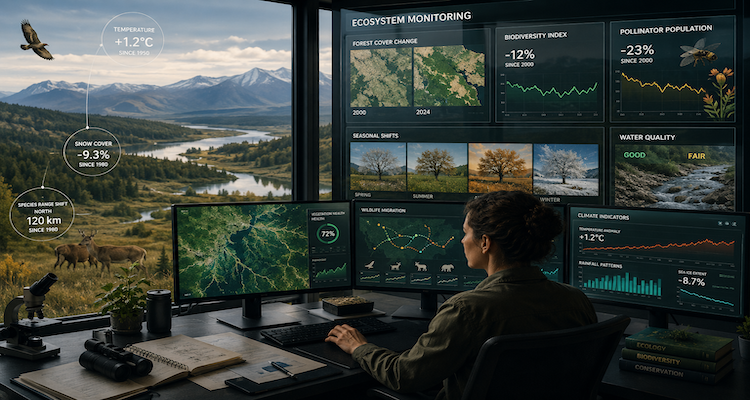
A forest can appear unchanged for years while losing the insects that pollinate its plants. A river can look healthy even as subtle temperature shifts alter the species living beneath its surface. A city skyline may seem constant while tiny changes in air chemistry quietly reshape public health. Some of the most important environmental transformations on Earth do not announce themselves through dramatic disasters or headline-grabbing events. They unfold slowly, almost invisibly, until their consequences become impossible to ignore.
Public attention often gravitates toward environmental crises that are easy to see: raging wildfires, powerful storms, droughts, and melting glaciers. These events matter enormously. Yet many scientists argue that some of the most significant environmental changes are the quieter ones, gradual shifts in ecosystems, species behavior, soil health, ocean chemistry, and seasonal patterns that accumulate over decades.
Understanding these subtle transformations may be one of the most important challenges of the century, not because they are dramatic, but because they influence nearly every aspect of human life.
The Problem With Slow Change
Human beings are remarkably good at reacting to immediate threats. We notice smoke, floods, and heatwaves because they disrupt daily life. Slow-moving environmental changes operate differently.
A lake becoming slightly warmer each year rarely attracts attention. Neither does a gradual decline in pollinating insects or a small reduction in soil fertility. Yet over time, these seemingly minor shifts can affect food production, water quality, biodiversity, and economic stability.
This phenomenon is sometimes described as a challenge of perception. People tend to compare the present with recent memory rather than with conditions from decades earlier. As a result, gradual environmental deterioration can become normalized.
A generation may grow up believing a diminished ecosystem is normal simply because they never experienced what came before.
Nature’s Hidden Signals
Many environmental changes reveal themselves through small biological signals long before larger consequences emerge.
Bird migration patterns may shift by days or weeks. Plants may bloom earlier in the year. Marine species may slowly move toward cooler waters. Insects may appear in regions where they were once uncommon.
Individually, these changes can seem insignificant. Collectively, they can indicate profound alterations in environmental systems.
What makes these signals important is that ecosystems function through countless interconnected relationships. A change affecting one species can ripple outward, influencing many others. When those connections begin to shift, entire ecological networks can gradually reorganize.
The challenge is that such changes often occur below the threshold of everyday observation.
Why Scientists Are Paying Closer Attention
Advances in environmental monitoring have transformed our ability to detect subtle change.
Satellite observations, long-term ecological studies, remote sensors, and advanced data analysis tools now allow researchers to track patterns that would have been nearly impossible to identify decades ago.
Scientists are increasingly discovering that environmental systems often experience long periods of gradual change before reaching critical thresholds. Once those thresholds are crossed, the resulting impacts can emerge much more quickly than expected.
This does not mean every environmental trend will lead to a sudden crisis. However, it highlights the importance of understanding early indicators rather than waiting for visible consequences.
The growing focus on environmental monitoring reflects a broader shift in scientific thinking: prevention and adaptation are often more effective than reaction.
The Connection to Everyday Life
One reason these quiet environmental changes deserve more attention is that they directly affect human systems.
Agriculture depends on predictable weather patterns, healthy soils, pollinators, and reliable water supplies. Small disruptions in any of these areas can influence crop yields over time.
Cities rely on ecosystems in ways many residents rarely consider. Urban trees help regulate temperature. Wetlands reduce flooding risks. Healthy watersheds support drinking water supplies.
Even consumer prices can be affected by gradual environmental shifts. Changes in fisheries, agricultural productivity, and ecosystem services can influence supply chains long before environmental causes become obvious to the public.
The effects are often indirect, which makes them easy to overlook. Yet their economic and social significance can be substantial.
The Rise of Environmental Intelligence
One of the most interesting developments emerging from these trends is the growing importance of environmental intelligence.
Businesses, governments, researchers, and communities are increasingly investing in tools that detect environmental change before it becomes disruptive. Monitoring systems now track everything from soil moisture and vegetation health to ocean temperatures and biodiversity indicators.
This reflects a larger transformation in how society approaches environmental management.
In the past, environmental protection was often viewed as a response to visible damage. Today, there is growing recognition that understanding subtle trends can provide valuable time to adapt and make informed decisions.
The shift mirrors broader changes seen in healthcare, cybersecurity, and risk management, where early detection is often more effective than crisis response.
The Cultural Blind Spot Around Environmental Change
Perhaps the most underappreciated aspect of environmental change is cultural rather than scientific.
People naturally respond to stories. Dramatic events generate headlines because they are easy to understand and emotionally compelling. Gradual transformations rarely produce the same sense of urgency.
As a result, public conversations can become dominated by visible events while quieter developments receive less attention despite potentially larger long-term consequences.
This creates an important communication challenge. How do societies stay engaged with changes that unfold slowly across decades?
The answer may lie in making environmental change more relatable. When people understand how ecosystem shifts influence food, health, infrastructure, recreation, and local communities, abstract environmental trends become tangible realities.
What Makes This Moment Different
Environmental change itself is not new. Earth’s systems have always evolved over time.
What is different today is our ability to observe those changes with unprecedented precision. Modern monitoring technologies allow scientists to detect patterns that were once invisible. At the same time, environmental systems are increasingly interconnected with global economies, supply chains, and urban populations.
This combination means that subtle environmental shifts can have wider implications than in the past, while also becoming easier to measure and understand.
For the first time in history, humanity possesses both the tools to observe many of these changes and the responsibility to respond to them.
Looking Beyond the Obvious
The future of environmental stewardship may depend less on reacting to dramatic events and more on recognizing quiet signals.
A slightly earlier spring. A gradual decline in biodiversity. Changes in water quality. Small shifts in species distribution. These developments rarely dominate public attention, yet they often reveal where larger environmental trends are heading.
The most important environmental stories are not always the loudest ones. They are often the subtle changes unfolding in forests, oceans, rivers, and cities, changes that quietly reshape the conditions upon which human societies depend.
By learning to pay attention to these signals, we gain something valuable: the opportunity to act before challenges become crises and to understand the natural world not only through its most visible disruptions, but through the quieter transformations that define its future.
This content is published for informational or entertainment purposes. Facts, opinions, or references may evolve over time, and readers are encouraged to verify details from reliable sources.