









The Bread That Was Once Used as a Dinner Plate and Eaten After the Meal Was Over
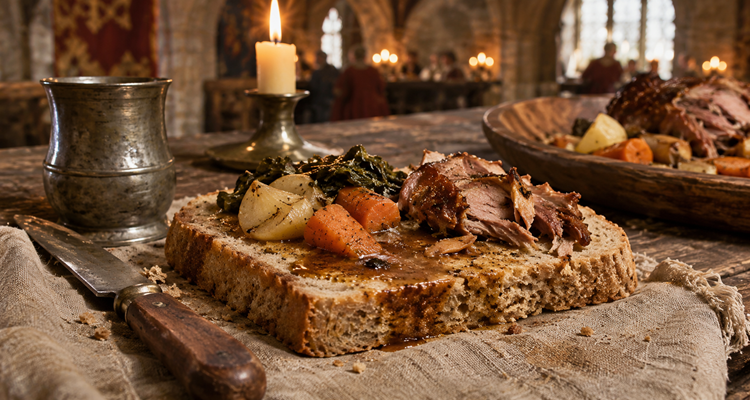
Long before ceramic dinnerware became commonplace, medieval diners sometimes served their meals on thick slices of bread called trenchers. These edible plates reveal a fascinating connection between food, practicality, social status and charity.
In medieval Europe, bread could serve a purpose far beyond satisfying hunger. A thick, firm piece of bread could become the surface on which meat, vegetables and sauces were served. As the meal progressed, it absorbed juices and flavours from the food placed upon it.
Known as a trencher, this unusual form of tableware occupied a place somewhere between a dinner plate and a meal in itself.
However, eating the bread after dinner was not the only possible outcome. Depending on the household and dining customs, used bread trenchers could also be distributed to the poor.
What seems like an unusual culinary tradition today offers an intriguing glimpse into how medieval societies understood food, hospitality and social hierarchy.
What Was Trencher Bread?
A trencher was an early form of tableware commonly associated with medieval dining. The name comes from the Old French word tranchier, meaning to cut.
Unlike the soft bread people might choose to accompany a meal, trencher bread needed to be sufficiently firm to support food without immediately breaking apart.
The Metropolitan Museum of Art explains that bread trenchers were a familiar feature of late medieval Western European feasts, where individual dinner plates were relatively uncommon.
Trenchers were not necessarily identical in shape, size or composition. Their preparation varied according to local ingredients and household traditions. Coarser bread containing wheat, rye or barley could be used for this purpose.
The important distinction was not how attractive the bread looked, but how effectively it performed as a dining surface.
Why Medieval Diners Used Stale Bread
Fresh bread was not always the best material for an edible plate. Bread that had hardened over several days provided a firmer base for serving and cutting food.
The practice also fitted naturally into medieval baking routines. Producing bread required considerable labour, involving grain preparation, milling, kneading and baking.
A 2023 historical study published in the Journal of Medieval History, A Simple Food with Many Meanings: Bread in Late Medieval England, describes how some households baked bread at intervals of several days or longer. Older loaves could subsequently become useful as trenchers.
This gave ageing bread a second practical purpose. A loaf that was becoming less desirable for ordinary eating could still be valuable at the dinner table.
As diners cut their meat, the bread underneath gradually collected its juices. What would otherwise remain on a conventional plate became part of something potentially edible.
A Bread Plate With Its Own Preparation Process
Some historical institutions developed remarkably specific methods for preparing trenchers.
The Museum of the Order of St John describes how knights belonging to the Order used specially prepared unleavened barley bread as tableware.
These trenchers measured approximately six inches long and two inches wide and were allowed to harden for two to four days before use. A household official known as a pantler was responsible for their preparation.
This example reveals that bread plates were not always improvised from whatever leftovers happened to be available. In some establishments, they formed an organised part of meal preparation and service.
Did People Really Eat Their Plates After Dinner?
Yes but the practice was more complicated than the popular image of medieval diners finishing their meals by eating their plates.
Once a trencher had absorbed the flavours of the food served upon it, it could be consumed with the remaining sauce.
English Heritage describes this practice in its educational material about medieval dining at Clifford’s Tower.
However, wealthy households often followed a different custom.
Used trenchers could be collected and distributed as alms to people in need. They might also be passed to servants or fed to household animals.
The Mills Archive Trust documents these alternatives in its account of historical cereal products.
The evidence does not establish that every medieval diner ate their trencher. What it demonstrates is that an edible plate could remain useful even after its original function had been fulfilled.
What Bread Plates Reveal About Medieval Social Class
Perhaps the most interesting aspect of the trencher was not what it was made from, but who eventually consumed it.
Bread was a fundamental part of medieval diets, yet its quality and ingredients could reflect economic circumstances. The same food could carry very different meanings depending on where someone stood within society.
At an aristocratic banquet, a piece of bread might be regarded primarily as a dining implement. Once the feast ended, that same piece could become nourishment for someone who could not afford such a meal.
The Welsh historic environment service, Cadw, notes that distributing food to the poor could also demonstrate the wealth and importance of those providing it.
Seen in this context, the trencher reveals a contradiction within medieval hospitality. A practice that helped redistribute food could simultaneously reinforce the social divisions between those attending a feast and those receiving its remains.
The journey of a single piece of bread therefore offers a small but revealing illustration of medieval inequality.
How Bread Trenchers Became Wooden Plates
The word trencher eventually came to describe reusable dining surfaces as well as edible ones.
Wooden trenchers offered a durable alternative to bread. Some featured carved depressions that helped contain food, while others included a separate recess for salt.
Metal tableware also formed part of historical dining traditions, particularly among wealthier households.
The transition was gradual rather than a sudden replacement of one material with another. Bread, wood and metal could coexist, sometimes within the same table setting.
Cadw’s educational material describes bread trenchers being placed on wooden or silver dishes, illustrating how edible and reusable tableware could work together.
As dining habits and manufacturing methods changed, the edible trencher gradually lost its place as an everyday dining surface.
Its name, however, survived beyond its original material.
Modern Foods That Resemble Medieval Trenchers
Although people rarely use hardened slices of bread as conventional dinner plates today, the underlying culinary idea remains familiar.
Bread bowls filled with soup, bunny chow from South Africa, pizzas and meals served on flatbread all demonstrate how bread can function as both a supporting structure and part of the food being eaten.
The resemblance is functional rather than necessarily historical. These dishes have their own culinary traditions, and their similarities do not establish that they descended from medieval trenchers.
Nevertheless, they demonstrate the enduring usefulness of combining food with its serving surface.
The distinction between a container and its contents becomes less important when both are edible.
Were Medieval Bread Plates an Early Form of Sustainable Dining?
From a modern perspective, trenchers might appear to anticipate some principles of waste-conscious living.
They gave hardened bread another use, captured food juices and could provide nourishment after the meal.
However, it would be misleading to assume that medieval households adopted them out of environmental concerns comparable to those of today.
Their use is better understood through historical food production, dining conventions, economic circumstances and charitable customs.
The practical lesson remains relevant: whether a food is considered waste often depends on whether another useful purpose can be found for it.
Medieval trencher bread illustrates how an ingredient approaching the end of one use could begin another.
A Forgotten Chapter in the History of Dining
Modern dinner plates are such ordinary household objects that their history rarely attracts attention. Yet the medieval trencher reminds us that the tools people use to eat are shaped by their resources, technology and social customs.
What made trencher bread remarkable was its ability to move between different roles. It began as a baked food, became a dining surface and could eventually return to being nourishment.
For some, it was a practical utensil. For others, it was part of a meal received through charity.
The history of this humble bread offers more than an unusual culinary fact. It reveals how even the smallest objects at a dinner table can tell much larger stories about the societies that used them.
This content is published for informational or entertainment purposes. Facts, opinions, or references may evolve over time, and readers are encouraged to verify details from reliable sources.
Related News
- The Fruit That Makes Sour Lemons Taste Sweet Without Adding a Single Grain of Sugar
- The Foods That Change Their Flavour Depending on What You Ate Five Minutes Earlier
- The Cheese That Gets Its Flavour From Tiny Creatures Living on Its Surface
- Why the Last Spoonful of a Meal Can Taste Like a Different Dish