










How Digital Nomad Villages Are Creating Unexpected Economic Growth
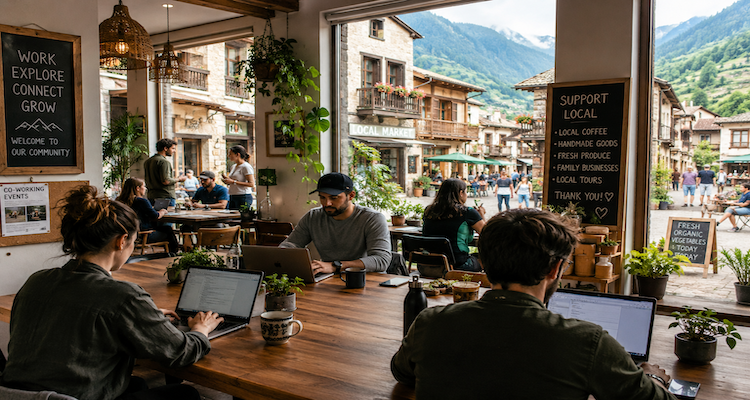
The rise of remote work has produced many travel trends, but few have evolved as quickly, or as unexpectedly, as digital nomad villages. What began as a niche solution for remote professionals seeking affordable places to work and live has quietly become an economic development strategy for communities that were once struggling to attract investment, visitors, or new residents.
Across coastal towns, mountain communities, rural regions, and lesser-known destinations, a new pattern is emerging. Places that once depended heavily on seasonal tourism are discovering that long-stay remote workers can generate a different kind of economic activity—one that is steadier, broader, and often more sustainable than traditional visitor spending.
The story of digital nomad villages is not simply about people working from scenic locations. It is increasingly about how changing work habits are reshaping local economies in ways few policymakers, tourism officials, or residents anticipated.
From Tourist Destinations to Temporary Communities
Traditional tourism tends to follow a familiar pattern. Visitors arrive, spend money on hotels, restaurants, attractions, and transportation, then leave after a few days. While valuable, this model often creates economic peaks and valleys, particularly in destinations dependent on seasonal travel.
Digital nomads operate differently.
Instead of staying for a weekend, they may remain for weeks or months. They rent apartments, use local grocery stores, join gyms, visit cafés repeatedly, and participate in community activities. Their spending becomes woven into everyday local life rather than concentrated around tourist attractions.
This distinction is significant. A remote worker staying for three months may contribute to a local economy in ways that resemble a temporary resident more than a tourist.
As a result, destinations that attract digital nomads are finding themselves less dependent on traditional tourism cycles.
Why Small Communities Are Embracing the Trend
Major cities initially dominated the digital nomad movement. Locations such as Lisbon, Barcelona, and Bali became well-known hubs for remote workers.
However, rising costs and overcrowding have pushed many nomads toward smaller destinations.
Communities that once struggled to compete with global cities are now seeing opportunity. Instead of building large tourism infrastructure projects, some regions are investing in coworking spaces, reliable internet, community events, and long-stay accommodation.
The appeal works both ways.
Remote workers gain affordability, access to nature, and a stronger sense of community. Local economies gain a steady stream of consumers who often spend more consistently than short-term tourists.
This shift is especially attractive for regions facing population decline or economic stagnation. Even a relatively small influx of long-term visitors can have a noticeable impact on local businesses.
The Hidden Economic Multiplier
One of the most overlooked aspects of digital nomad villages is how spending spreads across the local economy.
A typical tourist may interact primarily with hospitality businesses. A digital nomad often engages with a much wider range of services.
They may hire fitness instructors, attend language classes, purchase local products, visit healthcare providers, use transportation services, and support independent cafés and restaurants on a regular basis.
This creates what economists often describe as a multiplier effect. Money circulates through multiple sectors rather than remaining concentrated within tourism alone.
The result is that even a modest number of remote workers can support economic activity across a surprisingly broad network of businesses.
For small communities, this diversification can be more valuable than large visitor numbers that generate spending in only a handful of sectors.
A New Form of Economic Development
Perhaps the most interesting development is that some regions are beginning to view digital nomad attraction as an economic policy rather than a tourism campaign.
Traditionally, communities seeking growth focused on attracting companies, factories, or large employers.
Digital nomad villages represent a different model.
Instead of bringing jobs to residents, they bring residents with jobs.
Remote professionals arrive with income already secured through employers or clients located elsewhere. This means local communities can benefit from spending without having to create large numbers of new jobs themselves.
The model effectively imports purchasing power.
For smaller destinations with limited resources, that can be a powerful proposition.
The Community Challenge
The economic story is not entirely positive.
As digital nomad destinations gain popularity, some communities face familiar challenges associated with growth. Housing availability can become strained. Rental prices may increase. Long-term residents sometimes worry about cultural change or displacement.
These concerns have already surfaced in several popular remote-work destinations around the world.
The lesson emerging from early adopters is that success requires balance.
Communities that benefit most tend to focus on integration rather than isolation. They encourage interaction between visitors and residents, support local businesses, and develop policies that protect housing affordability while welcoming newcomers.
Digital nomad villages work best when they become part of a community rather than existing separately from it.
Why This Moment Feels Different
Remote work is no longer viewed as a temporary workplace experiment.
Many organizations now operate with distributed teams, hybrid structures, or location-flexible arrangements. At the same time, workers increasingly value experiences, flexibility, and quality of life alongside salary considerations.
These trends are reinforcing one another.
People who once chose between career advancement and geographic freedom increasingly expect both. That expectation is helping sustain demand for destinations designed around remote living.
Unlike earlier travel trends driven primarily by leisure, digital nomad villages sit at the intersection of work, lifestyle, technology, and community.
That makes them more resilient than many observers initially assumed.
The Bigger Shift Behind the Boom
The most important insight may have less to do with travel and more to do with economics.
For decades, economic growth was closely tied to where businesses chose to locate. Remote work is gradually changing that relationship.
Increasingly, individuals can choose where they live first and work second.
That seemingly simple reversal has profound implications. It means smaller communities are no longer competing solely for tourists or corporate investment. They are competing for talented individuals who can bring economic activity with them.
Digital nomad villages are an early example of this transformation.
What appears on the surface to be a travel trend may actually represent a broader reorganization of how people distribute income, talent, and economic value across regions.
Looking Ahead
The future of digital nomad villages will likely depend on how effectively communities balance growth with sustainability.
Not every destination will become a remote-work hotspot, and not every experiment will succeed. Yet the underlying forces driving the trend, flexible work, lifestyle-driven relocation, and distributed economic activity, show little sign of disappearing.
For travelers, digital nomad villages offer a different way to experience a destination. For communities, they present a chance to diversify local economies. And for policymakers, they provide a glimpse into how work and geography may interact in the years ahead.
The unexpected economic boom behind these villages is not simply about attracting visitors. It is about attracting participation, connection, and long-term engagement. In an increasingly mobile world, that distinction may prove far more valuable than traditional tourism alone.
This content is published for informational or entertainment purposes. Facts, opinions, or references may evolve over time, and readers are encouraged to verify details from reliable sources.