








AI Is Teaching Scientists to Hear Entire Ecosystems
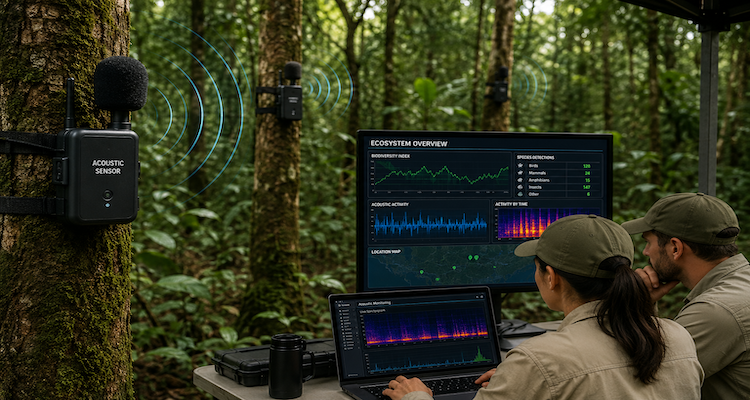
A forest rarely falls silent. Even when no animals are visible, the air carries thousands of signals: birds calling across the canopy, insects vibrating through the undergrowth, frogs responding to changing humidity, and distant mammals moving through the night. For centuries, scientists trying to understand wildlife had to rely largely on what they could see. Today, a growing number of researchers are discovering that listening may reveal far more than looking.
The shift is subtle but transformative. Advances in artificial intelligence are allowing scientists to monitor entire ecosystems through sound, turning forests, wetlands, grasslands, and oceans into living sources of continuous environmental information. What once required years of field observations can now be supported by systems capable of processing vast amounts of audio data around the clock.
The result is not simply better wildlife monitoring. It represents a new way of understanding how nature changes, adapts, and sometimes struggles under pressure.
The Rise of Acoustic Ecology
Every ecosystem produces a unique soundscape. Birds, insects, amphibians, mammals, wind, rainfall, and flowing water combine to create an acoustic signature that reflects environmental conditions.
Scientists have long known that these sounds contain valuable information. The challenge was scale. A single recording device left in a forest for weeks can generate hundreds or even thousands of hours of audio. Manually reviewing such recordings is often impractical.
Artificial intelligence is changing that equation.
Modern machine-learning systems can analyze massive audio datasets and identify patterns that would be difficult or impossible for humans to detect consistently. Instead of listening to every recording, researchers can train AI models to recognize specific species, identify unusual activity, or track changes across entire habitats.
What makes this development particularly significant is that ecosystems rarely communicate through isolated signals. They reveal themselves through collective patterns. AI excels at finding those patterns.
From Individual Species to Ecosystem Health
Traditional wildlife monitoring often focuses on individual animals. Researchers may track a threatened bird population, monitor large mammals, or count specific amphibian species.
Acoustic AI expands that perspective.
By analyzing the combined sounds of an environment, scientists can gain insights into overall ecosystem health. A diverse and balanced soundscape often indicates a thriving habitat. Declining acoustic diversity may signal environmental stress, habitat degradation, invasive species, or broader ecological disruption.
This broader view is becoming increasingly important as conservation efforts move beyond protecting individual species toward preserving entire ecological systems.
A healthy ecosystem is more than the presence of a few iconic animals. It is a complex network of interactions, many of which become audible long before they become visible.
Listening in Places Humans Cannot Constantly Watch
One of the most practical advantages of AI-powered listening is its ability to monitor remote locations continuously.
Dense rainforests, mountain regions, wetlands, and marine environments can be difficult and expensive to survey regularly. Automated recording devices, however, can operate for extended periods with minimal human presence.
When paired with AI analysis, these recordings become a powerful monitoring tool.
Researchers can detect seasonal migrations, breeding activity, changes in species composition, and even signs of illegal activities such as unauthorized logging or poaching. In some cases, unusual sound patterns may provide early warnings of ecological changes before they become apparent through traditional observation methods.
The ability to monitor environments continuously rather than periodically offers a fundamentally different understanding of how ecosystems function.
The Ocean Is Becoming Easier to Hear
The acoustic revolution is not limited to forests.
Marine environments are among the most challenging ecosystems to study. Much of what occurs beneath the ocean surface remains difficult to observe directly.
Sound, however, travels efficiently underwater.
Researchers increasingly use AI to analyze recordings from underwater microphones, known as hydrophones, to detect whale vocalizations, monitor dolphin populations, and study broader patterns of marine activity.
This approach is helping scientists understand migration routes, habitat use, and potential environmental threats while reducing the need for constant physical surveys.
As ocean conservation becomes more urgent, AI-assisted acoustic monitoring may play an increasingly important role in protecting marine biodiversity.
The Hidden Insight: Nature Generates Big Data Too
One of the most overlooked aspects of this trend is that wildlife conservation is quietly becoming a data-intensive discipline.
When people think about artificial intelligence, they often associate it with business analytics, consumer platforms, or workplace automation. Yet ecosystems themselves generate enormous quantities of information every second.
Bird songs, insect choruses, whale calls, and environmental sounds collectively create datasets of remarkable complexity.
AI’s growing role in conservation highlights a broader shift occurring across science: the most valuable discoveries increasingly emerge from finding meaningful patterns within overwhelming amounts of information.
In this sense, conservation is beginning to resemble fields such as astronomy, climate science, and genomics, where advanced computing helps researchers uncover relationships hidden within vast datasets.
The future of wildlife protection may depend as much on interpreting information as collecting it.
Why Public Interest Is Growing
Interest in AI-powered wildlife monitoring is rising for reasons that extend beyond scientific research.
People are becoming more aware of biodiversity loss, habitat fragmentation, and environmental change. At the same time, there is growing fascination with how emerging technologies can address real-world challenges.
Unlike many discussions about artificial intelligence that focus on automation or productivity, acoustic ecology presents a different narrative. Here, AI is not replacing human expertise. Instead, it amplifies human capacity to observe, understand, and respond.
That distinction resonates with audiences seeking examples of technology serving environmental goals rather than purely commercial objectives.
It also reflects a broader cultural shift. As environmental challenges become more complex, solutions increasingly depend on combining traditional scientific knowledge with advanced analytical tools.
The Limitations Scientists Must Still Navigate
Despite its promise, AI-powered listening is not a perfect solution.
Environmental recordings often contain overlapping sounds, background noise, weather interference, and unexpected acoustic events. Species may vary their calls across regions or seasons, making identification more difficult.
AI models also require careful validation. Incorrect classifications can lead to misleading conclusions if results are not verified by researchers.
For this reason, most scientists view AI as a powerful assistant rather than a replacement for ecological expertise. Human interpretation remains essential for understanding the ecological significance behind detected patterns.
The technology can reveal what is happening. Understanding why it is happening still requires scientific judgment.
A New Relationship Between Technology and Nature
Perhaps the most fascinating aspect of this development is philosophical rather than technical.
For much of modern history, technological progress and environmental protection were often portrayed as competing forces. The rise of acoustic AI suggests a more nuanced relationship.
Instead of distancing humans from nature, advanced technologies may help people perceive aspects of the natural world that were previously inaccessible. Entire ecosystems are becoming measurable in ways that were unimaginable only a generation ago.
Scientists are no longer limited to snapshots of wildlife activity. They can increasingly observe the continuous rhythm of living systems.
The quiet revolution taking place in forests, wetlands, and oceans is not merely about artificial intelligence. It is about learning to listen more carefully to a planet that has always been communicating. For the first time, we are developing tools capable of hearing the conversation at scale, and that may reshape how conservation is understood in the decades ahead.
This content is published for informational or entertainment purposes. Facts, opinions, or references may evolve over time, and readers are encouraged to verify details from reliable sources.
Related News
- Mary the Elephant: The Animal They Executed for a Crime She Could Never Understand
- The Animals That Change Their Daily Routine When Humans Stop Watching
- The Forest Has a Warning System That Works Before Most Animals Ever See the Predator
- The Animals That Change Their Behavior When Nobody Is Watching