








After We’re Gone: The Unseen Future of Our Digital Lives
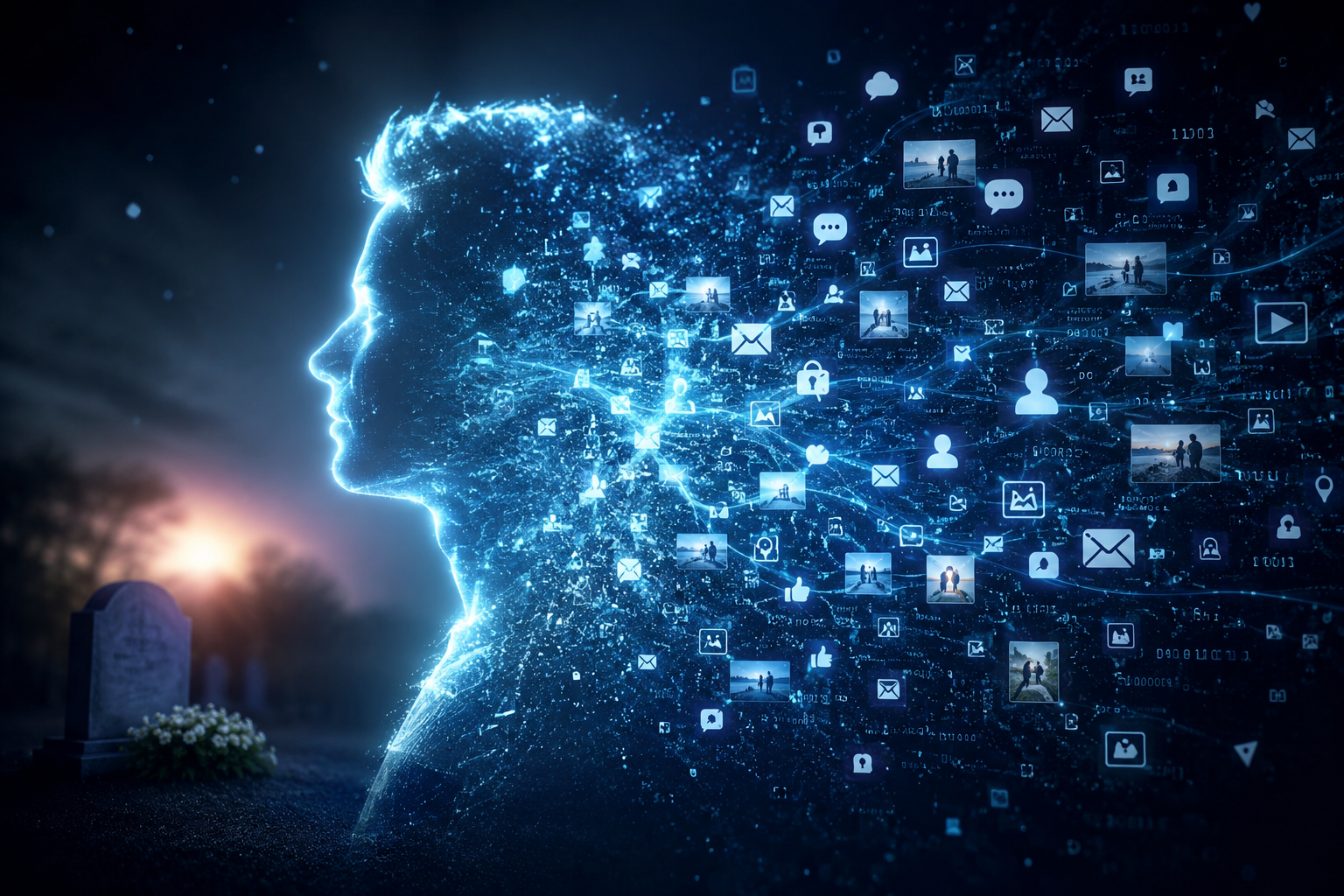
A person dies, but their social media profile keeps sending birthday reminders. Their old posts continue appearing in friends’ memories. An AI chatbot trained on their messages can still generate responses that sound remarkably like them. In some cases, their email account remains active for years, quietly receiving newsletters, password resets, and messages from people who never learned they had passed away.
Death used to leave behind physical traces: photographs, letters, journals, and personal belongings. Today, it leaves something else—an extensive digital presence that can persist indefinitely. From social media profiles and cloud storage accounts to online subscriptions and digital assets, modern life has created a new category of legacy that previous generations never had to manage.
The rise of these “digital ghosts” is forcing families, technology companies, and society itself to confront a question that has become increasingly difficult to ignore: what happens to our online lives when our real lives end?
The Internet Was Never Designed for Death
Most digital platforms were built around growth, engagement, and continuous activity. Their systems assume users will keep logging in, updating profiles, sharing content, and interacting with others.
Death disrupts that assumption.
When someone passes away, their accounts often remain scattered across dozens of services. Social media profiles may continue to exist. Streaming subscriptions may continue billing. Cloud storage accounts may contain valuable documents, family photos, or personal records that relatives cannot access.
The challenge is not merely technical. It is emotional.
For some families, a deceased person’s online presence becomes a digital memorial. Old posts, photos, and messages provide comfort and preserve memories in a way that traditional keepsakes never could.
For others, these accounts become painful reminders that are difficult to manage or remove.
As a result, technology companies have gradually begun introducing tools for account memorialization, legacy contacts, and digital inheritance. Yet the broader issue remains far from resolved.
Digital Legacy Is Becoming a New Form of Estate Planning
For decades, estate planning focused on property, financial assets, and legal documents. Increasingly, digital assets are becoming part of that conversation.
Many people now store significant portions of their lives online. Personal photographs may exist only in cloud services. Important documents may be stored in email accounts. Creative work may live on websites, social platforms, or digital marketplaces.
Cryptocurrency holdings add another layer of complexity. Without proper access information, these assets can become permanently inaccessible.
What makes digital legacy unique is that ownership and access are often governed by platform policies rather than traditional inheritance laws alone. A family member may legally inherit someone’s estate but still encounter obstacles accessing digital accounts protected by privacy rules or security systems.
This shift suggests that future estate planning may increasingly include digital instructions alongside wills and financial documents.
The Emergence of AI-Powered Memory
Perhaps the most striking development is the growing role of artificial intelligence in preserving aspects of human identity.
AI systems can already analyze vast collections of emails, messages, recordings, and social media posts. In some cases, they can generate text that resembles a person’s communication style.
This raises profound questions.
If an AI can simulate how someone spoke, joked, or responded to friends, does it function as a memorial, a tool for remembrance, or something entirely different?
Some people view such technologies as comforting. Others find them unsettling.
The debate reflects a broader cultural shift. For the first time in history, human behavior is being recorded at a scale detailed enough to create digital approximations of personality. Whether society embraces or rejects these capabilities remains uncertain, but their existence is changing how people think about memory and mortality.
Why Interest in Digital Death Is Growing
The topic is attracting attention for a simple reason: nearly everyone now has a digital footprint.
A generation ago, only a small portion of life was documented online. Today, much of daily activity leaves a digital record.
People maintain multiple social media profiles. They store years of photos in cloud services. They subscribe to digital platforms, conduct financial transactions online, and communicate primarily through messaging apps.
As these habits become universal, questions about digital afterlife move from niche concerns to mainstream issues.
The growing awareness is also tied to demographic reality. As larger populations age and digitally native generations grow older, families increasingly encounter the practical challenges of managing online accounts after a loved one’s death.
What once seemed like a futuristic issue is becoming an everyday one.
The Hidden Insight: We Are Creating Permanent Versions of Ourselves
One of the most overlooked aspects of digital legacy is that it changes the nature of memory itself.
Historically, memories faded, evolved, and depended on human recollection. Digital records operate differently. They preserve conversations, images, opinions, and moments with extraordinary permanence.
As a result, future generations may encounter highly detailed archives of their parents’ and grandparents’ lives. Instead of relying on stories, they may browse decades of posts, videos, messages, and photographs.
This creates an unusual paradox.
Technology gives us unprecedented control over preserving memories, yet it also reduces our ability to leave certain parts of life behind. Opinions expressed years earlier can remain searchable. Personal moments once considered temporary may become permanent records.
In this sense, digital ghosts are not merely about death. They are about the transformation of memory from something human and imperfect into something increasingly persistent and searchable.
Who Owns a Life After It Ends?
The question of ownership sits at the center of the digital afterlife debate.
Should families have complete control over a deceased person’s online accounts?
Should private messages remain inaccessible, even after death?
Should platforms decide what content remains visible?
There are no universally accepted answers.
Different services take different approaches. Some allow memorialized accounts. Others permit designated contacts to manage certain settings. Some prioritize privacy and restrict access even after death.
As society becomes more dependent on digital systems, these questions will likely become more urgent. Legal frameworks, platform policies, and cultural expectations are still evolving.
What Comes Next?
The future of digital legacy will likely extend beyond account management.
We may see broader adoption of digital inheritance tools, automated legacy planning services, and more sophisticated methods for preserving personal histories. AI could enable interactive archives that help future generations explore family memories in entirely new ways.
At the same time, concerns about privacy, consent, authenticity, and emotional impact will grow.
The challenge is balancing preservation with respect, innovation with ethics, and memory with human dignity.
The rise of digital ghosts reveals something larger than a technological trend. It highlights a fundamental shift in how humanity records, preserves, and remembers life itself.
For the first time, many people will leave behind not just memories in the minds of others, but entire digital versions of their existence. The decisions made today, by individuals, families, and technology companies, will shape how those digital lives continue long after their creators are gone.
And that may become one of the defining legacy questions of the digital age.
This content is published for informational or entertainment purposes. Facts, opinions, or references may evolve over time, and readers are encouraged to verify details from reliable sources.