










When Every Spare Moment Is Filled, What Do We Lose?
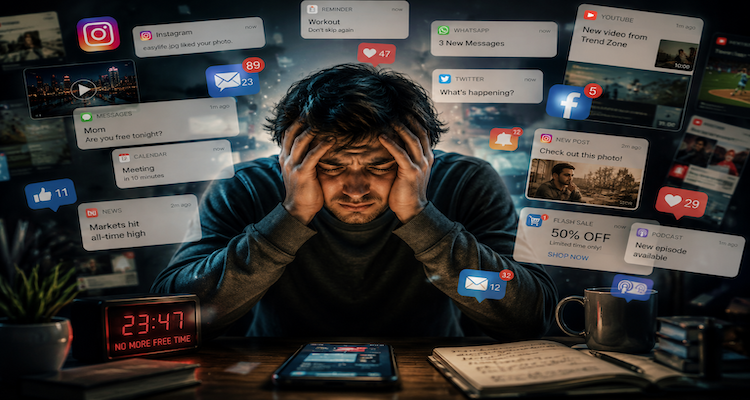
There was a time when waiting was unavoidable. People stood in line without checking notifications, sat on trains looking out the window, and spent idle moments letting their minds wander. Those gaps in the day were rarely considered valuable. They were simply empty spaces between activities.
Today, those spaces are disappearing.
A few seconds in an elevator, a short walk between meetings, or a pause before falling asleep can instantly be occupied by videos, messages, podcasts, games, shopping apps, news feeds, or AI assistants. The modern digital economy has become remarkably efficient at turning downtime into engagement. As a result, many people are spending less time being bored than at any point in history.
The shift may seem harmless. After all, filling spare moments often feels productive, entertaining, or informative. Yet an important question is emerging beneath the convenience: what happens when every spare moment is filled?
The Disappearing Space Between Activities
Most discussions about technology focus on screen time. But a more subtle change may be occurring beneath the surface.
The issue is not necessarily how many hours people spend online. It is how few moments remain untouched.
Many digital platforms are designed around immediacy. The instant a moment opens up, there is something ready to occupy it. Algorithms ensure there is always another video, another recommendation, another conversation, or another piece of content waiting.
As a result, the boundaries between activities are shrinking. The mental transition periods that once existed throughout the day are becoming increasingly rare.
Those small gaps may seem insignificant, but they have traditionally served important psychological functions. They gave people time to process experiences, reflect on conversations, organize thoughts, and mentally prepare for what came next.
When those pauses disappear, life can begin to feel like a continuous stream of inputs.
Why Boredom May Be More Important Than It Looks
Boredom has an image problem.
Most people view boredom as something to avoid. Businesses compete to eliminate it. Apps promise endless stimulation. Entertainment platforms offer infinite content libraries.
Yet boredom has historically played a surprising role in human creativity and problem-solving.
Many ideas emerge not during periods of intense focus but during moments when the mind is free to wander. A walk without distractions, a quiet commute, or an afternoon spent doing repetitive tasks often creates conditions for unexpected connections and insights.
Researchers and psychologists have long explored how mind-wandering contributes to creativity, self-reflection, and future planning. While constant stimulation keeps attention occupied, unstructured thinking allows the brain to make associations that may not emerge during focused tasks.
The growing scarcity of boredom may therefore have consequences that are not immediately visible.
People may be gaining more content while losing some opportunities for deeper thought.
The Rise of Micro-Consumption
One of the defining habits of the digital age is micro-consumption.
Instead of dedicating an hour to reading a book or watching a documentary, people increasingly consume information in fragmented pieces throughout the day. A few minutes here. Thirty seconds there. A quick scroll while waiting for coffee.
This pattern has obvious advantages. It allows learning, entertainment, and communication to fit into busy schedules.
However, it also changes how attention is distributed.
When every spare moment becomes an opportunity for consumption, attention becomes fragmented across dozens of small experiences rather than concentrated on fewer meaningful ones.
Many people report feeling constantly informed yet strangely overwhelmed. They encounter hundreds of pieces of information daily but have limited opportunities to process what they have absorbed.
The result can be a paradox: more information, less reflection.
The Attention Economy Has Moved Into Every Gap
The competition for attention is no longer confined to prime-time television or major websites.
Today, businesses compete for seconds.
Streaming platforms want the moments between tasks. Social media platforms target short breaks. Retail apps use notifications to capture attention throughout the day. AI-powered tools increasingly offer instant answers whenever curiosity appears.
This reflects a larger economic shift.
Attention has become one of the most valuable resources in the digital marketplace. Every spare moment represents an opportunity for engagement, advertising, data collection, or platform growth.
For consumers, the challenge is that attention is finite.
The more fragmented attention becomes, the more difficult it can be to sustain focus, engage deeply with complex ideas, or simply enjoy periods of uninterrupted presence.
What This Means for Work and Learning
The effects extend beyond personal habits.
Workplaces increasingly rely on constant connectivity. Messages, updates, and notifications can arrive at any moment. Employees often move between tasks with little opportunity for mental recovery.
Education faces similar challenges. Students have access to unprecedented amounts of information, yet maintaining sustained concentration is becoming more difficult for many learners.
This does not mean technology is inherently harmful. Digital tools provide enormous benefits for productivity, communication, and access to knowledge.
The challenge lies in balance.
A mind that never experiences downtime may struggle to consolidate information, generate original ideas, or maintain long-term focus.
Ironically, the skills becoming most valuable in a distracted environment may be the ability to concentrate, reflect, and think deeply.
The Hidden Cultural Shift
Perhaps the most interesting development is cultural rather than technological.
For generations, being busy signaled productivity. Now, being constantly occupied mentally is increasingly becoming the norm.
Silence, waiting, and inactivity are often treated as inefficiencies to be optimized away.
Yet some countertrends are beginning to emerge. Digital detox retreats, silent weekends, mindfulness practices, long walks without devices, and growing interest in slow living all point toward a desire for mental space.
These movements suggest that people are starting to recognize something valuable about unoccupied time.
Not because they reject technology, but because they sense that constant engagement comes with trade-offs.
The Future of Unstructured Time
The next stage of the digital era may not be defined by how much technology people use but by how intentionally they use it.
As AI assistants, personalized content feeds, and immersive digital experiences become more sophisticated, the ability to fill every spare moment will only increase.
The question is whether people will allow every moment to be filled.
The most valuable resource in the future may not be information. It may not even be attention.
It may be the ability to protect moments of mental freedom.
Those seemingly empty spaces between activities often serve as the mind’s workshop. They are where experiences settle, ideas connect, and self-awareness develops.
The growing disappearance of spare moments reveals a larger truth about modern life: efficiency and fulfillment are not always the same thing.
Sometimes the moments that appear least productive are quietly doing some of the most important work.
This content is published for informational or entertainment purposes. Facts, opinions, or references may evolve over time, and readers are encouraged to verify details from reliable sources.