









Why More People Are Creating Personal Information Diets
The average person has more access to information than any generation before them. News alerts arrive instantly, social feeds refresh endlessly, podcasts compete for attention during commutes, and video platforms offer an infinite stream of content tailored to individual interests. Yet despite this unprecedented abundance, many people report feeling less informed, more distracted, and increasingly overwhelmed.
A growing number of individuals are responding in an unexpected way: they are intentionally consuming less information.
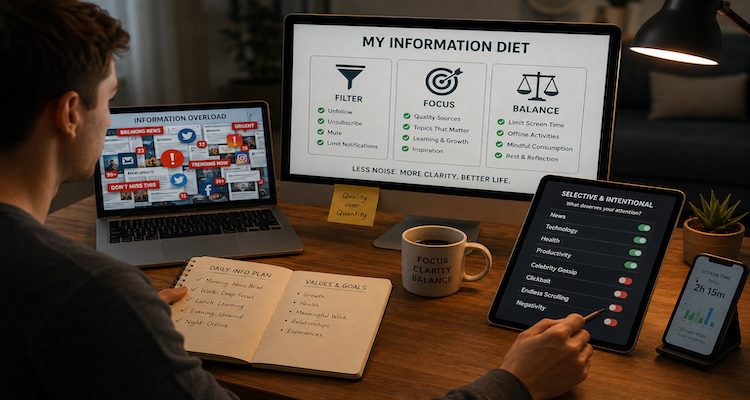
Rather than trying to keep up with every headline, trend, opinion, and update, people are beginning to build what could be described as personal information diets deliberate systems that determine what information enters their lives, how often they consume it, and which sources deserve their attention. What began as a productivity tactic is increasingly becoming a lifestyle choice.
The Shift From Information Scarcity to Information Overload
For most of human history, obtaining information required effort. Newspapers arrived once a day. Television broadcasts followed fixed schedules. Books demanded time and commitment.
Today, the challenge is no longer finding information. The challenge is filtering it.
Algorithms, notifications, newsletters, social platforms, and streaming services continuously compete for attention. The result is an environment where information consumption can easily become passive rather than intentional.
Many people discover that despite spending hours reading, watching, and scrolling, they struggle to remember what they consumed or why it mattered. Information begins to feel less like a tool for understanding and more like a constant background noise.
Personal information diets emerge as a response to this imbalance. Instead of maximizing consumption, individuals focus on improving the quality and relevance of what they consume.
Why More People Are Questioning Their Media Habits
Several cultural shifts are fueling interest in information diets.
One factor is digital fatigue. The constant flow of updates can create a feeling that there is always something important happening somewhere. This makes disconnecting difficult, even when the information provides little practical value.
Another factor is growing awareness of how platforms are designed to capture attention. Many users have become more conscious of recommendation algorithms, engagement-driven content, and the emotional impact of continuous exposure to sensational or highly polarized information.
At the same time, professionals, students, entrepreneurs, and knowledge workers face increasing pressure to focus deeply. Endless information consumption often conflicts with the concentration required for meaningful work.
As a result, people are beginning to ask a different question. Instead of wondering how to access more information, they are asking how much information they actually need.
The Rise of Intentional Consumption
A personal information diet does not necessarily mean consuming less news or abandoning digital platforms altogether.
Instead, it involves making deliberate choices about information sources and consumption habits.
Some people limit news consumption to specific times of the day. Others unsubscribe from newsletters they never read, disable non-essential notifications, or rely on a small number of trusted sources rather than dozens of competing voices.
Many professionals are becoming selective about which podcasts, industry publications, and social channels they follow. Rather than collecting information broadly, they prioritize information that aligns with their goals, work, or personal interests.
This shift mirrors changes seen in other areas of life. Just as people increasingly think about nutrition, exercise, and sleep quality, information is becoming another area where intentional choices matter.
The Hidden Cost of Consuming Everything
One of the most overlooked consequences of information overload is decision fatigue.
Every article, video, notification, and recommendation competes for mental resources. Even seemingly small decisions whether to click, read, save, or ignore content accumulate throughout the day.
Over time, excessive information consumption can reduce the mental energy available for analysis, creativity, and reflection.
This reveals an important insight: the value of information is not determined by how much is consumed but by what it enables someone to do.
Many people assume that being constantly informed leads to better decisions. In reality, endless exposure to information can sometimes create confusion rather than clarity. When too many perspectives compete simultaneously, distinguishing signal from noise becomes increasingly difficult.
A well-designed information diet seeks clarity, not volume.
How Information Diets Reflect a Broader Cultural Change
The growing interest in information diets reflects a larger shift in how people view attention.
For years, discussions about digital technology focused primarily on access. More access was considered inherently beneficial.
Now attention itself is increasingly viewed as a limited and valuable resource.
This perspective is influencing everything from workplace productivity practices to education strategies and personal well-being habits. The ability to manage attention is becoming a skill that many people consider as important as managing time.
The trend is particularly visible among younger professionals who have grown up with digital platforms. Having experienced constant connectivity throughout much of their lives, many are actively experimenting with boundaries around information consumption.
This does not represent a rejection of technology. Instead, it reflects a more mature relationship with it.
Businesses and Platforms Are Paying Attention
The rise of information diets has implications beyond individual users.
Technology companies, media organizations, and content creators increasingly operate in an environment where audience attention is finite. Users are becoming more selective about what earns their time.
This may encourage greater emphasis on quality, trust, and relevance rather than simply maximizing volume.
Publishers, educators, and brands face a growing challenge: creating content that genuinely deserves attention rather than merely competing for it.
Consumers who adopt information diets often become more discerning audiences. They may engage less frequently, but they are more likely to invest attention in content they perceive as valuable.
This shift could reshape how information is produced and distributed in the years ahead.
What a Healthier Information Future Might Look Like
The popularity of personal information diets suggests that society may be entering a new phase of digital maturity.
People are increasingly recognizing that information abundance does not automatically produce knowledge, wisdom, or understanding. Those outcomes require reflection, context, and focus.
The future may involve more personalized approaches to information management. Individuals may become increasingly skilled at curating their own media environments, selecting trusted sources, and creating intentional boundaries around consumption.
In many ways, the goal is not to know less. It is to know what matters.
As information continues to expand across every aspect of life, the ability to filter, prioritize, and focus may become one of the most valuable skills of the digital age. The people building personal information diets today are not necessarily withdrawing from the flow of information. They are learning how to navigate it more effectively.
And in a world where attention is constantly under pressure, that may prove to be a significant advantage.
This content is published for informational or entertainment purposes. Facts, opinions, or references may evolve over time, and readers are encouraged to verify details from reliable sources.