









The Fish That Recognise Individual Human Faces Without Having a Human-Like Brain
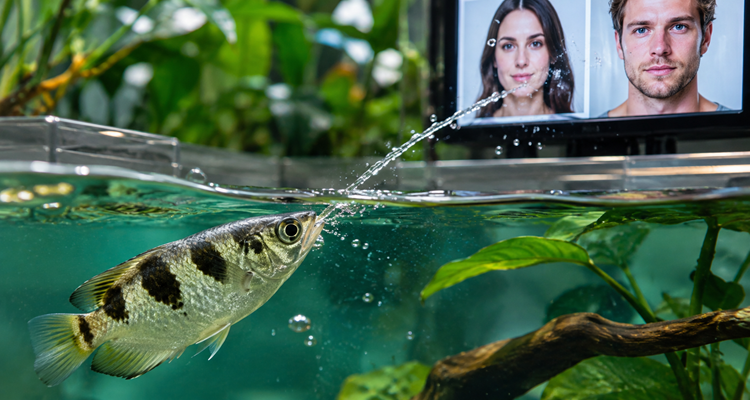
Recognising a human face might seem like a task that requires a sophisticated brain. Yet the archerfish, a remarkable fish known for shooting jets of water at insects above the surface, can learn to distinguish between individual human faces despite lacking the neocortex associated with complex visual processing in humans.
This ability challenges conventional assumptions about animal intelligence. It also raises a fascinating scientific question: how much of what we consider advanced intelligence actually requires a brain like ours?
In experiments published in 2016 and 2018, scientists demonstrated that archerfish could distinguish human facial images and recognise previously learned faces from unfamiliar viewing angles. The findings suggest that complex visual recognition can emerge from evolutionary pathways remarkably different from our own.
Meet the Archerfish: Nature’s Underwater Marksman
The archerfish (Toxotes chatareus) possesses an unusual hunting technique. Rather than pursuing prey exclusively underwater, it targets insects above the water’s surface, knocking them down with precisely directed jets of water.
Successful hunting requires more than accurate aim. The fish must locate potential prey against complicated backgrounds, distinguish relevant objects from surrounding vegetation and respond to movement.
These visual demands make archerfish particularly interesting to scientists investigating animal cognition.
A 2018 scientific review of archerfish visual processing describes how their hunting behaviour makes them valuable subjects for research into visual attention, object recognition and movement prediction.
Although recognising human faces offers little obvious advantage in their natural environment, the visual abilities that support hunting may also help them solve unfamiliar recognition tasks.
How Scientists Discovered That Fish Can Recognise Human Faces
In June 2016, researchers associated with the University of Oxford and the University of Queensland published a study in Scientific Reports investigating whether archerfish could distinguish individual human faces.
The researchers used the fish’s natural shooting behaviour to create an experimental selection mechanism.
A computer monitor positioned above an aquarium displayed two facial photographs. The fish indicated its selection by directing water towards an image, receiving food as reinforcement for correct responses.
After training, the researchers introduced unfamiliar faces to determine whether the animals could distinguish them from a previously learned face.
The experiments involved eight archerfish, divided into two groups of four. The first group encountered 44 unfamiliar facial images during testing, while the second encountered 18 under more controlled visual conditions.
According to the University of Queensland’s research announcement, performance reached approximately 81% and 86% in the two experiments.
The results demonstrated that the fish were doing considerably more than making random selections.
Removing the Obvious Clues
Distinguishing photographs does not necessarily require recognising facial features. Differences in colour, brightness or the outline of a person’s head could provide easier shortcuts.
To address this possibility, researchers modified the images in the second experiment.
They removed colour, standardised brightness and concealed differences in external head outlines. The fish nevertheless continued to make successful selections.
This strengthened the evidence that archerfish could detect relatively subtle visual differences rather than relying entirely on conspicuous characteristics.
It did not, however, establish precisely which facial features the animals used. Whether they processed the relationships between features or relied on particular local details remained uncertain.
Recognising Faces From Different Angles
A greater challenge in visual recognition is identifying something when its appearance changes.
Consider seeing a familiar colleague from the side rather than directly from the front. Although the visible arrangement of their facial features has changed, you can usually recognise them.
Scientists refer to the ability to maintain recognition across changing perspectives as view invariance.
In a follow-up study published in Animal Behaviour in 2018, researchers investigated whether archerfish possessed this capability.
The fish initially learned to distinguish front-facing portraits. They were subsequently presented with versions showing different orientations.
Most successfully recognised the learned face even when its orientation changed by as much as 90 degrees, although performance varied.
This finding suggests that archerfish recognition extends beyond memorising an unchanging photograph. Their visual systems can retain useful information about an object despite substantial changes in its appearance.
How Can Fish Recognise Faces Without a Human-Like Brain?
In humans, face perception involves several interconnected brain regions, including areas within the temporal cortex that respond strongly to faces.
Archerfish lack the mammalian neocortex. Nevertheless, their brains contain neural systems capable of processing visual information, forming associations and guiding learned behaviour.
The important distinction is between a biological structure and the function it performs.
Two species do not necessarily need identical brain structures to solve similar problems. Evolution can produce different neural arrangements that support comparable behavioural outcomes.
Think of a recognition problem as a destination that can be reached through several routes. The human brain may follow one route, while an archerfish follows another.
The experiments establish that a mammalian neocortex is not indispensable for every aspect of recognising human facial images. They do not establish that fish and humans accomplish recognition through identical mechanisms.
Did Evolution Prepare Archerfish for This Ability?
Human faces are not a natural hunting target for archerfish. Their ability to distinguish them may instead reflect visual skills developed in response to other environmental demands.
An insect viewed from different directions does not always present the same outline. Leaves, reflections, shadows and movement can further complicate its appearance.
An animal capable of recognising relevant visual characteristics despite such changes may have an advantage when searching for food.
Further evidence emerged from a 2022 study investigating natural object recognition in archerfish.
Researchers found that the fish could classify unfamiliar objects and identify previously encountered objects under altered visual conditions. Their experiments also indicated that object outlines were particularly informative relative to surface textures.
Together, these findings support the possibility that human-face discrimination draws upon broader visual capabilities rather than a specialised adaptation for recognising people.
The precise evolutionary and neurological origins of that capability remain open to investigation.
Can Archerfish Recognise Their Owners?
Aquarium owners sometimes report that their fish respond differently to familiar people. Such observations are intriguing, but they are not equivalent to controlled demonstrations of facial recognition.
An aquarium fish might associate a particular person with feeding through several signals:
-
Body shape and movement.
-
Clothing or contrasting colours.
-
Vibrations near the aquarium.
-
Familiar feeding routines.
-
Facial characteristics.
The archerfish studies demonstrate that trained individuals can distinguish visual representations of human faces without needing all these additional cues.
They do not prove that every aquarium fish recognises its owner’s face or understands human identity in the way another person does.
Recognition, familiarity and emotional attachment are different phenomena, each requiring its own evidence.
What Archerfish Research Reveals About Intelligence
Animal intelligence is frequently evaluated according to how closely a species resembles humans. Yet this approach risks overlooking abilities that evolved to solve entirely different environmental problems.
An archerfish does not need human language, abstract reasoning or a mammalian brain to perform demanding visual tasks.
Its capabilities illustrate why brain size and anatomical similarity alone are insufficient measures of cognitive competence.
The research also highlights an important principle: an animal’s intelligence is better understood by examining what its nervous system enables it to accomplish, rather than simply comparing its anatomy with ours.
That perspective has implications for comparative neuroscience and the study of how different biological systems process information efficiently.
What Scientists Still Do Not Know
Although the research provides compelling evidence of visual discrimination, several questions remain unanswered.
Scientists have yet to establish whether archerfish recognise faces as a special category or process them like other complex objects. The detailed neural mechanisms responsible for their performance also require further investigation.
The relatively small experimental groups limit how confidently the results can be generalised to other individuals and species.
Nor do the experiments resolve whether human face recognition is entirely learned or partly dependent on specialised, inherited neurological mechanisms.
Their significance lies in demonstrating an alternative biological capacity, not in overturning everything established about human perception.
A Different Way of Understanding the Animal Mind
The most remarkable aspect of archerfish facial recognition is not that these animals behave like humans. It is that they accomplish a challenging visual task while possessing a fundamentally different nervous system.
Their abilities invite us to reconsider intelligence as a collection of specialised and adaptable capabilities rather than a single hierarchy with humans at the top.
A fish that evolved to find insects above water can, under experimental conditions, distinguish between human faces it would otherwise have little reason to recognise.
That unexpected flexibility reveals something important about evolution: the abilities developed to solve one problem can sometimes open the door to solving another.
Intelligence in nature may be far more diverse than human experience leads us to imagine.
This content is published for informational or entertainment purposes. Facts, opinions, or references may evolve over time, and readers are encouraged to verify details from reliable sources.