









Water-Based Computers: How Flowing Water Can Perform Calculations Instead of Electronics
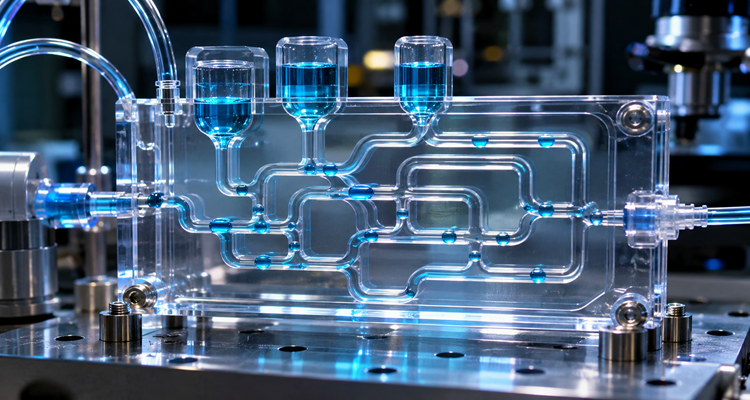
Computers do not necessarily need electronic circuits to perform calculations. Under the right conditions, flowing water, changes in pressure and the movement of droplets can process information, perform logical operations and even model complex mathematical problems.
The concept belongs to a field known as fluidic computing, where the physical behaviour of liquids or gases becomes a mechanism for computation. Although it sounds like a futuristic invention, its foundations stretch back decades, long before smartphones and modern microprocessors became part of everyday life.
What makes water-based computing particularly interesting is not its potential to replace conventional computers entirely, but its ability to rethink how information can be processed using the physical properties of matter.
How can water behave like a computer?
At its most fundamental level, computation involves representing information, applying rules to that information and producing an output. Electricity is an exceptionally efficient way to accomplish this, but it is not a mathematical requirement.
A conventional digital computer uses transistors to manipulate binary information. A water-based computer can represent the same information through the presence or absence of water in a container or channel.
Consider a simple arrangement:
-
A container holding water represents the binary digit 1.
-
An empty container represents the binary digit 0.
-
Pipes, valves and siphons determine how information moves.
-
The resulting water levels represent the calculated answer.
By connecting these components in carefully designed arrangements, engineers can create hydraulic equivalents of electronic logic gates.
Water is not performing arithmetic independently. Instead, the architecture of the machine translates predictable physical behaviour into mathematical operations.
How water-based computers perform arithmetic
In 2018, researchers Nicolas Taberlet, Quentin Marsal, Jérémy Ferrand and Nicolas Plihon published a study in the European Journal of Physics explaining how hydraulic components could form a digital binary calculator.
Their design used containers, connecting pipes, siphons and controlled drainage to perform elementary logical operations. These components could be combined into a four-bit binary adder.
The research, titled Hydraulic Logic Gates: Building a Digital Water Computer, demonstrates that arithmetic can emerge from fluid mechanics rather than semiconductor switching.
Understanding the calculation
Imagine two containers that supply water to a hydraulic circuit. Each input can represent either 0 or 1.
Illustrative hydraulic logic gate
0 — Empty1 — Filled
0 — Empty1 — Filled
0
1
1 + 0 = 1 (binary: 01)
Interactive conceptual demonstration of binary addition. The diagram is not an engineering schematic of the published experiment.
The AND operation determines whether both inputs are active, while the XOR operation determines whether exactly one input is active.
Together, these operations form the basis of a half-adder, a fundamental building block of digital arithmetic.
The remarkable aspect is that the mathematical rules remain unchanged even when the physical components implementing them are completely different.
The water computer that simulated an entire economy
Developed by New Zealand economist William Phillips, the machine represented economic activity through the movement of water.
Instead of displaying financial transactions on a digital screen, the MONIAC used interconnected reservoirs and pipes to simulate relationships within an economy.
Water represented money, while adjustable mechanical components represented different economic variables.
Changing the machine’s settings allowed observers to see how one part of the economy could influence another.
According to Engineering New Zealand’s historical account, the MONIAC represents an important development in analogue computing and economic modelling.
Unlike a digital water calculator, which processes discrete binary values, the MONIAC represented quantities through continuously changing physical measurements.
Its significance lies in making an abstract mathematical model physically observable. However, its accuracy depended on the economic assumptions built into the machine, rather than its ability to predict every aspect of a real economy.
Stanford’s computer built around microscopic water droplets
Rather than relying on large containers and hydraulic pipes, their device operated with tiny magnetically responsive droplets.
The researchers positioned the droplets within a specially designed arrangement of magnetic tracks. A rotating magnetic field coordinated their movement, allowing the droplets to advance through the circuit in synchronized steps.
Interactions between droplets produced computational effects.
The team demonstrated several important capabilities, including:
-
AND, OR, XOR, NOT and NAND logic operations.
-
Binary addition.
-
One-bit memory storage.
-
A finite-state machine capable of changing between defined computational states.
The original study, Synchronous Universal Droplet Logic and Control, established the experimental foundations of a versatile droplet-based computing architecture.
The research demonstrated something more significant than an unusual calculator. It showed that a computing system could process information while simultaneously directing the movement of physical materials.
Two different ways of computing with water
Water-based computers are not a single technology. They encompass several approaches that exploit different physical properties.
| Feature | Analogue water computers | Digital fluidic computers |
|---|---|---|
| Information | Continuous quantities | Discrete binary values |
| Mechanism | Water levels and flow rates | Fluid switches or droplets |
| Output | Physical measurements | Logical or numerical results |
| Example | MONIAC | Hydraulic binary adder |
| Primary strength | Physical modelling | Logical operations |
| Main limitation | Measurement precision | Speed and scalability |
A 2019 scientific review of liquid computers, written by unconventional computing researcher Andrew Adamatzky, also documents experimental approaches involving interacting liquid streams and chemical reactions.
These systems illustrate how computation can be adapted to the properties of different physical environments.
Do water computers really work without electricity?
This distinction is essential.
Using water as a computational medium does not automatically make a machine completely electricity-free.
A gravity-driven hydraulic calculator can perform its core logical operations without electronic transistors. However, other fluidic systems may require electrically powered pumps, magnetic-field generators, sensors or recording equipment.
Stanford’s droplet-based system, for example, depends on a rotating magnetic field to coordinate computation.
Every physical computer requires some mechanism to provide the energy needed for its operations. That energy might come from gravity, pressure, electricity or another external source.
Water-based computation changes how information is processed, but it does not eliminate the fundamental energy requirements of computing.
Similarly, it would be premature to assume that liquid computers have a smaller environmental footprint. Such a conclusion would require a comprehensive comparison of their energy consumption, manufacturing requirements, maintenance and useful computational output.
Where fluidic computing could become useful
Miniature laboratories
One promising application involves microfluidics, a field concerned with controlling very small quantities of liquids.
In a laboratory, a conventional computer might instruct external equipment to transport, combine or separate chemical samples.
A fluidic computer could potentially integrate some of those decision-making operations into the physical environment containing the samples.
This approach could help researchers develop compact systems for chemical experimentation and biological analysis.
Medical diagnostic technology
Fluidic logic could contribute to diagnostic devices in which samples travel through predetermined pathways depending on physical inputs or designed conditions.
Integrating sample handling and decision-making could simplify certain specialized instruments. However, successful laboratory demonstrations do not establish clinical effectiveness or commercial readiness.
Programmable materials
Another research opportunity involves materials that respond to their surroundings through embedded fluidic mechanisms.
A structure containing fluid channels might be designed to change its physical behaviour when pressure or other inputs reach particular thresholds.
Combined with logical components, such systems could eventually support specialized adaptive materials and automated mechanical devices.
These possibilities remain dependent on engineering advances, reliability testing and application-specific validation.
Why water computers are unlikely to replace silicon processors
Electronic computers possess enormous advantages in speed, compactness and manufacturing maturity.
Modern semiconductor processors integrate vast numbers of transistors into small chips. Electronic signals can be manipulated far more rapidly than ordinary hydraulic components can transport liquid through physical pathways.
Fluidic devices also face practical challenges, including controlling pressure, preventing unwanted interactions, maintaining consistent behaviour and connecting multiple computational stages reliably.
The researchers behind Stanford’s droplet computer were interested in applications involving physical material manipulation rather than competing directly with everyday electronic computers, as explained in the university’s research announcement.
This suggests a more realistic technological direction: electronic and fluidic computers could serve different purposes within the same larger system.
An electronic processor might handle complex numerical analysis, while a fluidic subsystem manages the movement and interaction of actual chemical or biological materials.
In such an arrangement, water-based computing would complement electronics rather than replace them.
Rethinking what a computer actually is
The history of computing is often described as a progression from mechanical calculators to electronic circuits and increasingly powerful semiconductor processors. Water-based computers reveal another dimension of that history.
A calculation is not inherently tied to a particular material. It can emerge from any appropriately engineered physical system capable of representing information and transforming it according to defined rules.
The MONIAC demonstrated this through economic modelling. Hydraulic logic circuits demonstrated it through arithmetic. Droplet-based systems extended the idea toward programmable material manipulation.
Their greatest technological contribution may not be creating a faster computer. It may be creating computers that perform useful physical tasks as part of the calculation itself.
That possibility expands the meaning of computing beyond screens, processors and electronic signals and brings it directly into the physical world.
The information presented in this article is based on publicly available sources, reports, and factual material available at the time of publication. While efforts are made to ensure accuracy, details may change as new information emerges. The content is provided for general informational purposes only, and readers are advised to verify facts independently where necessary.
Related News
- The Satellites That Navigate Space Without GPS by Watching Dead Stars
- The Websites That Look Completely Different Depending on Which Country You Visit Them From
- The Internet That Keeps Working Because Someone Still Maintains a System From the 1980s
- The Digital Identity That Outlives the Phone You Created It On