







The People Who Can Recognise a Face in a Photograph but Cannot Picture It With Their Eyes Closed
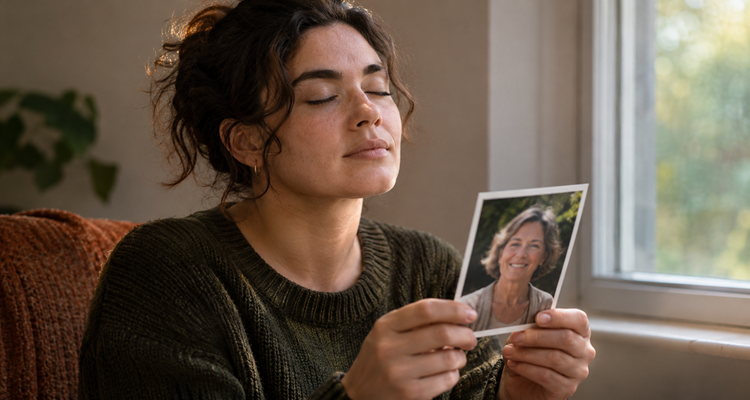
For people with aphantasia, remembering a loved one’s face does not necessarily involve seeing it in the mind. This remarkable variation in human cognition challenges conventional ideas about memory, imagination and the way we experience the world.
Look at a photograph of someone you love. Notice the shape of their face, the expression in their eyes and the familiar curve of their smile. Now put the photograph away and try to recreate that face in your imagination.
For some people, a recognisable mental image appears. For others, the details are faint or incomplete. And for a particular group of people, no voluntary visual image appears at all.
They know whose face they are thinking about. They may remember its features, recognise it instantly in a crowded room and recall years of experiences with that person. Yet they cannot summon an internal picture of it.
This phenomenon is known as aphantasia, and it reveals an important distinction between seeing, remembering and imagining. Although these abilities often work together, they are not necessarily inseparable.
What Is Aphantasia?
Aphantasia is a cognitive characteristic in which a person experiences little or no ability to deliberately generate visual mental imagery. Neurologist Adam Zeman and his colleagues introduced the term in 2015, although differences in human visual imagination had been documented as far back as the nineteenth century.
For someone with aphantasia, instructions such as picturing a sunset, imagining a childhood bedroom or visualising a friend’s face may produce knowledge about those things without an accompanying image.
Consider a red apple. A person with aphantasia may understand its colour, shape, texture and size perfectly well. They might even draw one from memory. What is missing is the subjective experience of mentally seeing it.
This does not mean that their eyesight is impaired or that their imagination is absent. Rather, their conscious imagination operates without the visual component that many other people experience.
How Common Is Aphantasia?
A 2024 study published in Frontiers in Psychology examined differences in mental imagery across an international sample. Its combined analysis of 9,063 participants estimated that approximately 0.9% experienced a complete absence of voluntary visual imagery.
The research also identified several levels of imagery vividness.
The spectrum of visual imagination
Aphantasia
0.9%
Absent voluntary visual imagery
Hypophantasia
3.3%
Unusually weak visual imagery
Typical imagery
89.7%
Ordinary range of visual imagery
Hyperphantasia
6.1%
Exceptionally vivid visual imagery
Source: Frontiers in Psychology, 2024. Combined sample: 9,063 participants. Estimates are based on questionnaire scores.
These figures depend on how researchers define and measure mental imagery. They should not be interpreted as an exact worldwide population count.
What they do demonstrate is that human imagination is not a uniform experience. Two people can be thinking about precisely the same object while experiencing something fundamentally different internally.
Why Recognising a Face Is Different From Imagining One
Recognising someone’s face and mentally reconstructing that face place different demands on the brain.
Recognition begins with information supplied by the outside world. When a familiar person appears, the brain can process their facial characteristics and connect them with stored information about their identity.
Visual imagination works in the opposite direction. Without a person or photograph present, the brain must internally generate a representation that produces something resembling a visual experience.
A person can retain enough information to identify a familiar face without being able to recreate its appearance voluntarily.
Think of the difference between recognising a song when it plays and deliberately reproducing its melody in your imagination. The two abilities are related, but they need not be equally strong.
Importantly, aphantasia does not guarantee that face recognition remains entirely unaffected.
A 2023 study published in Cortex found that participants with aphantasia performed less well, on average, on face-recognition assessments than participants with visual imagery. Nevertheless, both groups were similarly successful at constructing facial composites from memory.
The finding suggests that useful information about a face can remain accessible even when a person cannot consciously visualise it.
What Happens to Memories Without Mental Pictures?
Memory is often described as a collection of snapshots from the past. Aphantasia exposes the limitations of that metaphor.
Imagine remembering a family holiday without mentally seeing the hotel, the beach or the people who accompanied you. You might still remember where you travelled, what happened, who was present and why the experience mattered.
A memory can contain facts, spatial relationships, emotions and personal significance without being accompanied by a vivid picture.
Research published in Cortex in 2021 offered an intriguing demonstration of this distinction.
In a study led by Wilma Bainbridge, researchers asked participants to examine images of rooms and subsequently reproduce them through drawings from memory.
Participants with aphantasia generally included fewer objects and less colour in their drawings. However, the spatial arrangement of the objects they remembered was comparably accurate.
Some participants also relied more heavily on verbal information when reconstructing the scenes.
The findings help explain how someone might navigate a familiar house, remember the arrangement of furniture or understand the layout of a neighbourhood without mentally seeing those places.
Remembering where something belongs is not necessarily the same as remembering what it looks like.
Scientists Can Detect Differences Beyond Self-Reported Experiences
One of the challenges of studying imagination is that a person’s internal experience cannot be directly observed by someone else.
How can scientists establish whether someone genuinely lacks visual imagery rather than simply describing imagination differently?
A 2022 study published in eLife investigated this question through pupil responses.
Human pupils ordinarily constrict in brighter conditions and dilate in darker ones. For people with visual imagery, imagining brightness or darkness can also produce measurable changes in pupil size.
Researchers found that participants with aphantasia responded normally to actual visual light but did not exhibit a significant brightness-related pupil response when attempting to generate mental images.
Their pupils still responded to increased cognitive effort, suggesting that the absence of the imagery-related response was not simply a matter of failing to engage with the task.
This provides physiological evidence that differences in mental imagery extend beyond how people describe their thoughts.
It does not, however, establish a universal clinical test or explain every individual experience of aphantasia.
Aphantasia Is Not the Same as Face Blindness
Because aphantasia can affect how people remember faces, it is sometimes confused with prosopagnosia, commonly known as face blindness.
However, these are distinct characteristics.
| Aphantasia | Prosopagnosia |
|---|---|
| Difficulty generating voluntary mental images | Difficulty recognising people’s faces |
| A familiar face may be recognisable when physically present | A familiar face may be difficult to identify even when physically present |
| Primarily concerns mental imagery | Primarily concerns facial identity recognition |
Although these characteristics can coexist, having one does not automatically mean having the other.
A 2026 study published in Cortex found group-level differences in facial perception and memory among people with aphantasia, while their ability to match faces remained relatively preserved.
Such findings highlight the complexity of facial processing. Recognising a person involves several cognitive abilities rather than a single, unified mental function.
Can People With Aphantasia See Images in Their Dreams?
The absence of voluntary mental imagery does not necessarily mean the absence of visual dreams.
Some people with aphantasia experience dreams containing recognisable faces, landscapes and other visual details, despite being unable to deliberately produce similar images while awake.
This distinction matters because dreaming does not require the same conscious effort as intentionally visualising something.
A 2020 study published in Scientific Reports found that people with aphantasia tended to report less vivid dreams and fewer sensory details in their recollections of personal experiences.
However, experiences varied considerably between individuals. Some also reported difficulties imagining sounds, smells or other sensations, while others retained these abilities.
Aphantasia, therefore, may describe a range of cognitive experiences rather than one identical way of thinking.
Does Aphantasia Affect Creativity?
The popular expression seeing something in the mind’s eye suggests that visualisation lies at the heart of creativity. Yet a person does not necessarily need an internal picture to develop an original idea.
Consider an architect designing a building. One architect might begin by visualising its finished appearance. Another might develop the design through measurements, sketches, structural relationships and successive modifications.
Both approaches can produce creative work, even though the underlying mental processes differ.
People with aphantasia can pursue artistic, scientific and technically demanding careers. They may use language, external visual references, abstract concepts or spatial reasoning to develop ideas.
An absence of visual imagery does not establish a lack of intelligence, originality or creative potential.
What matters is distinguishing the ability to generate mental pictures from the broader ability to create something that did not previously exist.
Why Some People Discover Aphantasia Only in Adulthood
Mental imagery is an unusually private experience. People cannot directly compare what happens inside their minds with what happens inside someone else’s.
A person who has never experienced voluntary visual imagery may assume that expressions such as picture yourself on a beach are entirely metaphorical.
Similarly, someone with vivid imagery may assume that everybody experiences recognisable internal pictures.
Neither assumption necessarily gets challenged during ordinary conversations.
A discussion about meditation, dreams, reading fiction or childhood memories may eventually reveal that people interpret the same instructions differently.
For someone discovering lifelong aphantasia, this can provide an explanation for experiences they have previously struggled to describe.
Nothing about their cognitive abilities has necessarily changed. What has changed is their understanding of how other people think.
How to Explore Your Own Mental Imagery
A simple exercise can help illustrate differences in visual imagination.
Imagine a bright red apple resting on a white table. Consider its shape, colour, shadow and the direction from which light reaches it.
Researchers formally investigate these differences using instruments such as the Vividness of Visual Imagery Questionnaire (VVIQ).
However, a single imagination exercise cannot conclusively establish whether someone has aphantasia. Mental imagery also need not resemble an actual photograph projected onto the inside of closed eyelids.
The important distinction is whether an internal visual experience occurs, not whether someone literally sees an image in the darkness.
Is Aphantasia Something That Needs Treatment?
Lifelong aphantasia is generally understood as a variation in human cognition rather than an illness requiring treatment.
There is no established treatment that reliably restores voluntary mental imagery, and many people with lifelong aphantasia have no need for medical intervention.
The situation is different when someone suddenly loses an ability to visualise that they previously possessed. Acquired changes in mental imagery can occur alongside medical or neurological conditions and warrant professional assessment.
According to the Cleveland Clinic’s medical overview of aphantasia, understanding this characteristic can help people appreciate how their minds operate without assuming that every cognitive difference needs to be corrected.
Remembering Someone Without Seeing Their Face
Perhaps the most personally meaningful aspect of aphantasia concerns the people we love.
For someone with vivid mental imagery, remembering an absent loved one might involve reconstructing their facial expressions or imagining them sitting in a familiar chair.
Someone with aphantasia might instead remember conversations, characteristic gestures, shared experiences and the significance of that person’s presence in their life.
Photographs may offer a visual reminder that cannot be voluntarily recreated through imagination alone.
Yet the vividness of a mental image is not a measure of how much someone cares. The inability to picture a loved one’s face does not establish an inability to remember their importance.
Aphantasia reminds us that memory is more than an internal photograph.
A face can remain familiar without being visible in the imagination. An experience can remain meaningful without being mentally replayed. And a person can remain deeply significant without their image appearing when someone closes their eyes.
Human minds do not all represent reality in the same way. Understanding those differences brings us closer to understanding the extraordinary diversity of human consciousness itself.
This article is provided for general informational and educational purposes. It is not medical advice, diagnosis, or a substitute for consultation with a qualified healthcare professional. Health evidence can change, and individual circumstances vary.
Related News
- The Pain That Disappears When You’re Distracted and Returns the Moment You Remember It
- Why Your Brain Sometimes Wakes You Up Minutes Before an Alarm You Haven’t Heard Yet
- Why Your Body Can React to a Problem Your Mind Has Already Forgotten
- Why Your Body Sometimes Feels Hungry When What It Really Needs Is Sleep