







The Creepy World of Places That Officially No Longer Exist—but Still Appear on Maps
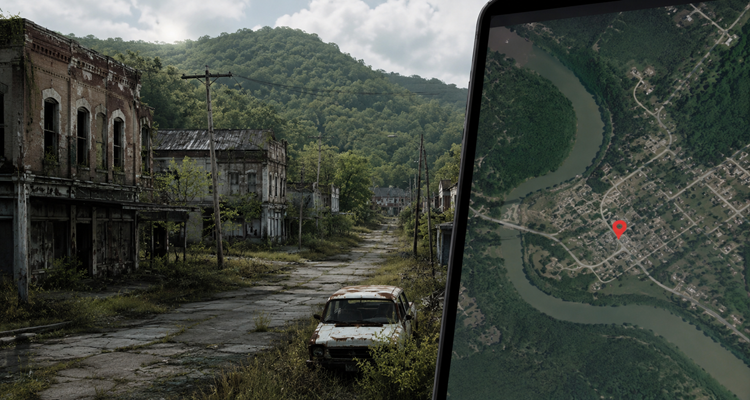
Maps are supposed to provide certainty. They tell us where things are, how to get there, and what exists in the world around us. Yet scattered across digital and paper maps are places that technically no longer exist, towns abandoned decades ago, villages swallowed by reservoirs, military settlements erased from public records, and communities that vanished after disasters.
What makes these locations unsettling is not simply that they disappeared. It is that they continue to appear as if they are still there.
For many people, the discovery happens accidentally. A curious traveler zooms into a mapping app and notices a settlement that shows no signs of life. A hiker follows directions to a destination only to find empty foundations and overgrown roads. An online explorer stumbles upon a town name that exists on maps but nowhere else in reality.
These ghost locations reveal something deeper about how societies remember, forget, and digitally preserve the past.
When a Place Disappears but Its Name Survives
Throughout history, countless communities have vanished for reasons ranging from economic collapse to environmental change.
Some mining towns thrived for decades before resources ran out. Others were abandoned when railroads shifted routes or industries moved elsewhere. Natural disasters, wars, government projects, and population migration have all contributed to the disappearance of settlements around the world.
Yet removing a place from existence is often easier than removing it from memory.
Maps, databases, historical records, navigation systems, and local traditions can preserve a location long after its final resident has left. As a result, a town may cease to function as a community while continuing to exist as a recognizable point on a map.
The result is a strange form of digital immortality.
The Rise of the Modern Ghost Map
The internet has transformed how people encounter vanished places.
Decades ago, discovering an abandoned settlement often required access to historical archives or local knowledge. Today, anyone with a smartphone can explore remote regions through satellite imagery and mapping platforms.
This accessibility has created a growing fascination with so-called “ghost maps”, digital maps that preserve traces of places that have disappeared from everyday life.
Online communities dedicated to forgotten locations frequently investigate abandoned towns, submerged villages, former military sites, and deserted industrial communities. Satellite images, historical documents, and user-generated content often reveal details that official records overlook.
The popularity of these explorations reflects a broader cultural shift. People are increasingly interested in hidden histories, lost infrastructure, and the stories buried beneath modern landscapes.
Places Swallowed by Water
Among the most haunting examples are communities that still appear on maps despite lying beneath lakes and reservoirs.
Around the world, dams have transformed valleys into vast bodies of water. Entire villages were relocated before flooding began, leaving roads, homes, churches, and cemeteries submerged beneath the surface.
In some cases, the original place names remain visible on maps even though the physical communities disappeared years ago.
When water levels drop during droughts, remnants occasionally re-emerge. Stone walls, building foundations, and abandoned roads suddenly become visible, creating a surreal connection between past and present.
These moments remind people that beneath many modern landscapes lie forgotten layers of human history.
The Towns That Time Left Behind
Not every vanished place was destroyed. Some simply faded away.
Across various countries, small communities have experienced decades of population decline. Younger generations moved to larger cities, businesses closed, schools shut down, and residents gradually left.
Eventually, the settlement stopped functioning as a living community.
Yet many mapping systems continue to display these locations because they remain historically recognized geographic points.
This creates an unusual contradiction. A place can officially exist in databases, navigation systems, and archives while effectively disappearing from real-world social life.
The map says a town exists. Reality tells a different story.
Why Mapping Systems Keep Forgotten Places Alive
The persistence of vanished locations highlights an important truth about modern technology: maps are not purely objective representations of reality.
Every map reflects choices about what information should be preserved.
Digital mapping platforms often combine historical records, government databases, satellite imagery, geographic surveys, and user contributions. Removing a location entirely can be complicated because different sources may continue to recognize its existence.
In some cases, keeping these places visible serves practical purposes. Researchers, historians, genealogists, emergency planners, and environmental scientists may rely on historical geographic references.
What appears to be an outdated mistake may actually be a deliberate effort to preserve historical continuity.
The map becomes both a navigation tool and a cultural archive.
The Psychology Behind Our Fascination
The popularity of vanished places reveals something interesting about human behavior.
People are naturally drawn to locations that challenge expectations. A place that exists and does not exist at the same time creates a powerful sense of mystery.
These locations force us to confront uncomfortable questions.
How permanent are the places we call home?
What happens when communities disappear?
How much of human history remains hidden beneath modern development?
Unlike fictional ghost stories, these places are real. Their roads existed. Their residents lived ordinary lives. Their schools, shops, and homes once formed functioning communities.
That reality makes them more compelling than many imagined mysteries.
The fascination is not just about abandonment. It is about evidence of lives that have quietly slipped out of public awareness.
What Vanished Places Reveal About the Digital Age
Perhaps the most significant insight is that maps have become a form of collective memory.
Historically, when a place disappeared, it often faded from public consciousness over time. Today, digital systems preserve traces of locations indefinitely.
As mapping technologies become more sophisticated, the boundary between current reality and historical reality becomes increasingly blurred. A location can remain searchable, visible, and documented long after its physical significance has faded.
This creates a new relationship between geography and memory.
Instead of erasing the past, modern mapping systems frequently layer it alongside the present. The result is a world where forgotten communities can continue to occupy digital space even after disappearing from physical life.
In a sense, maps have become museums without walls.
The Strange Future of Places That No Longer Exist
As climate change, urban development, demographic shifts, and technological change continue reshaping landscapes, more communities may undergo dramatic transformations.
Some locations may be abandoned. Others may be relocated. New forms of digital preservation may ensure their names remain visible long after their original purpose disappears.
Future generations could encounter countless places that survive primarily as data points, historical references, or digital memories.
The eerie appeal of vanished places is ultimately not about ghosts. It is about permanence, or the lack of it.
Maps give the impression that the world is fixed and stable. The existence of places that officially no longer exist tells a different story.
Beneath every map lies a hidden layer of forgotten towns, abandoned communities, and erased histories waiting to be rediscovered. And sometimes, all it takes is a single place name appearing on a screen to remind us that disappearance is rarely as complete as it seems.
This content is published for informational or entertainment purposes. Facts, opinions, or references may evolve over time, and readers are encouraged to verify details from reliable sources.