







Why Antarctica Froze First While the Arctic Stayed Ice-Free
Science and Environment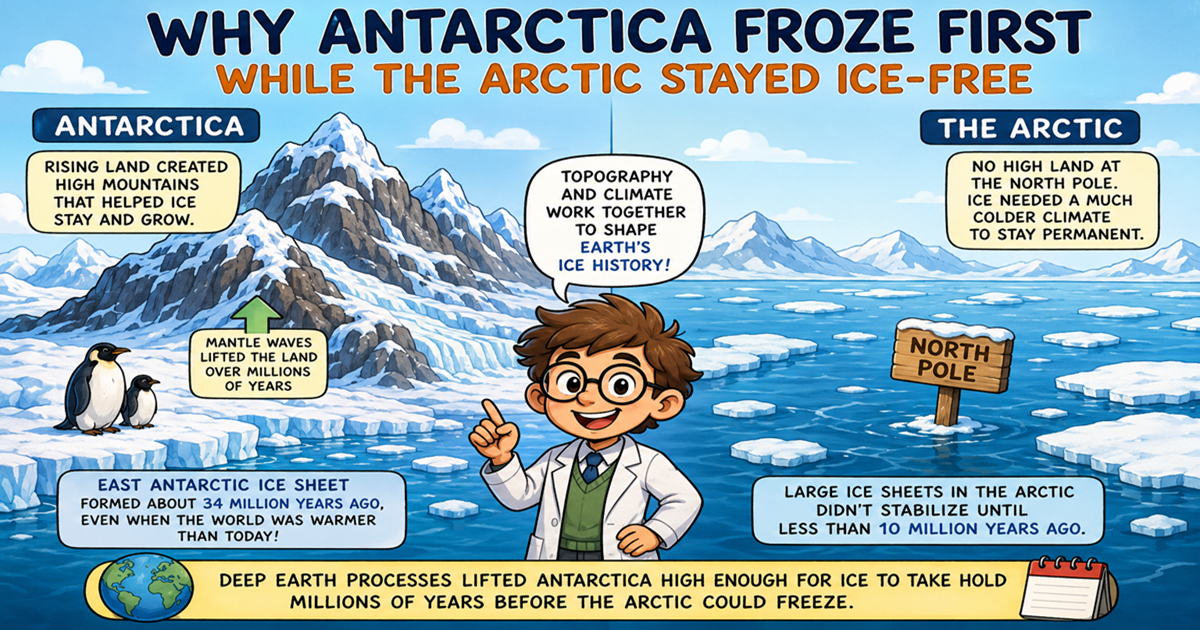
Key Takeaways
- Scientists believe Antarctica’s icy transformation was driven not only by climate but also by the rise of its landscape.
- Deep-Earth geological forces gradually lifted eastern Antarctica above a critical elevation where permanent ice could survive.
- The East Antarctic Ice Sheet formed roughly 34 million years ago despite global temperatures being warmer than today.
- The Arctic lacked high land at the North Pole, delaying the formation of long-lasting ice sheets for millions of years.
- The findings highlight how Earth’s geology and climate work together to shape long-term planetary change.
Introduction
For decades, scientists have grappled with a seemingly simple question: if Earth has two poles, why did one freeze millions of years before the other?
The answer matters far beyond geological curiosity. Polar ice sheets influence sea levels, global weather systems, ocean circulation, and the planet’s ability to regulate temperature. Understanding how they formed offers valuable insight into Earth’s climate history and may even improve predictions about its future.
Antarctica today is synonymous with ice, holding the largest ice sheet on Earth and enough frozen water to dramatically alter global coastlines if it were to melt. Yet the continent was not always a frozen wilderness. Tens of millions of years ago, it supported forests and experienced a much milder climate. Meanwhile, the Arctic remained largely free of permanent ice long after Antarctica had transformed into a frozen continent.
New research suggests the explanation lies beneath Earth’s surface. Rather than climate alone determining the fate of the poles, deep geological processes may have created the conditions that allowed Antarctica to freeze first, reshaping scientific understanding of one of Earth’s most significant climate transitions.
Understanding the Development
A Mystery Hidden in Earth’s Deep Past
Around 34 million years ago, Antarctica underwent a dramatic transformation. The continent became home to the East Antarctic Ice Sheet, a massive body of ice that still exists today and remains the largest ice sheet on the planet.
What makes this event remarkable is that global temperatures at the time were estimated to be around 5 degrees Celsius warmer than modern averages. Conventional thinking suggested that cooling temperatures alone drove the formation of polar ice. However, that explanation left an important question unanswered: why did Antarctica freeze while the Arctic remained largely ice-free for another 25 million years?
Recent scientific investigations point toward an answer rooted in Antarctica’s changing topography. Researchers reconstructed the continent’s ancient landscape and discovered that significant uplift occurred in eastern Antarctica long before widespread glaciation began.
The Role of Mantle Waves
The key mechanism appears to be a phenomenon known as mantle waves.
Deep beneath Earth’s crust lies the mantle, a vast layer of hot rock that slowly flows over geological timescales. When continents break apart, disturbances can ripple through this layer. These disturbances may gradually remove dense material beneath continental plates, making the land above lighter and causing it to rise.
This process unfolded over tens of millions of years following the breakup of Gondwana, the ancient supercontinent that once connected Antarctica, Africa, South America, Australia, Arabia, and the Indian subcontinent.
As Antarctica drifted toward its modern position, mantle-driven uplift elevated large portions of eastern Antarctica, including the region surrounding the Gamburtsev Mountains. These mountains, now buried beneath thick ice, became a crucial factor in creating conditions favorable for permanent glaciation.
Why This Matters
Elevation Can Be as Important as Temperature
Many people think of ice formation as purely a temperature issue. In reality, altitude plays a major role.
Anyone who has visited a mountain region knows that temperatures generally decrease with elevation. Snow can persist on mountain peaks even when surrounding lowlands remain relatively warm.
Scientists found that as eastern Antarctica rose higher, increasing portions of the landscape crossed a critical elevation threshold. Once enough terrain existed above this level, snow and ice could survive year-round. Over time, glaciers expanded and merged into a stable continental ice sheet.
This finding changes the way researchers think about planetary climate systems. Instead of viewing ice ages solely as products of atmospheric conditions, the study demonstrates that geological evolution can create opportunities for climate transitions.
A Lesson in Earth System Complexity
One of the most important insights from the research is that Earth operates as an interconnected system.
Climate influences landscapes through erosion and weathering. At the same time, landscapes influence climate by altering atmospheric circulation, snowfall patterns, and the ability of snow and ice to accumulate.
The Antarctic story illustrates how processes occurring deep underground can ultimately affect conditions at the planet’s surface millions of years later.
What Is Changing
A Shift in Scientific Understanding
Traditional explanations for Antarctic glaciation often emphasized declining atmospheric carbon dioxide levels and global cooling.
While those factors remain important, the new findings suggest that topographic evolution deserves equal attention. Antarctica may have become glaciated not simply because the world cooled, but because its rising terrain created the perfect environment for ice to establish itself.
This perspective broadens scientific discussions about climate transitions throughout Earth’s history.
Revisiting the Arctic’s Story
The Arctic presents a striking contrast.
Unlike Antarctica, the North Pole sits in the middle of an ocean rather than atop a continent. There was no equivalent mountain plateau capable of reaching elevations where permanent ice could stabilize early.
As a result, Arctic ice development depended more heavily on global cooling. Atmospheric carbon dioxide concentrations had to decline further before ice could persist at lower elevations and eventually form large northern ice sheets.
This difference helps explain the long-standing asymmetry between Earth’s poles.
The Bigger Picture
Antarctica’s Journey From Forests to Ice
The frozen continent seen today bears little resemblance to its ancient past.
During earlier periods of Earth’s history, Antarctica supported vegetation, rivers, and ecosystems that thrived in much warmer conditions. Fossil discoveries have revealed evidence of forests and diverse plant life that once existed near the South Pole.
The transition from a temperate continent to an icy one represents one of the most significant environmental shifts in Earth’s history.
Importantly, this transformation was not sudden. It unfolded over tens of millions of years through a combination of tectonic movements, landscape evolution, atmospheric changes, and declining greenhouse gas concentrations.
What the Research Reveals About Planetary Evolution
The study highlights a broader principle: Earth’s surface is constantly shaped by forces operating across vastly different timescales.
A continental breakup that began more than 160 million years ago ultimately influenced ice-sheet formation over 100 million years later. This illustrates how geological events can produce consequences far removed from their original cause.
For scientists studying Earth’s future, these long-term connections provide valuable perspective on the complexity of environmental change.
Opportunities and Challenges
Better Climate Models
Understanding how topography affects glaciation could improve climate simulations.
Researchers use computer models to reconstruct past climates and project future conditions. Incorporating geological factors more accurately may help explain historical climate shifts and refine predictions about ice-sheet behavior.
Such improvements are especially important as scientists seek to understand how modern ice sheets might respond to ongoing warming.
Remaining Questions
Despite the new insights, uncertainties remain.
Researchers continue investigating how different factors, including ocean circulation, atmospheric carbon dioxide levels, volcanic activity, and continental positioning, interacted during Antarctica’s transformation.
No single explanation fully captures the complexity of Earth’s climate system. Instead, glaciation likely emerged from multiple processes acting together over millions of years.
Understanding the relative importance of each factor remains an active area of scientific inquiry.
Implications for Modern Society
Although the events occurred millions of years ago, the lessons remain relevant today.
Modern discussions about climate often focus on atmospheric changes. This research serves as a reminder that Earth’s systems are interconnected, with geological processes influencing environmental outcomes in ways that are not always immediately obvious.
Recognizing these interactions helps create a more complete understanding of how the planet responds to change.
What Comes Next
Expanding the Search for Climate Triggers
Future research is likely to explore similar relationships between geology and climate in other regions of the world.
Scientists increasingly recognize that understanding Earth’s past requires combining expertise from multiple disciplines, including geology, climatology, oceanography, and geophysics.
Advances in computational modeling are also making it possible to reconstruct ancient landscapes with greater accuracy than ever before. These tools may reveal additional examples where geological uplift helped shape major climate events.
A New Perspective on Earth’s Ice Ages
The Antarctic case suggests that ice ages are not simply products of colder temperatures. They may also depend on whether the physical landscape provides suitable conditions for ice to persist and grow.
This insight could reshape how scientists interpret other climate transitions throughout Earth’s history and improve understanding of why certain regions respond differently to environmental change.
Conclusion
Antarctica’s early freeze was not merely the result of a cooling planet. It was the outcome of a remarkable partnership between climate and geology. Deep-Earth forces slowly lifted eastern Antarctica, creating high-altitude terrain capable of sustaining permanent ice even during a relatively warm period in Earth’s history.
Meanwhile, the Arctic lacked the elevated land necessary for similar ice development, forcing it to wait for much cooler global conditions before permanent ice sheets could emerge.
The discovery offers a compelling reminder that Earth’s history is written not only in its atmosphere but also in the hidden movements beneath its surface. Understanding those connections provides a richer picture of how our planet evolved—and why its future may be shaped by interactions we are only beginning to fully appreciate.
The views and opinions expressed in this article are those of the author and are intended for informational and educational purposes only. While every effort is made to ensure accuracy, Wiobs does not guarantee the completeness, reliability, or timeliness of the information presented. Readers are encouraged to verify facts independently and use their own judgment before making decisions based on this content.
Stay Connected with Wiobs
Explore more insights on technology, artificial intelligence, science, business, and innovation. Follow Wiobs and never miss an update.