










Why Your Brain Sometimes Feels Watched Even When You’re Alone
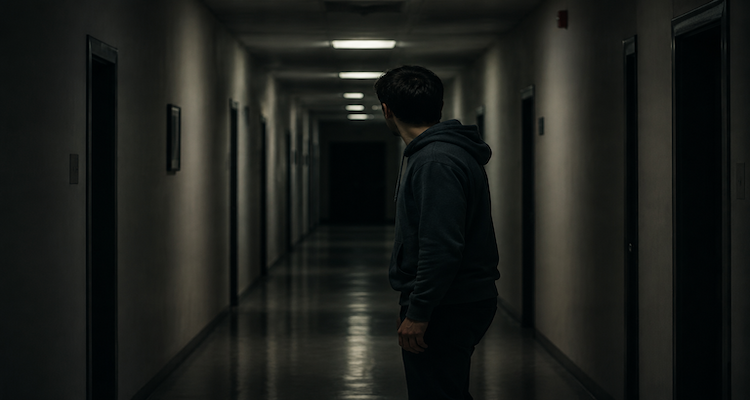
A quiet room. An empty hallway. A familiar walk home after dark. Suddenly, an unsettling sensation appears: the feeling that someone is watching you.
Most people experience this at some point. It can happen in a deserted parking lot, while working late at night, or even while sitting alone in a perfectly safe house. Despite the absence of any visible observer, the feeling can be remarkably convincing.
What makes this experience so intriguing is that it is not necessarily a sign that something is wrong. In many cases, it reveals something important about how the human brain evolved to detect threats, interpret uncertainty, and navigate the world. The sensation of being watched is less about what is around us and more about how our minds process incomplete information.
The Brain Is Built to Assume Before It Knows
Human survival has always depended on detecting danger quickly.
For most of human history, waiting for certainty could be costly. If an early human heard movement in the bushes, assuming a predator was nearby, even when there wasn’t one, was often safer than ignoring the possibility.
As a result, the brain developed systems that prioritize caution over accuracy when information is limited. Psychologists sometimes describe this as a tendency toward “false positives” in threat detection. The brain would rather mistakenly detect a threat than miss a real one.
This survival mechanism remains active today.
When visibility is poor, surroundings are unfamiliar, or environmental cues are ambiguous, the brain begins filling in gaps. That process can create the powerful impression that another presence is nearby, even when none exists.
The feeling may seem irrational, but from an evolutionary perspective, it is remarkably practical.
Why Darkness Changes Everything
Many people report feeling watched more frequently at night.
Darkness removes information that the brain relies on to assess safety. Shapes become unclear. Sounds seem more significant. Distances become harder to judge. Familiar places can suddenly feel unfamiliar.
This uncertainty forces the brain into a heightened state of vigilance.
Researchers studying perception have long noted that the human mind does not simply record reality like a camera. Instead, it continuously predicts what might be happening based on available clues. When those clues become scarce, prediction begins to play a larger role.
That is why an ordinary coat hanging in a dim room can briefly resemble a person. A shadow can appear to move. A harmless sound can feel loaded with meaning.
The brain is not malfunctioning. It is actively attempting to make sense of limited information.
The Hidden Role of Social Awareness
Humans are deeply social creatures.
Throughout history, survival depended not only on avoiding predators but also on understanding the intentions of other people. Recognizing attention—who was looking at us, following us, or evaluating us, became a critical skill.
Some scientists believe the feeling of being watched may be connected to these social monitoring systems.
Our brains are exceptionally sensitive to faces, eye contact, and signs of attention. In fact, people can often detect when someone is looking directly at them faster than they can process many other visual details.
This sensitivity serves important social functions. It helps us navigate relationships, avoid conflicts, and cooperate with others.
The downside is that these systems sometimes activate when no observer is present. Under conditions of uncertainty, the brain may interpret vague environmental cues as evidence of attention.
In essence, a mechanism designed to detect other people can occasionally become overactive.
Why Empty Spaces Can Feel So Unsettling
One of the most interesting aspects of this phenomenon is that it often occurs in places that are completely empty.
Abandoned buildings, vacant streets, quiet offices, and deserted shopping centers frequently evoke feelings of unease. Many people describe these environments as eerie despite the absence of any obvious threat.
Part of the explanation lies in expectation.
Humans constantly predict how environments should behave. A city street should contain movement. A school should contain students. A shopping mall should contain shoppers.
When those expectations are violated, the brain notices immediately.
The mismatch creates a subtle cognitive tension. Something feels “off,” even if there is no danger. The resulting discomfort can heighten awareness and increase the sensation that an unseen presence might be nearby.
This helps explain why an empty airport terminal at midnight often feels stranger than a crowded one, even though the physical environment remains largely the same.
The Digital Age Has Changed the Feeling
The sensation of being watched has acquired a new dimension in modern life.
For much of history, being observed required another person to be physically present. Today, observation often happens through cameras, sensors, algorithms, and digital platforms.
Many people spend large portions of their day aware that their actions may be recorded, tracked, or analyzed. Security cameras are common. Smartphones collect location data. Online platforms personalize content based on behavior.
As a result, the idea of being watched is no longer purely psychological.
Even when individuals are alone, they may retain a low-level awareness that some form of observation is possible. This cultural shift may influence how people interpret feelings of presence and surveillance.
The experience is no longer confined to dark forests or empty hallways. It has become intertwined with daily digital life.
When Imagination Meets Pattern Recognition
Humans excel at finding patterns.
This ability allows us to recognize faces, understand language, identify opportunities, and solve complex problems. Yet the same skill can occasionally produce false signals.
A rustling sound becomes footsteps. Random shadows become figures. Ordinary noises become signs of movement.
The brain’s pattern-recognition machinery is constantly operating beneath conscious awareness. Most of the time it helps us navigate reality efficiently. Occasionally, however, it generates interpretations that feel real despite limited evidence.
This tendency becomes stronger when people are tired, stressed, anxious, or emotionally vulnerable. Under these conditions, the brain often adopts a more cautious approach to uncertainty.
The result can be an intensified sense that someone or something is nearby.
What This Reveals About Human Nature
The feeling of being watched is often discussed as a mysterious or paranormal experience. Yet its deeper significance may be even more fascinating.
It highlights a fundamental truth about human perception: we do not simply experience reality as it is. We experience reality through predictions, expectations, memories, emotions, and survival instincts.
The brain is constantly balancing two competing goals. It wants to understand the world accurately, but it also wants to keep us safe.
When uncertainty increases, safety often wins.
That tradeoff explains why an empty room can feel occupied, why a quiet street can seem threatening, and why the sensation of being watched remains such a common human experience.
Far from being a strange anomaly, it may be evidence of one of the brain’s oldest and most successful survival strategies, a system designed to notice potential danger before danger becomes obvious.
And sometimes, even in complete solitude, that system continues to do exactly what it was built to do.
This content is published for informational or entertainment purposes. Facts, opinions, or references may evolve over time, and readers are encouraged to verify details from reliable sources.