










Why the Bhagavad Gita Says Mastering Yourself Is the Greatest Victory
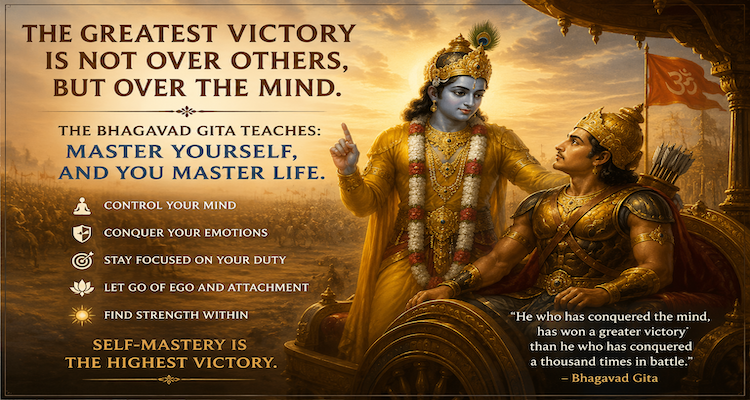
Many of humanity’s most celebrated victories have one thing in common: they involve defeating someone else. Nations commemorate military triumphs, businesses celebrate outperforming competitors, and individuals often measure success by winning arguments, earning higher salaries, or gaining greater recognition than their peers.
Yet the Bhagavad Gita offers a strikingly different definition of victory. In its view, conquering external opponents is secondary. The greater achievement is mastering one’s own mind, emotions, desires, and impulses. More than two thousand years after it was composed, this idea remains surprisingly relevant in a world increasingly shaped by competition, comparison, and constant distraction.
The enduring appeal of the Bhagavad Gita lies not merely in its spiritual teachings but in its practical understanding of human nature. The text recognizes that external victories can be temporary, while inner mastery has the potential to transform every aspect of life.
The Battlefield Within
The Bhagavad Gita unfolds on the battlefield of Kurukshetra, where Arjuna faces a profound crisis. Although he is one of the greatest warriors of his time, his challenge is not a lack of military skill. His real struggle is internal.
He is overwhelmed by fear, doubt, grief, and confusion. Before any battle begins, he finds himself unable to act. Seeing this, Lord Krishna does not immediately discuss military tactics or strategies for defeating enemies. Instead, he focuses on helping Arjuna understand and govern his own mind.
This distinction is important. The Gita suggests that human beings often assume their biggest obstacles exist outside themselves. In reality, many of life’s most significant challenges originate from within: anxiety that prevents action, anger that clouds judgment, attachment that distorts priorities, and ego that creates unnecessary conflict.
The external battlefield becomes a symbol of an internal one.
Why External Victories Often Feel Incomplete
Modern society places enormous value on achievement. Promotions, awards, social media influence, academic success, and financial gains are widely recognized markers of accomplishment.
Yet many people discover that reaching these goals does not always produce lasting satisfaction.
The Bhagavad Gita offers an explanation. External victories address circumstances, but they do not automatically transform the mind. A person may defeat competitors while remaining controlled by insecurity. They may accumulate wealth while remaining trapped by greed. They may gain influence while becoming increasingly dependent on validation.
The text repeatedly points to a simple truth: if the mind remains unsettled, no amount of external success can create enduring peace.
This perspective helps explain why individuals who appear successful by conventional standards can still experience dissatisfaction, stress, or emotional exhaustion.
Self-Mastery as Freedom
In the Bhagavad Gita, self-mastery is not about suppressing emotions or denying ambition. It is about developing the ability to respond consciously rather than react impulsively.
Krishna describes the disciplined mind as a friend and the undisciplined mind as an enemy. This teaching shifts responsibility inward. Instead of viewing obstacles solely as external problems, the Gita encourages individuals to examine how their own thoughts and reactions contribute to suffering.
Freedom, in this context, is not merely the ability to do what one wants. It is the ability to choose wisely despite temptation, fear, or emotional turbulence.
A person who can remain calm during criticism, focused during uncertainty, and ethical during success possesses a form of strength that external circumstances cannot easily diminish.
The Hidden Relevance in the Digital Age
One reason interest in the Bhagavad Gita continues to grow is that its teachings address challenges that feel increasingly familiar in modern life.
Today’s digital environment is designed to capture attention. Social media platforms encourage comparison. News cycles amplify emotional reactions. Algorithms reward outrage, instant responses, and constant engagement.
As a result, many people find themselves fighting battles that previous generations encountered less intensely: distraction, information overload, fear of missing out, and dependence on external validation.
Viewed through the lens of the Gita, these are not merely technological challenges. They are challenges of self-mastery.
The ability to resist impulsive reactions, maintain focus amid endless distractions, and avoid defining self-worth through comparison has become a valuable skill in both personal and professional life.
In this sense, the Bhagavad Gita appears remarkably contemporary. Its teachings on discipline and mental clarity align with concerns that psychologists, educators, business leaders, and productivity experts increasingly discuss today.
Leadership Begins With Inner Governance
The Bhagavad Gita’s concept of self-mastery extends beyond personal development. It also offers an important lesson about leadership.
Many leadership failures do not occur because of a lack of intelligence or technical expertise. They emerge from unmanaged emotions, unchecked ego, impulsive decision-making, or attachment to power.
History and contemporary business alike provide examples of talented individuals whose inability to govern themselves ultimately undermined their achievements.
The Gita suggests that effective leadership begins with self-leadership. Before influencing others, one must learn to manage one’s own motivations, reactions, and desires.
This principle remains relevant across industries. Whether leading a company, managing a team, teaching students, or raising a family, the ability to remain balanced under pressure often proves more valuable than dominance or authority alone.
The Difference Between Control and Mastery
One of the most misunderstood aspects of self-mastery is the assumption that it requires complete control over every thought and emotion.
The Bhagavad Gita presents a more nuanced view.
The goal is not to eliminate emotions but to avoid becoming enslaved by them. Fear, anger, ambition, and desire are natural aspects of human experience. Problems arise when these forces begin directing behavior without conscious awareness.
Self-mastery involves observing emotions without immediately acting on them. It creates space between impulse and action.
This distinction has significant practical implications. A person may feel anger without becoming destructive. They may experience fear without abandoning responsibility. They may pursue success without becoming consumed by attachment to outcomes.
The result is not emotional suppression but emotional intelligence.
A Victory That Cannot Be Taken Away
External victories are often temporary. Markets change. Competitors emerge. Status rises and falls. Public opinion shifts.
The Bhagavad Gita points toward a different kind of achievement, one that remains valuable regardless of changing circumstances.
When individuals develop discipline, resilience, clarity, and self-awareness, they acquire qualities that continue serving them through success and failure alike. These qualities cannot be easily lost because they are rooted in character rather than circumstance.
This may be why the Gita places such emphasis on inner conquest. Defeating others can alter the world around us. Mastering ourselves transforms how we experience the world itself.
In a culture that frequently equates winning with outperforming others, the Bhagavad Gita offers a timeless alternative. The greatest victory is not achieved on a battlefield, in a boardroom, or through public recognition. It is achieved when individuals learn to govern their own minds, act with wisdom rather than impulse, and remain steady amid life’s inevitable challenges.
That victory may be less visible than external success, but according to the Bhagavad Gita, it is far more enduring.
This content is published for informational or entertainment purposes. Facts, opinions, or references may evolve over time, and readers are encouraged to verify details from reliable sources.