









Battle of Longewala: How India Turned the Tide in 1971
Culture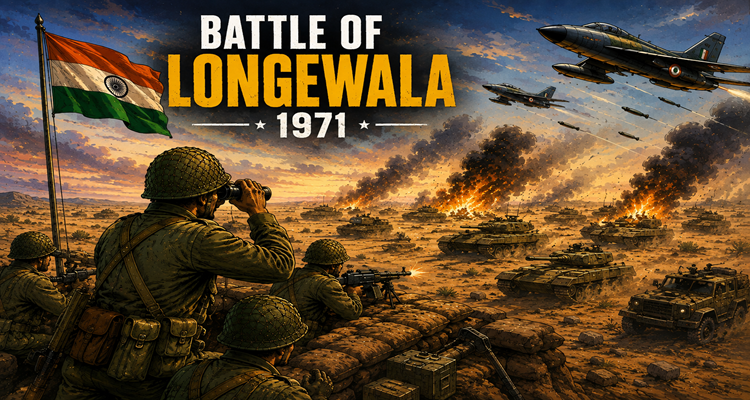
The Battle of Longewala is often remembered as a dramatic confrontation between a small Indian garrison and a much larger Pakistani armoured force in the Thar Desert. But the historical significance of the battle goes beyond the difference in troop numbers.
Fought during the 1971 India-Pakistan War, Longewala became a test of something more complicated than courage: how effectively a smaller defensive force could use terrain, time, leadership, reconnaissance and air support against a larger mechanised formation.
Major Kuldip Singh Chandpuri and A Company of the 23 Punjab Regiment held the Longewala post through the critical night of December 4–5. Their decision to maintain the position prevented the Pakistani advance from quickly moving deeper toward Ramgarh and Jaisalmer. Once daylight arrived, Indian Air Force aircraft were able to locate and attack the exposed Pakistani armour in the open desert.
The result was a failed Pakistani offensive and one of the best-known combined Army-Air Force actions of the 1971 war.
Key Takeaways
- Longewala was part of a wider Pakistani offensive intended to create pressure in India’s western sector during the 1971 war.
- Major Kuldip Singh Chandpuri’s roughly 120-man company held the post long enough for daylight and reinforcement to change the battlefield.
- Desert terrain, vehicle mobility problems, logistics and the absence of effective Pakistani air support weakened the attacking force.
- Indian Air Force Hunters, supported by Air Observation Post aircraft, became decisive after first light.
- Historical sources differ on exact Pakistani tank losses, but they agree that the armoured offensive failed and large numbers of vehicles were destroyed, damaged or abandoned.
Longewala Was One Part of a Much Larger War
The Battle of Longewala took place during the 1971 India-Pakistan War, a conflict whose central strategic theatre was East Pakistan.
Pakistan had launched air strikes against Indian airfields on December 3, 1971. The conflict then expanded across the western and eastern fronts. While India’s main military effort was directed toward the liberation of East Pakistan, Pakistan sought opportunities in the west that could force India to divert resources and potentially provide leverage elsewhere.
The Rajasthan sector offered one such opportunity.
Pakistan’s plan involved an armoured thrust toward the Longewala-Ramgarh area, with the possibility of advancing toward the Jaisalmer airfield. Historical studies of the battle identify Pakistani formations including the 51 and 206 Infantry Brigades and the 22 and 38 Cavalry regiments.
Longewala therefore mattered not because it was an isolated border post, but because its location was connected to a broader operational objective.
If the attacking force could break through the area, the pressure on India’s western defences could increase substantially.
Why a Small Defensive Position Became So Difficult to Overrun
The geography of Longewala was central to the battle.
The post stood on elevated ground in the Thar Desert. For the Indian defenders, that provided observation and a better defensive position. For the Pakistani armoured force, the surrounding desert presented a very different problem.
Heavy vehicles need suitable routes, reliable mobility and logistical support. Soft sand can reduce speed, restrict manoeuvrability and create recovery problems for tanks and other vehicles.
The Pakistani force therefore entered an environment in which its numerical and armoured superiority could not automatically translate into rapid movement.
This is one of the most important lessons of Longewala.
Combat power is not simply the number of soldiers or tanks on a battlefield. It depends on whether those forces can move, communicate, sustain themselves and employ their weapons effectively.
The USI study of the battle records difficulties involving sand, vehicle movement and mechanical problems, all of which contributed to the weakening of the Pakistani advance.
Major Chandpuri’s Real Advantage Was Time
Major Kuldip Singh Chandpuri commanded A Company, 23 Punjab, at Longewala.
The Indian position was heavily outnumbered, but it was not completely surprised. Reports of the approaching Pakistani force reached the defenders, giving Chandpuri time to assess the threat and organise his company.
That warning was crucial.
Chandpuri could not reasonably expect a small infantry company with limited anti-armour capability to destroy a large mechanised formation by itself.
His immediate objective was more practical:
hold the position and prevent the attackers from turning their numerical advantage into a rapid breakthrough.
Government records and Army historical accounts credit Chandpuri with maintaining the defence despite the pressure and encouraging his men to hold their ground. He was subsequently awarded the Maha Vir Chakra for his leadership during the battle.
The achievement was therefore not simply personal bravery.
Chandpuri’s leadership helped preserve the defensive force’s cohesion during the hours when it was most vulnerable.
Those hours ultimately proved decisive.
The Pakistani Advance Lost Momentum Before Daylight
The attacking force had to deal with several problems before it could fully exploit its strength.
The desert slowed the movement of armoured vehicles. The defenders were occupying a favourable position. The Pakistani force also faced the increasingly urgent problem of time.
Night operations are difficult even under favourable conditions.
In a desert environment, locating the precise position of an enemy, coordinating infantry with armour and moving large formations safely becomes more complicated.
The Indian defenders therefore benefited from a simple but powerful military equation:
Every hour the Pakistani force spent outside the objective was another hour closer to daylight.
Once daylight arrived, the tactical situation would change dramatically.
Indian aircraft could operate more effectively, identify targets and attack formations that had little concealment in the open desert.
The Pakistani offensive had to succeed quickly.
It did not.
The Minefield Story Needs More Care Than Popular Accounts Suggest
The minefield is one of the most frequently repeated elements of the Longewala story, but this is also an area where different historical accounts need to be distinguished.
Some Indian accounts describe anti-tank mines being laid during the battle and credit them with contributing to the defence. The Indian Army’s historical account also records the actions of Sepoy Bishan Dass, who was killed while involved in the defensive preparations.
However, the detailed USI study presents a more complicated picture of the minefield issue and describes the attackers encountering indications that mines might have been present.
That means the popular version, where a rapidly constructed minefield alone stopped the Pakistani armour, should not be treated as the complete explanation.
The more defensible interpretation is that the possibility of mines, the physical characteristics of the terrain and the Indian defensive position all contributed to slowing the attackers.
This distinction matters because historical journalism should not turn a disputed detail into an established fact merely because the simplified version makes for a better story.
Daylight Changed the Battlefield
The decisive phase of the battle began after first light.
Indian Air Force Hunters operating from Jaisalmer were prepared to support the Longewala defenders. Air Observation Post aircraft played a particularly important role by helping identify Pakistani armour and directing the attacking aircraft toward the correct targets.
Indian Air Force accounts describe this cooperation as an important feature of the battle. The small Krishak aircraft used for observation operated at low altitude and helped the Hunter pilots identify the Pakistani vehicles.
The significance of this coordination is easy to underestimate.
The Hunters had the weapons and speed required to attack the armour.
But finding the correct targets in a vast desert battlefield was another problem.
The Air Observation Post aircraft helped reduce that uncertainty.
This became an early example of the value of integrating observation, communication and strike aircraft during a battlefield engagement.
Why Pakistani Tanks Became Vulnerable
On paper, the Pakistani armoured force possessed a major advantage.
But once the tanks were concentrated in open desert and exposed to Indian aircraft, that advantage became increasingly difficult to exploit.
The tanks had limited opportunities to conceal themselves.
Some vehicles were also affected by the terrain and mechanical difficulties. Indian Air Force accounts describe repeated attacks against tanks and vehicle concentrations around Longewala and along the routes used by the retreating force.
The battlefield had effectively changed from an infantry-versus-armour problem into an air-ground engagement.
The Indian defenders had survived the night.
Now the Pakistani formation had to survive daylight.
It could not.
The Army and Air Force Were Both Essential
One of the biggest misunderstandings surrounding Longewala is the temptation to assign the entire victory to one service.
Indian Army accounts naturally emphasise Chandpuri and A Company, 23 Punjab.
Indian Air Force accounts place greater emphasis on the Hunter operations that destroyed or disabled large numbers of Pakistani vehicles.
The historical evidence suggests that treating the two contributions separately misses the central lesson.
The Army held the position.
The Air Force exploited the opportunity created by that resistance.
The Indian Army’s official historical account records that the final Pakistani attempts to capture Longewala were defeated by the combined efforts of A Company, 23 Punjab, the Indian Air Force and artillery.
The Indian Air Force’s own historical accounts, meanwhile, describe the daylight operations as decisive in destroying the Pakistani armoured thrust.
The most useful interpretation is therefore joint action rather than competition between services.
The soldiers on the ground bought the time.
The aircraft turned that time into battlefield advantage.
How Many Pakistani Tanks Were Lost?
This is where a WIOBS article should avoid false precision.
Different historical accounts give different figures.
The Indian Army’s historical account states that Major Chandpuri’s men destroyed 12 enemy tanks while the Indian Air Force accounted for 25 tanks, producing a combined figure of 37.
The Indian Air Force’s historical account likewise states that 37 tanks were ultimately accounted for.
Other accounts use different totals depending on whether they count destroyed, damaged or abandoned vehicles and whether they include equipment lost during the wider operation.
The safest conclusion is therefore not to present a single number as if every historical source agrees.
What the evidence consistently shows is that a very substantial portion of the Pakistani armoured force was destroyed, disabled or abandoned, and the offensive failed to achieve its intended objectives.
That conclusion is stronger, and more historically responsible, than arguing over one exact number.
What Happened to the Pakistani Offensive?
Once the Indian Air Force began repeatedly attacking the armoured formation, the Pakistani advance lost its ability to continue toward its intended objectives.
Indian Army historical material records that the Pakistani force made another attempt to capture Chandpuri’s position after it had been reinforced. That attack also failed.
The Pakistani force eventually broke contact and withdrew toward the border.
The Indian Army account records that the battle cost the defenders three casualties, with three others wounded, while Major Chandpuri received the Maha Vir Chakra and several other soldiers were decorated for their actions.
The Indian Air Force also suffered the risks inherent in low-level operations. Its historical accounts record aircraft operating under ground fire and describe the dangerous work of the observation pilots who helped direct the attacks.
Longewala was therefore not a one-sided engagement in which the Indian side faced no danger.
The defenders survived a genuinely dangerous night before the balance shifted.
What the Film Border Gets Right and Wrong
For millions of Indians, the 1997 film Border became the cultural reference point for Longewala.
The movie helped preserve the memory of the soldiers who fought there, particularly Major Chandpuri.
But a feature film should not be treated as a military archive.
The real battle was more complicated than the cinematic version. Different characters, conversations and sequences were dramatised, while the role of the Indian Air Force has also been debated in discussions about the movie.
The historical record is actually more interesting than the simplified cinematic formula.
It shows a battle in which infantry defence, armoured warfare, desert geography, reconnaissance and air power interacted within a few critical hours.
That makes Longewala useful not merely as a patriotic story, but as a case study in military decision-making.
The Deeper Lesson: Numbers Are Not the Same as Combat Power
The most important lesson from Longewala is not that 120 soldiers can routinely defeat thousands.
That would be an irresponsible conclusion.
The actual lesson is more precise.
A smaller force can resist a much larger one when it combines several advantages:
- favourable terrain
- early warning
- strong local leadership
- disciplined defensive fire
- effective communications
- time
- reinforcements
- accurate reconnaissance
- coordinated air support
The attacking force, meanwhile, must convert its numerical advantage into movement and firepower.
If terrain, logistics, communications or air support prevent that conversion, a large force can become surprisingly vulnerable.
This principle remains relevant to modern military thinking.
Technology has transformed warfare since 1971. Satellites, drones, precision weapons, digital communications and advanced surveillance now provide capabilities that were unavailable during the Longewala battle.
But the underlying problem remains familiar:
Having more equipment does not guarantee that a force can use it effectively at the decisive moment.
Why Longewala Still Matters
Longewala has survived in India’s collective memory because it combines human courage with a clear strategic lesson.
Major Chandpuri’s leadership mattered.
So did the discipline of the soldiers who held the position.
But so did the desert.
So did reconnaissance.
So did the ability of Indian commanders to maintain communications.
And, crucially, so did the Indian Air Force’s ability to respond rapidly once daylight made the Pakistani armour visible.
The battle therefore illustrates something larger than individual heroism.
It demonstrates how time can become a military resource.
The defenders did not need to defeat the entire Pakistani force during the night. They needed to prevent it from succeeding before the battlefield changed.
They accomplished that.
When the sun rose, the balance of power was no longer the same.
Conclusion
The Battle of Longewala was not simply a story of a tiny Indian force defeating a massive Pakistani army through courage.
It was a more sophisticated military success.
Major Kuldip Singh Chandpuri and A Company, 23 Punjab, held a strategically important position when abandoning it could have opened the way for a deeper advance. Their resistance preserved the battlefield long enough for Indian air power to become effective.
The Pakistani force then faced the consequences of difficult terrain, disrupted momentum, limited air support and an increasingly exposed armoured formation.
By daylight, the advantages had changed hands.
That is why Longewala remains one of the defining engagements of the 1971 war.
Its enduring lesson is not that numbers do not matter.
It is that numbers matter only when a force can turn them into effective combat power. At Longewala, India prevented that transformation and then used time, terrain, and air power to turn a vulnerable defensive position into a decisive victory.
The views and opinions expressed in this article are those of the author and are intended for informational and educational purposes only. While every effort is made to ensure accuracy, Wiobs does not guarantee the completeness, reliability, or timeliness of the information presented. Readers are encouraged to verify facts independently and use their own judgment before making decisions based on this content.
Stay Connected with Wiobs
Explore more insights on technology, artificial intelligence, science, business, and innovation. Follow Wiobs and never miss an update.